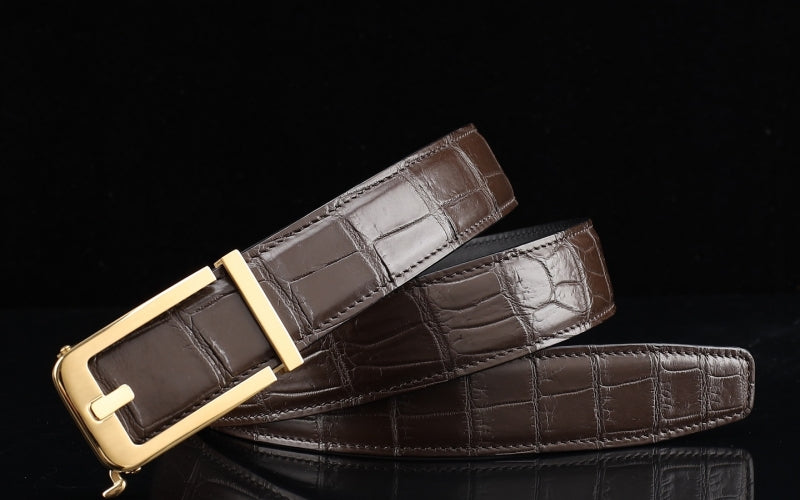
CITES Certificate Explained for Crocodile Belt Buyers
TL;DR:
- A CITES crocodile belt is one whose hide moved across borders under a CITES permit — not a quality grade, but a legal passport.
- Appendix I species (wild Siamese, some Cuban crocodiles) are banned from commercial trade. Appendix II species (Nile, American alligator, farmed Porosus, farmed Siamese) are legal under regulated farming.
- Every legitimate hide carries a numbered CITES tag with a country code, source code, year, and unique serial — verifiable against the export permit.
- Farm income from Appendix II hides funds wetland conservation, which is why CITES is pro-survival, not anti-leather.
- BELTLEY sources only from CITES Appendix II compliant farms and keeps permit copies on file for every batch.
Quick Facts
| Stat | Value |
|---|---|
| CITES treaty signed | 1973, in force since 1975 |
| Member countries | 184 Parties |
| Crocodilian species listed | All 23 |
| Appendix II species commonly used in belts | Nile, American alligator, farmed Porosus, farmed Siamese |
| Permits required per shipment | Export permit (origin) + import permit (destination) |
| BELTLEY in-stock dispatch | 2-3 business days, free worldwide shipping |
When a customer asks me whether their new crocodile strap is "the real, legal kind," I usually walk them to the back of our workshop and point at a small plastic tag, no bigger than a fingernail, attached to a raw crocodile hide. That tag is the entire reason crocodiles still exist in commercial numbers. This guide explains what CITES actually is, what the paperwork looks like, and how a buyer can read the markings on a belt to confirm it was sourced legally. If you want a deeper look at how species choice affects the leather itself, our companion guide on Porosus vs Niloticus crocodile belts is a useful follow-up.

What is CITES and why does it matter for a crocodile belt?
CITES is the Convention on International Trade in Endangered Species of Wild Fauna and Flora — a 184-country treaty that controls cross-border trade in protected species. For a crocodile belt, it means every hide must travel with a government-issued permit proving it came from a legal, sustainable source rather than poaching.
The treaty came into force in 1975 and is administered through the CITES Secretariat in Geneva. Crocodilians were among the earliest beneficiaries. In the 1960s, wild populations of American alligator and Nile crocodile had collapsed from uncontrolled hunting. CITES listings, combined with farm-and-ranch programs, reversed the decline so completely that several populations have been downlisted from "endangered" status. The IUCN Crocodile Specialist Group now treats regulated leather trade as a primary funding mechanism for wetland protection.
Appendix I vs Appendix II: which crocodiles can legally become belts?
Appendix I covers species threatened with extinction — commercial trade is banned. This includes wild-caught Siamese crocodile and some Cuban crocodile populations. Appendix II covers species that are not yet endangered but need monitored trade. Most belt leather — Nile, American alligator, farmed Porosus, and farmed Siamese — comes from Appendix II.

The split matters because it determines what is legally sellable. A wild-shot Siamese hide cannot enter commerce no matter how beautiful the skin. A farm-raised Siamese from a registered Vietnamese or Thai operation, however, is Appendix II and fully tradable. The same logic applies to saltwater crocodile (Crocodylus porosus): wild Australian populations are Appendix II under a strict ranching quota, while farmed Porosus from Singapore or Papua New Guinea moves freely under permit.
| Species | Common name | CITES status | Belt-legal? |
|---|---|---|---|
| Alligator mississippiensis | American alligator | Appendix II | Yes (farmed + wild quota) |
| Crocodylus niloticus | Nile crocodile | Appendix II (most populations) | Yes (farmed) |
| Crocodylus porosus | Saltwater (Porosus) | Appendix II (ranched/farmed) | Yes (farmed) |
| Crocodylus siamensis | Siamese | Appendix I wild / II farmed | Farmed only |
| Caiman crocodilus | Spectacled caiman | Appendix II | Yes |
For a closer look at the species themselves, see our caiman vs crocodile vs alligator belt guide.
What does a real CITES permit actually look like?
A CITES permit is a numbered, security-printed government document issued per shipment. It names the exporter, importer, species (Latin name), source code, quantity, and unique permit number. Two permits are required for most belt shipments: an export permit from the origin country and an import permit from the destination country.
The form itself looks bureaucratic — a watermarked A4 sheet, often green or yellow, with embossed seals from the issuing CITES Management Authority. For an American alligator hide moving from Louisiana to our Singapore workshop, the chain looks like this:
- Source farm registers each hatchling and tags every harvested hide.
- Tannery receives hides with intact tags and consolidates them under a single export permit issued by the U.S. Fish & Wildlife Service.
- Importing country (Singapore, in our case) issues a matching import permit before the shipment clears customs.
- Belt maker records the permit number against the production batch and retains copies for at least five years.
A finished belt sold at retail does not normally ship with a copy of the permit (it is a B2B trade document), but the brand should be able to produce one on request. If you ever wonder whether a $500 strap or a $5,000 strap is the legitimate one, our analysis of why crocodile belts cost $500 vs $5,000 breaks down where the paperwork sits in the price stack.
How does the CITES tag work for a crocodile belt?
The CITES tag is a small plastic seal attached to the hide at the farm and tracked through the supply chain — it stays with the raw hide at the trade level rather than being attached to each finished belt. It encodes four pieces of information: the ISO country code, a source-code letter (C for captive-bred, R for ranched, W for wild), the year of harvest, and a unique serial number.

A typical tag string reads something like ZW/R/24/0001234:
- ZW = Zimbabwe (origin country)
- R = ranched (eggs collected from the wild, raised in captivity)
- 24 = harvest year 2024
- 0001234 = unique serial, traceable to a single hide
Source codes you may see:
- W — Wild-caught (rare, quota-limited)
- R — Ranched (eggs/juveniles from wild, raised on farm)
- C — Captive-bred (entire life cycle in captivity)
- F — Born in captivity from wild parents
Buyers can cross-check the serial against the export permit number provided by the seller. Any reputable exotic specialist will share that on request. If a seller refuses, treat it as a red flag — it is the same red flag we discuss in our piece on where luxury brands source crocodile leather.
Key Takeaways
- CITES is a legal framework, not a quality stamp. A CITES belt is not automatically a fine belt — but a fine crocodile belt should always be CITES.
- Appendix II farming is what keeps the species commercially viable and ecologically protected.
- The plastic tag is the single most important physical proof. No tag, no provenance.
- Permits travel with shipments, not with retail packaging — but a real seller can produce them.
Why does CITES farming actually help crocodiles survive?
Regulated farming gives wetlands economic value. When a Louisiana landowner can sell a quota of alligator eggs to a licensed farm, the marsh becomes worth more standing than drained. CITES Appendix II essentially turns the species into its own conservation funder, which is why populations of American alligator and Nile crocodile have rebounded under the system.

The American alligator is the textbook case. Listed as endangered in 1967, it was downlisted by 1987 thanks to the ranching program — within two decades of legal trade returning, the species had fully recovered. A similar pattern played out in Zimbabwe, Madagascar, and Australia. This is the reasoning behind the CITES treaty's pro-use stance for crocodilians: controlled trade aligns commercial incentive with species survival.
It is also why "synthetic is always more ethical" is too simple. Embossed cowhide is fine, but it generates zero conservation revenue — and as we explain in embossed cowhide vs real crocodile belt, the two products serve different buyers.
What does BELTLEY do to comply with CITES?
BELTLEY sources exclusively from CITES Appendix II compliant farms, primarily American alligator from Louisiana and farmed Porosus from Singapore. Every hide arrives with intact CITES tags, every shipment travels under matched export and import permits, and we keep permit copies on file for every production batch we ship.
We never buy from grey-market brokers. We never buy untagged or de-tagged hides. When a customer orders a crocodile belt from our alligator belt collection or the broader exotic leather belt range, the strap is already in stock at our workshop, cut from a permitted hide, and ships in 2-3 business days — no months-long custom order, no paperwork ambiguity. You can read more about how we operate in our About Us page.
The Bottom Line
A CITES certificate is not a luxury flourish — it is the legal backbone of the entire crocodile leather industry, and the reason the species is still around to be made into belts at all. When you buy a legally traded crocodile belt, the permit trail behind its hide represents a chain of permits, a farm, a wetland, and a conservation budget. At BELTLEY, we treat that chain as non-negotiable: every exotic strap in our stockroom has a tag, a permit, and a paper trail behind it, and every belt ships within 2-3 days backed by our 10-year warranty and 30-day returns. Browse the in-stock alligator belt collection to see what permitted, fully traceable exotic leather looks like.

Frequently Asked Questions
Q: Does my crocodile belt come with a CITES certificate in the box?
No — the CITES permit is a B2B trade document filed at customs, not a retail insert. Because a single hide yields several belts, an individual belt does not carry its own CITES tag — the tag stays with the raw hide at the trade level. Reputable sellers like BELTLEY keep the import permit documentation on file and can confirm legal sourcing on request.
Q: Is it illegal to travel internationally with a CITES crocodile belt?
Personal effects are generally exempt from re-permitting if the belt was legally purchased and is for personal use, but rules vary by country. If you are crossing into a strict jurisdiction (Australia, EU member states, the U.S.), keeping the original receipt and noting the species can prevent customs questions.
Q: What's the difference between a CITES tag and a brand authentication tag?
A CITES tag is a government-mandated plastic seal applied at the farm with a unique serial. A brand tag is just marketing — leather quality stamps, logo embossing, or hangtags. Only the CITES permit trail proves legal sourcing.
Q: Can a Hermès or other luxury crocodile belt be CITES exempt?
No brand is exempt. Every commercially traded crocodile hide — Hermès, BELTLEY, or otherwise — must move under CITES permits. Higher price does not change the legal regime; it only changes the markup.
Q: How can I verify a seller's CITES claim before buying?
Ask three questions: which species, which country of origin, and what is the CITES tag format. A seller who can answer all three (and provide a permit number on request) is operating legitimately. A seller who deflects or says "all our leather is ethical" without specifics usually is not.
%20are%20...)