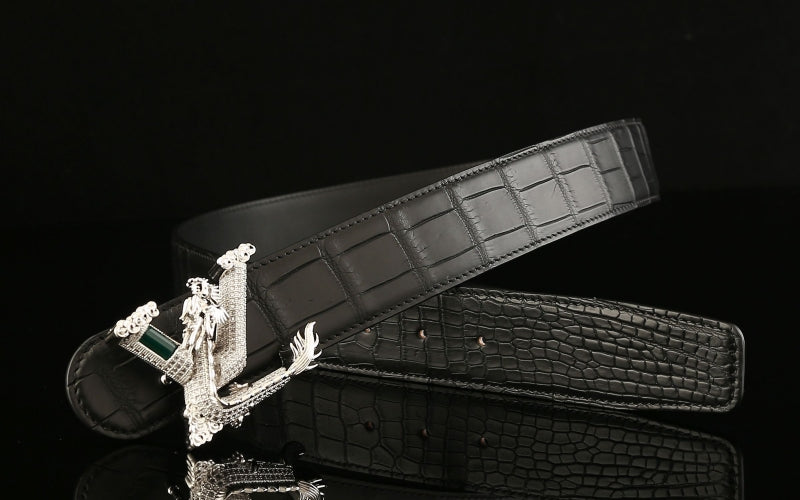
American Alligator vs Nile Crocodile Belt: Which Is Better?
TL;DR:
- American alligator (Alligator mississippiensis) is the smoother, more uniform, more expensive choice — no visible pores between scales, tighter belly tile pattern, the species Hermès marks with a single underscore "_".
- Nile crocodile (Crocodylus niloticus) shows a distinct ISO pore on each belly scale, slightly larger and more variable tiles, and trades at a more accessible price — Hermès marks it with two dots "••".
- For collectors chasing the cleanest classic look: pick American alligator. For buyers who want exotic character and stronger value: pick Nile crocodile. Both are CITES-regulated, farm-sourced, and built to last decades.
Alligator or Nile Croc: Decide by What You Value
Both are genuine, CITES-regulated luxury hides. The choice is about taste and budget:
| Your situation | Go with |
|---|---|
| You want the cleanest, most classic look | American alligator — no visible pores, tighter belly tiles, the collector's standard |
| You want exotic character at better value | Nile crocodile — distinct pore on each scale, more accessible price, no compromise on durability |
| You're learning to authenticate hides | The pore test below settles it in seconds — alligator scales are pore-free, Nile croc's aren't |
| This is your first exotic belt | Either species works — spend your decision energy on finish (matte vs. glazed) and color instead |
Compare both species side by side in the collection. The full species breakdown:
Quick Facts
| Stat | American Alligator | Nile Crocodile |
|---|---|---|
| Latin name | Alligator mississippiensis | Crocodylus niloticus |
| Primary farms | Louisiana, Florida (USA) | Zimbabwe, Kenya, Zambia |
| ISO pores on scales | None | Yes — visible dot per tile |
| Hermès species mark | "_" (underscore) | "••" (two dots) |
| Typical retail (luxury houses) | $1,800–$5,000+ | $1,200–$3,500+ |
| BELTLEY price range | $269–$299 | $239–$279 |
After three decades of cutting, skiving, and edge-finishing both species, here is the honest truth: neither is "better." They are different leathers with different fingerprints. The question is which fingerprint matches your wrist, your wardrobe, and your wallet. I still remember the first Louisiana hide I burnished by hand in 1999 — the way the umbilical scar sat dead-center on the belly, the way the tiles caught light like a piano keyboard. That moment shaped how BELTLEY sources to this day. Below is the side-by-side every smart-money buyer deserves before spending four figures on a belt — or two-something on ours, in stock and shipped from our atelier in 2-3 days.

What is the visible difference between American alligator and Nile crocodile scales?
American alligator scales are smaller, more uniform, and completely smooth — no pores. Nile crocodile scales are slightly larger, more variable in shape, and each belly tile shows a single visible pinprick called an integumentary sensory organ (ISO) pore. That pore is the fastest field ID in exotic leather.
Run a fingertip across an American alligator belt and you feel glass. The belly tiles march in tight, near-rectangular rows, and at the navel you can usually spot the umbilical scar — a small star-shaped mark prized by collectors as proof of authenticity. Nile crocodile, by contrast, has a topography. Each tile carries that ISO pore (a holdover from the species' aquatic prey-detection system), giving the leather a subtly textured, almost punctuated surface. For deeper visual training, our center-cut vs side-cut guide shows how cut placement amplifies these patterns.

Which is more durable — alligator or Nile crocodile leather?
Both leathers are exceptionally durable — properly tanned exotic belts last 20-30 years with care. American alligator is marginally denser and resists creasing slightly better, while Nile crocodile is more flexible and breaks in faster. The real durability driver is tannage and craftsmanship, not species.
Density tests on farmed hides published by the IUCN Crocodile Specialist Group place both species in the same elite tier of reptilian leather. What matters far more than the species is whether the belt was glazed properly, edge-painted in multiple coats, and stitched with bonded polyester or silk. A poorly finished alligator belt will fail before a beautifully finished Nile croc belt every time. That is why BELTLEY hand-burnishes every edge and backs every belt with a 10-year warranty — covering construction, not just leather.

Where do American alligator and Nile crocodile hides actually come from?
American alligator is farmed almost exclusively in Louisiana and Florida under the USFWS-CITES "ranching" program, which returns a percentage of hatchlings to the wild. Nile crocodile is farmed primarily in Zimbabwe, Kenya, Zambia, and South Africa under similar CITES Appendix II quotas.
The Louisiana program — documented at louisianaalligators.com — is one of the most successful conservation models in the world, having pulled the species back from near-extinction in the 1960s. Nile crocodile farming, regulated under CITES, follows comparable hatchling-return protocols and supports rural employment across southern and eastern Africa. Both supply chains are traceable, legal, and ethically defensible — a point worth remembering when you encounter cheap "crocodile-print" belts of unknown origin. For the full ethics breakdown, see our caiman vs crocodile vs alligator guide.

Why is American alligator more expensive than Nile crocodile?
American alligator commands a 20-40% premium over Nile crocodile because supply is tighter (only two US states produce commercial volume), the umbilical scar and pore-free belly are visually preferred by classic luxury houses, and US labor and CITES compliance costs are higher than African farming costs.
Hermès, for example, almost exclusively uses farmed American alligator and Porosus crocodile for its top belt and Birkin lines — and marks them accordingly with the "_" or "^" stamp. Nile crocodile appears more often in Italian and French houses targeting the entry-luxury tier. Want the deep dive on luxury species hierarchy? Read why crocodile belts cost $500 vs $5,000 and our authoritative breakdown of Porosus vs Niloticus crocodile belts — the cluster anchor for everything we publish on crocodilian comparison.
Key Takeaways (Mid-Post Recap)
- Pores or no pores — the single fastest ID: pores = Nile crocodile, no pores = American alligator.
- Hermès marks: "_" = American alligator, "••" = Nile crocodile, "^" = Porosus saltwater crocodile.
- Both legal, both farmed, both CITES-regulated — the ethics question is settled if you buy from a transparent brand.
- Price gap is supply-driven, not quality-driven.
- BELTLEY belts in either species are in stock and ship in 2-3 business days, with free worldwide shipping and 30-day returns.

Which luxury houses use American alligator vs Nile crocodile?
Hermès, Brioni, and Stefano Ricci favor American alligator and Porosus crocodile for flagship belts. Gucci, Bottega Veneta, Tom Ford, and many Italian ateliers use Nile crocodile for accessible-luxury exotic lines. BELTLEY uses both, sourced from licensed farms, finished by hand in small batches.
The species choice often signals price tier as much as aesthetic. When you see "alligator" on a $4,500 Hermès belt, that is American. When you see "crocodile" on a $1,400 Gucci belt, that is most often Nile. Neither is inferior — they simply occupy different shelves of the exotic-leather market. At BELTLEY, we removed the brand tax entirely: the same hides, the same hand-finishing, DTC fair pricing, no markup theater.
How do glaze and finish affect each species' appearance?
A high-glaze finish maximizes American alligator's mirror-like uniformity and is the most-requested treatment for that species. Nile crocodile is often shown in semi-matte or matte to highlight tile texture and ISO pores rather than mask them. Choosing the wrong finish for the species mutes its character.
If you want a Wall Street boardroom belt, pair American alligator with high glaze in black or espresso. If you want something with more visual rhythm — weekend-with-a-blazer territory — Nile crocodile in matte cognac is hard to beat. Our glazed vs matte vs semi-matte guide walks through every finish option and which species each flatters.
The Bottom Line
If you want the cleanest, most classic exotic leather belt — the species that whispers rather than speaks — choose American alligator. If you want exotic character, visible ISO pores, and roughly 25-35% more belt for your money, choose Nile crocodile. Both are conservation success stories, both are built to outlast every fast-fashion belt in your closet, and both reward proper care with decades of patina.
BELTLEY has cut both species since 1999 and went DTC in 2025 for one reason: smart-money buyers should not pay a brand tax to wear the same hides Hermès cuts. Every belt we make — alligator or Nile crocodile — is handcrafted, in stock, and shipped within 2-3 business days, backed by a 10-year warranty, free worldwide shipping, and 30-day returns. Browse the full lineup at the alligator belt collection or the broader exotic leather belt collection.
Frequently Asked Questions
Q: Is American alligator the same as crocodile? No. American alligator (Alligator mississippiensis) and Nile crocodile (Crocodylus niloticus) are different species in different families. Alligators have a broader U-shaped snout and no ISO pores on belly scales; crocodiles have a V-shaped snout and visible pores.
Q: How can I tell American alligator from Nile crocodile on a finished belt? Look at the belly tiles under good light. If each tile has a tiny pinprick (ISO pore), it is crocodile — most likely Nile. If the tiles are completely smooth and you can spot a small star-shaped umbilical scar near the buckle, it is American alligator.
Q: Is Nile crocodile leather ethical? Yes — when sourced from CITES-registered farms in Zimbabwe, Kenya, or Zambia. The trade is regulated under CITES Appendix II with hatchling-return quotas similar to the Louisiana alligator program. BELTLEY only sources from tagged, traceable farms.
Q: Which lasts longer, American alligator or Nile crocodile? Both last 20-30 years with proper care. Durability differences are marginal at the leather level — finishing quality, stitching, and edge work matter far more than species. A well-made Nile croc belt will outlast a poorly finished alligator belt every time.
Q: How much does a real American alligator belt cost? At luxury houses, $1,800-$5,000+. At BELTLEY's DTC pricing, from $178 for the same caliber of legally sourced Louisiana-farmed hide, hand-finished in small batches and shipped within 2-3 business days.
Q: Does BELTLEY ship internationally? Yes — free worldwide shipping on all belts. USA delivery in 4-8 days, international 4-10 days, with 30-day hassle-free returns and a 10-year warranty on materials and construction.
By the BELTLEY artisan team — master leatherworkers handling exotic hides since 1999.
Last updated: May 10, 2026
%20is%20the%20smoother,%20more%20uniform,%20more%20expensive%20choice%20%E2%80%94%20no%20visible%20pores%20between%20scales,%20tighter%20belly%20tile%20pattern,%20the%20species%20Herm%C3%A8s%20m...)