Can an Italian Leather Belt Be "Mass-Produced" and Still Be Premium?
TL;DR:
- Yes — but only if the production line uses premium leather, real hardware, and serious quality control.
- "Mass-produced" doesn't automatically mean "low quality." It means "made in volume."
- The biggest premium-quality killer isn't volume — it's leather grade, hardware substitution, and finishing shortcuts.
- Some of the best Italian dress belts in the world come off semi-automated lines. The leather and finishing standards are what separate them from cheap.
There's a lazy assumption in luxury marketing that goes: artisan = good, factory = bad.
The truth is messier. A small Tuscan workshop can produce a terrible belt if the leather is third-rate. A mid-sized Italian factory with strict quality controls can produce an excellent belt that lasts decades. The label "mass-produced" tells you about the scale of production, not the quality of the output.
This post walks through what mass production actually means in Italian belt making, what gets sacrificed at scale, and what doesn't. For wider Italian context, our why Italian leather belts cost more post is a useful starter.
What Counts as "Mass-Produced" in Italian Belt Making?
In Italian belt making, "mass-produced" generally means production runs above a few thousand units per year using semi-automated machinery for cutting, stitching, and assembly. The leather and hardware are still typically sourced from established suppliers, and quality control is built into the line. Mass production doesn't mean fully robotic — it means scaled human-machine collaboration.

A useful Italian belt-making scale hierarchy:
| Tier | Output per Year | Production Style |
|---|---|---|
| Bespoke artisan | 50–500 belts | Hand-cut, hand-stitched |
| Small workshop | 500–5,000 belts | Hand-finished, some machine work |
| Mid-sized factory | 5,000–50,000 belts | Semi-automated, hand QC |
| Mass-produced | 50,000+ belts | Highly automated, batch QC |
| Industrial export | 500,000+ belts | Fully automated, sample QC |
The "premium" label can theoretically apply to any of these tiers — but it scales with leather grade, hardware quality, and finishing standards. The production tier alone doesn't decide quality.
Wikipedia's mass production article covers the historical and economic logic of scaled manufacturing. Premium-tier mass production is a balancing act between volume and standards.
What Actually Determines Belt Quality?
Belt quality is determined by the leather grade, hardware material, stitching quality, edge finishing, and final inspection — not by the production method. A mass-produced belt using full-grain Italian veg-tan leather, solid brass buckle, and 7 SPI saddle-stitched edge with proper QC can be higher quality than a hand-made belt using corrected-grain leather, zinc-alloy hardware, and rushed finishing.
The five quality drivers, in order of impact:
- Leather grade (full-grain > top-grain > genuine > bonded)
- Hardware material (solid brass / stainless > plated alloy)
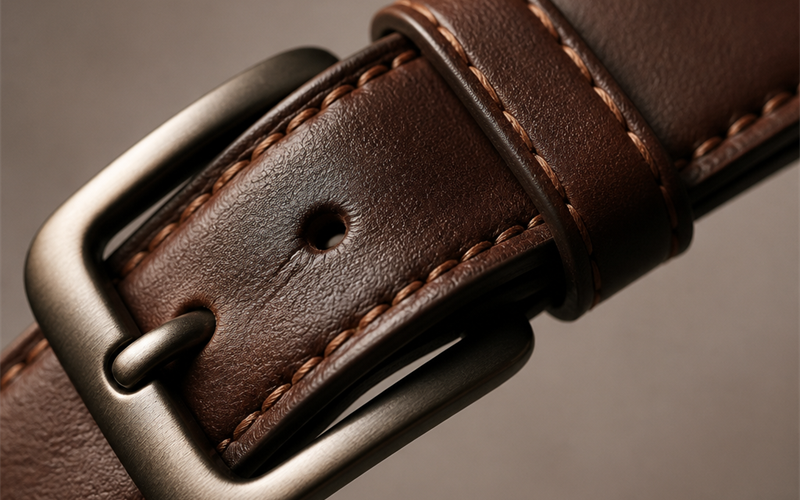
- Stitching quality (waxed linen at 7+ SPI > polyester at 4–5 SPI)
- Edge finishing (multi-coat painted or burnished > spray-sealed)
- Final inspection (every-belt QC > random sample QC)
Our 4 quality markers in calfskin belts post walks through the four most reliable visual checks. Our What Is the Most Durable Leather Belt? ranks the leather grades for longevity.
None of these five factors require pure hand production. Each can be done well at scale or poorly by an individual artisan. The label on the production method tells you almost nothing.
Where Does Mass Production Genuinely Hurt Belt Quality?
Mass production hurts belt quality in three specific ways: less hide selection (taking what the supplier sends rather than choosing each piece), shortcuts in edge finishing (single-coat paint instead of multi-coat), and corner-cutting on hardware (zinc alloy substituted for solid brass to hit unit cost targets). These shortcuts are common at the volume tier, but they're not inevitable.

Where mass production typically slips:
- Hide selection. Artisan workshops pick specific hides. Mass producers accept supplier batches.
- Edge work. Hand-painted multi-coat takes minutes per belt. Sprayed sealant takes seconds.
- Hardware. Solid brass costs 3–5x more than plated zinc. Volume buyers feel that math.
- Stitching. Hand saddle-stitching adds 40+ minutes per belt. Machine lockstitch adds 60 seconds.
- QC granularity. Artisans inspect every belt at every step. Volume QC samples random batches.
Whether these shortcuts get taken is a brand decision, not a manufacturing inevitability. Premium mass production simply doesn't take them — it accepts lower margins or higher prices in exchange for keeping the standards.
Can a Premium Brand Use Mass Production Ethically?
Yes — many of the most respected European leather brands use mass production for their core lines and reserve hand-craft for limited editions. The ethics question depends on transparency. A brand that mass-produces but markets itself as "100% handmade by master artisans" is misleading. A brand that mass-produces at premium standards and is honest about it is operating ethically.

Three honest mass-production brand archetypes:
- Volume-luxury houses. Massive global production, premium leather and hardware, brand markup high but quality real.
- DTC quality brands. Mid-volume Italian production, premium materials, transparent pricing.
- Mid-tier Italian fashion. Volume production for fashion markets, real Italian leather, simpler construction.
For deeper context on what hand-finishing actually adds, see our posts on Italian hand-skiving vs machine belts, the 14-step Tuscan workflow, and Italian stitching standards. Each one breaks down a specific step that gets harder to do well at scale.
What's the Real Difference Between Artisan and Mass-Produced Italian Belts?
The real difference is variability and specific hand-touch finishing — artisan belts show small natural variations from hand work, while mass-produced premium belts are more uniform but lack the hand-finished "tells." The functional quality can be identical. The aesthetic character is different.
A practical comparison:
| Trait | Hand-Made Artisan | Premium Mass-Produced |
|---|---|---|
| Stitch perfection | Slight variation (good) | Highly uniform (also good) |
| Edge finish | Hand-painted or burnished | Machine-applied multi-coat paint |
| Filetto line | Hand-creased | May or may not be present |
| Leather selection | Specific hides chosen | Batch sourced |
| Unit cost | High | Moderate |
| Lifespan | 25+ years if quality | 25+ years if quality |
| Repairability | Excellent | Excellent if quality |
| Aesthetic | "Handmade" character | Refined consistency |
Both can last decades. Both can look excellent. The artisan belt tells a slightly more visible "made by hands" story; the mass-produced premium belt tells a "made by serious workshop standards" story. Neither is universally better.
Our filetto detail post covers one of the small hand-finishing markers that's often missing from mass-produced belts even at premium tiers.
How Do You Tell If a Mass-Produced Belt Is Actually Premium?
You tell if a mass-produced belt is actually premium by checking the same five quality markers that matter for any belt: full-grain leather, solid metal hardware, dense stitching, finished edges, and proper buckle-fold construction. None of these require hand-only production — they just require workshop standards to be maintained at scale.

Five-second premium check on any belt:
- Magnet test on buckle. Non-magnetic = brass or stainless = premium. Magnetic = plated steel = often not premium.
- Flesh-side test. Natural beige (veg-tan) or pale gray (chrome) full-grain = premium. Pebbled glued backing = not.
- Stitch count. 7+ SPI with linen thread = premium. 4–5 SPI with polyester = not.
- Edge sharpness. Painted or burnished smooth = premium. Raw or sloppy = not.
- Bend test. Quality belt drapes evenly. Cardboard-stiff belt is over-pressed or low-grade.
Our How to Tell if a Belt is Full Grain Leather post covers the leather-side check in more detail.
Does DTC Pricing Make Premium Mass-Produced Belts Better Value?
Yes — direct-to-consumer brands that use mass production at premium quality standards usually offer the best value per dollar in the entire belt market. They remove retailer markup (typically 2.5–4x wholesale), distributor cuts, and brand-tax markup while keeping the workshop standards intact. The buyer pays for the belt, not the supply chain.

The math, simplified:
- Traditional retail luxury belt: $400 retail, $80 workshop cost, $320 markup
- DTC premium mass-produced belt: $200 retail, $80 workshop cost, $120 margin (still healthy)
- Both belts: roughly the same workshop standards
The customer in the DTC scenario gets the same belt for half the price. That's the value math that justifies skipping the traditional luxury supply chain entirely. This is the model BELTLEY operates on — see our full-grain leather belts collection for the result.
Wikipedia's Direct-to-consumer entry covers the broader business model logic.
The Bottom Line
The "mass-produced = bad" narrative is comfortable but wrong. What matters is leather grade, hardware material, stitching quality, and finishing standards — all of which can be done excellently at scale or poorly by a single artisan. Plenty of premium Italian belts come off semi-automated lines, and plenty of "artisan" belts skimp on materials.
The real question isn't "is it mass-produced." It's "does it meet the five quality markers." If yes, you have a premium belt regardless of production scale. At BELTLEY, our production model is mid-volume Italian workshop with premium leather and hardware, sold direct to keep prices fair. That's the value equation we've built around. Browse our dress belts collection and handmade belts collection to see how the scale-and-quality balance plays out.
Frequently Asked Questions
Q: Are luxury brand belts really "handmade" like they claim?
Mostly no. Luxury brands typically produce their belts using semi-automated processes in mid-to-large workshops, with hand-finishing on specific details. The "handmade" language usually refers to those specific hand-finishing steps, not the entire belt construction.
Q: Does mass-produced mean the same as machine-made?
Not exactly. Mass production usually uses both machines and human workers in coordination. Pure machine-made (zero human touch) is rare in premium belt production — even highly automated lines have human QC and hand-finishing steps.
Q: Can a $50 mass-produced belt be premium quality?
Almost never. The unit economics don't work — premium leather and hardware alone cost $20–$40 at wholesale. A $50 retail belt has to use lower-grade materials to leave room for any margin. Real premium quality starts around $120–$150 even in DTC pricing.
Q: Is "Made in Italy" still meaningful if the belt is mass-produced?
Yes, but with caveats. "Made in Italy" means the construction happened in Italy, which usually means access to Italian leather supply chains and Italian quality control standards. It doesn't mean handmade or artisan — those are separate claims.
Q: How can I find premium mass-produced belts without paying luxury markup?
Look for DTC brands with transparent leather sourcing, named tanneries, real hardware specifications (e.g., "solid brass" not "brass-toned"), and clear construction descriptions. Our Are Italian Leather Belts Worth Anything? post covers the value math in more detail.
Q: Will a mass-produced premium belt last as long as an artisan belt?
If the materials and construction standards are equivalent, yes — both should last 20+ years. The variable is the standards, not the production method. A poorly-made artisan belt won't outlast a well-made mass-produced one.