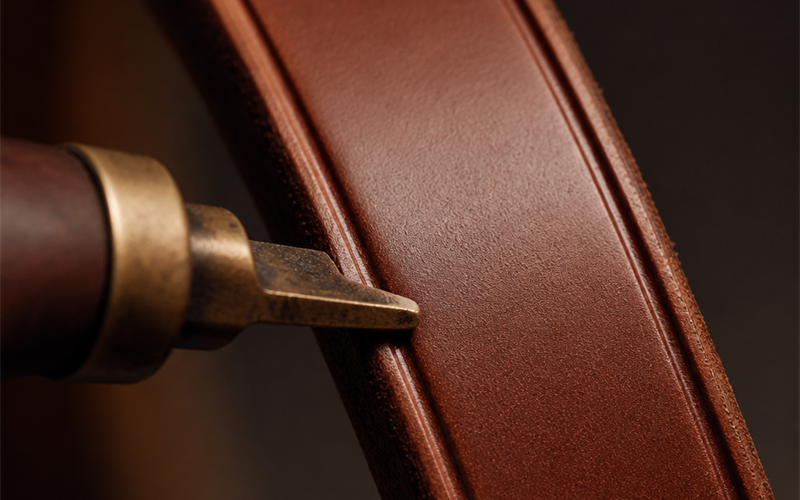
The "Filetto" Detail on Italian Belts (and Why It Signals Quality)
TL;DR:
- The filetto is a thin, decorative groove pressed into the face of an Italian belt, just inside the edge.
- It's done by hand with a hot creaser tool, one slow pass at a time.
- It looks like a small detail. It's actually one of the fastest ways to spot a real artisan belt.
- Fake belts skip it. Cheap belts fake it. Real Italian belts earn it.
There's a line on Italian belts that most buyers never notice.
It runs about 2–3mm in from the edge, parallel to the long sides, all the way around. It's tiny. It's elegant. And it's not decoration in the way most people think.
That line is called the filetto (sometimes spelled "filete" or just called "the line"), and it's one of the cleanest tells of a hand-finished Italian belt. The kind of detail that looks like nothing on Instagram but everything in your hand.
Let's break down what it is, why artisans add it, and why "no filetto" is often code for "this belt wasn't built the way you think it was." For wider craftsmanship context, our why Italian leather belts cost more post is a good companion read.
What Exactly Is a Filetto on an Italian Belt?
A filetto is a fine decorative groove pressed into the grain side of a leather belt, running parallel to the edge, typically 2–4mm in from the border. It's created with a heated brass or steel creaser tool that the artisan drags along the edge in one continuous motion. The groove is shallow — maybe 0.3–0.5mm deep — but visually defining.

The word filetto literally translates to "small thread" or "fillet" in Italian. The leather trade picked it up because the line looks like a thread laid along the belt edge. You'll hear French workshops call the same detail a filet, and English-speaking ones often just call it a "creased line" or "edge line."
It serves two purposes:
- Visual. Frames the edge, gives the belt a finished, intentional look.
- Structural. Compresses the fibers just inside the edge, which actually makes the edge slightly more rigid and less prone to fraying.
Most people focus on the first one. Artisans care about the second.
How Is the Filetto Actually Made?
The filetto is made by heating a brass creaser tool to about 80–120°C, then dragging it along the belt edge against a guide — usually a metal ruler held in place by the artisan's other hand. The heat softens the surface fibers just enough to compress them into a permanent groove without burning the grain.
This is a one-shot skill. There's no undoing a filetto. If the line wobbles, the belt is downgraded or scrapped. A master creaser runs the line in a single steady pull, holding the tool at a consistent angle, never lifting until the entire side is done.
Speed matters. Too slow, you burn a line into the leather. Too fast, you get a faint, inconsistent groove. The sweet spot is about 8–12 seconds per side on a standard 1.5" belt.
The tool itself is usually:
- Brass or hardened steel, with a precision-machined groove tip
- Heated by a small electric coil or a flame torch
- Hand-held, weighted just enough to glide without pressure
Bigger workshops have semi-automated creasers that hold the temperature and angle for you. Old-school Tuscan workshops still do it by hand, by feel. You can usually tell which is which by looking at the line under raking light — hand-creased filettos have a tiny variation in depth that machine-creased ones don't.
Why Do Italian Workshops Bother Adding It?
Italian workshops add the filetto because it's one of the cheapest, highest-impact ways to signal that a belt has been hand-finished. It costs the workshop maybe 30 seconds of labor per side, but it dramatically changes how the belt reads — from "leather strap with a buckle" to "finished object."

There's also a deeper reason. Italian leather goods culture treats the edge of a leather piece almost as much as the face. Edge paint, burnishing, beveling, and the filetto are all part of the same vocabulary — they're all ways of saying "we cared about the side you barely look at."
It's a flex. A quiet one. The kind a fellow craftsman would recognize at five paces.
Three concrete reasons the detail sticks around:
- Defines the silhouette. The line creates a visual border that makes the belt look thinner, more precise, more "designer."
- Hides minor imperfections. Tiny irregularities in the cut edge become invisible once the eye is drawn to the parallel filetto line.
- Marks the workshop. Some Tuscan ateliers have signature filetto widths or depths. Repeat customers can spot the maker.
You'll see this detail on pieces in our dress belts collection and across the full-grain leather belts range.
Can You Tell a Real Filetto From a Stamped One?
Yes — a real heat-creased filetto looks subtly burnished and slightly darker than the belt face, while a stamped or embossed fake looks uniform and flat. Run your finger across both. A real filetto feels like a smooth dip with rounded edges. A fake one feels sharp, like a stamp pressed in cold.

A few more visual tells:
- Color. Real filetto darkens the leather along the groove because heat caramelizes the surface tannins. Stamped fakes don't change color.
- Reflectivity. Hand-creased lines catch the light and almost glow. Cold-stamped lines look matte.
- Consistency. Ironically, a too perfect filetto can be a tell — machine-stamped lines are dead-uniform, while real hand work shows tiny natural variation.
The Italian vegetable-tanned leather tradition documented by the Tuscan Vegetable-Tanned Leather Consortium treats creased edge details as one of the markers of premium construction. It's not just an aesthetic choice — it's a tradition with a paper trail.
Does the Filetto Affect How Long a Belt Lasts?
The filetto contributes modestly to a belt's lifespan because the compressed fibers near the edge resist fraying and keep the edge crisp longer. The effect is small but real — belts with proper heat-creased filettos tend to look "newer" for longer, especially around the long edges where most wear happens.
What it doesn't do is make a bad belt last longer. If the leather is corrected-grain split, the buckle is zinc alloy, and the stitching is 4 SPI of polyester thread, a filetto won't save it. The detail is a marker of overall workmanship, not a structural feature.
For more on what does drive belt longevity, our 4 quality markers in calfskin belts post is a more comprehensive read.
Which Italian Belt Styles Always Have a Filetto?
Italian dress belts almost always have a filetto, while casual and vintage-style belts often skip it intentionally to keep a rougher, more rustic look. Dress belts use the line to amplify their precision; casual belts trade that precision for honest workshop texture.

Belt types that usually feature a filetto:
| Belt Style | Filetto Usual? | Why |
|---|---|---|
| Italian dress belts | Yes — almost always | Frames the edge, formal feel |
| Plaque buckle belts | Yes | Matches the geometric buckle vibe |
| Crocodile dress belts | Yes — narrow | Anchors the scales visually |
| Pull-up casual belts | No | Would fight the patina story |
| Distressed / vintage | No | Smoothness would feel wrong |
| Braided belts | Not applicable | Woven surface, no flat zone |
You can see how the detail interacts with formal hardware on pieces like our Italian Brutti craft pull-up belt — which intentionally skips the filetto for a rougher feel — versus dress-leaning belts in the stainless steel buckle belts range.
How Do You Spot a Skipped Filetto on a Fake "Italian" Belt?
You spot a skipped filetto by looking at the belt edge under direct light — fake "Italian" belts often have a clean cut and a painted edge but no parallel groove on the belt face. The face is flat right up to the edge paint. On a real Italian belt, you'll see that thin line running 2–4mm in.

Three-second authentication check:
- Hold the belt under a desk lamp at a 45° angle.
- Look at the long edge — both sides.
- If you don't see a faint parallel line about 3mm in, the belt was probably not finished in a traditional Italian workshop.
This isn't a perfect test — some legitimate workshops omit the filetto on purpose, especially on minimalist or modern designs. But for a "classic Italian dress belt" specifically? The line should be there.
In the luxury resale market, small craftsmanship details — the filetto among them — are increasingly used as authentication markers, alongside the construction techniques covered in Wikipedia's saddle stitch article.
The Bottom Line
The filetto is one of those tiny details that exists in a quiet conversation between artisans, and now you're in on it. A 3mm groove. Two seconds of light pressure with a hot tool. Decades of tradition built into a single line.
At BELTLEY we work with Italian workshops that still draw the filetto by hand because the difference is small until you've held two belts side by side — then it's enormous. If you want to see the detail in real life, our handmade belts collection is where the line work lives.
Frequently Asked Questions
Q: Is the filetto always near the edge of a belt?
Yes, almost always 2–4mm in from the long edge. Some workshops add a second decorative line near the buckle fold or tip, but the main filetto runs parallel to the belt's long edges.
Q: Can you add a filetto to a belt that doesn't have one?
A skilled leather worker can — but it's risky on a finished belt because the heated tool can scorch already-treated leather. Better to ask the original workshop or live with the belt as it came.
Q: Why do some Italian belts have no filetto at all?
Modern minimalist designs sometimes skip it on purpose. Vintage and pull-up belts skip it too, because the rough aesthetic would clash with the precision line. Absence of a filetto isn't automatically a quality red flag — context matters.
Q: Does the filetto wear off over time?
The visual contrast can soften after years of wear, but the compressed fiber line itself is permanent. Light conditioning and a quick buff usually bring the contrast back.
Q: Do American or French belt workshops use the filetto too?
French workshops do — they call it a filet. American workshops use the same technique but rarely have a specific name for it, sometimes calling it an "edge crease." The Italian tradition is just the most famous.


