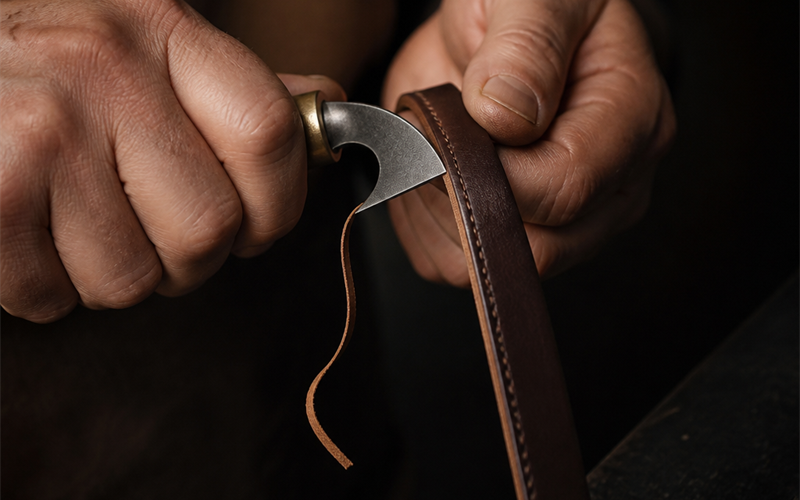
Italian Hand-Skiving vs Machine Belts: What's the Real Difference?
TL;DR:
- Hand-skiving is the slow art of thinning leather with a knife, by feel, one belt at a time.
- Italian artisans use it to make belts drape softly without sacrificing strength.
- Machine skiving is fast and uniform — but it can't read the hide the way a human can.
- You feel the difference on day one. You feel it harder ten years in.
If you've ever held a belt that lay flat on day one, curled around your waist like it knew you, and softened beautifully over time — odds are, somebody hand-skived it.
Most belts off a factory line never get that touch. They're cut, rolled, glued, stitched, and shipped. They work. They just don't sing.
Hand-skiving is the quiet step that separates "leather belt" from "Italian leather belt." Let's unpack what it is, why it matters, and how to spot it on a finished belt. The wider context — what makes leather "leather" in the first place — is covered well in Britannica's leather entry. For BELTLEY's own take on the tradition, see our guide on why Italian leather belts cost more.
Is Hand-Skiving Worth It to You?
The artisan premium, honestly allocated:
| Your situation | Go with |
|---|---|
| You notice how a belt drapes | Hand-skived — the day-one suppleness and year-ten softening are real, feelable differences. |
| You just want durable and honest | Quality machine-skived full-grain serves identically for most wearers — from $58. |
| Comparing two belts in hand | Bend both — hand-skived curls evenly without kinking; uniform machine cuts can hinge at one point. |
| Paying $100+ premium for the word | Only if the maker shows the workshop — "hand-crafted" without evidence is a font choice. |
Handcraft with receipts: BELTLEY's small-batch collections.
What Is Hand-Skiving in Belt Making?
Hand-skiving is the process of thinning specific areas of a leather strap with a sharpened knife, by hand, to control how the belt folds, lies, and ages. The artisan shaves micro-layers off the flesh side — usually near the buckle fold, holes, and edges — without cutting through the grain.

That's it. No magic. Just a very sharp blade, very steady hands, and a worker who's done it ten thousand times.
The trick is that every hide is different. One side of the same animal can be denser than the other. A skilled skiver feels the resistance under the knife and adjusts pressure mid-stroke. A machine can't do that — it just sets a depth and runs.
Why Do Italian Belt Makers Still Hand-Skive?
Italian workshops still hand-skive because Italian leather is engineered to behave, not just to look pretty. Italian vegetable-tanned hides — the kind protected by the Genuine Italian Vegetable-Tanned Leather Consortium of Tuscany — develop character through use, and hand-skiving makes sure the belt moves with that change instead of fighting it.
A few practical reasons:
- Buckle fold sits flat. The folded section gets thinned just enough to lay flush against the strap.
- No bulky lump under your shirt. Important when you wear a dress belt with a tucked shirt.
- Edges roll smoother. A skived edge takes burnishing or painting better.
- The belt drapes. Stiff belts look industrial. Drape feels custom.
In Tuscany, this step is usually done after the strap is cut and before stitching. It's a 90-second job per belt for a master. It looks like nothing. It is, in fact, the whole game.
How Is Machine Skiving Different?
Machine skiving uses a band-knife splitter to remove a uniform thickness across a leather panel, fast and consistently. It's accurate to a tenth of a millimeter. It's also blind — the machine doesn't know if the hide is dense or loose, fatty or fibrous, well-tanned or rushed.

Machines are perfect for what they do: high-volume runs where every piece must be identical. For premium leather goods, "identical" isn't the point. "Right for this hide" is the point.
A factory belt skived by machine often shows the trade-off:
- Edges that flake or split because the tool didn't follow the grain.
- A buckle area that feels stiff and refuses to soften.
- A "papery" feel under the fingers near the holes.
We've written more on these tells in our breakdown of the four quality markers in calfskin belts.
Can You Feel Hand-Skiving on a Finished Belt?
Yes — you can usually feel hand-skiving within ten seconds of picking up the belt. Run your thumb along the back of the buckle fold. A hand-skived belt tapers smoothly, with no hard ridge. The keeper loop slides over the fold without catching.

Other quick tells:
- Pinch test near the holes. Hand-skived areas feel softer than the surrounding strap.
- Hold it vertical. A well-skived belt curves gently. A machine-flat belt hangs like a board.
- Look at the back. You may see faint, slightly uneven shaving marks — that's good. That's hand work.
The other side of this conversation is the front-facing finish, which we cover in tonal vs contrast stitching on leather belts.
Does Hand-Skiving Affect How Long a Belt Lasts?
Hand-skiving extends belt life because it removes only what needs removing. A skilled artisan never thins below the grain layer, so the fiber structure stays intact where it matters most. The result is a belt that creases instead of cracking, and one that holds buckle tension for years rather than months.
The opposite problem — over-skived, machine-thinned belts — usually shows up first at the buckle fold. The strap collapses, the edge folds back on itself, and the belt starts to look tired before its second birthday. Wikipedia's overview of full-grain and top-grain leather construction explains why preserving the grain layer matters so much for long-term wear.
Want a more general primer on durability? Our exotic leather belts collection page walks through how exotic skins handle the same fold zones.
Where Does Hand-Skiving Show Up Most on a Belt?
Hand-skiving shows up most at four spots: the buckle fold, the punched holes, the tip taper, and along both long edges. These are the areas that flex, fold, or get pressed against your body — basically, the parts that suffer.

A typical Tuscan workshop sequence looks like this:
| Zone | Why it's skived | What it prevents |
|---|---|---|
| Buckle fold | Reduces stack height | Bulky lump under shirt |
| Hole area | Allows clean punch + softens edge | Cracking near holes |
| Tip | Tapers for clean entry through keeper | Catching, snagging |
| Long edges | Prepares for paint or burnishing | Edge fraying |
This is the kind of attention to detail you also see in our full-grain leather belts collection, where strap construction is the whole point of the product.
Is Hand-Skiving Worth Paying More For?
Hand-skiving is worth the premium if you wear the belt regularly and expect it to last more than a few years. The added cost is small — usually $10–$25 per belt at the manufacturing level — but the lifespan and comfort gains are large. For a daily belt, the math favors hand work easily.

For an occasional belt that lives in a drawer? Machine skiving is fine. Nobody's checking.
The reason BELTLEY leans into hand-skiving on our Italian-made pieces — like our Italian Brutti pull-up belt — is simple. We sell to people who plan to wear the belt for a decade. Hand work earns its keep over that timeline.
The Bottom Line
Hand-skiving is one of those craftsmanship details that sounds small until you wear two belts side by side. One drapes, ages, and gets better. The other doesn't.
At BELTLEY, we work with Tuscan artisans because their hand-skiving turns good leather into a belt you forget you're wearing — until you reach down and remember why you bought the nice one. If you're shopping, start with our handmade belts collection — that's where the knife-and-hand work lives.
Frequently Asked Questions
Q: What does "skiving" actually mean in leatherwork?
Skiving means thinning a piece of leather, usually with a sharp curved knife or a splitter machine. The goal is to control thickness in specific areas so the leather folds, layers, or finishes the way you want it to.
Q: Is hand-skived leather stronger than machine-skived?
Not necessarily stronger — but more consistent with the natural grain. A skilled hand-skiver removes material without weakening fiber structure, which usually means longer service life at flex points.
Q: How can I tell if my belt was hand-skived?
Check the back of the buckle fold for a smooth taper, look for slight tool marks near the holes, and pinch the strap near the punched areas. Softer, gradient thickness is a good sign.
Q: Do all Italian belts use hand-skiving?
No. Mass-market Italian-branded belts are often machine-skived for speed. True artisanal Italian belts — typically small-batch Tuscan production — still hand-skive critical zones.
Q: Does hand-skiving affect a belt's price a lot?
It adds modest cost at the workshop level — usually $10–$25 per piece — but retail markups can amplify that. BELTLEY skips the middleman markup, so the cost stays close to the actual labor value.


