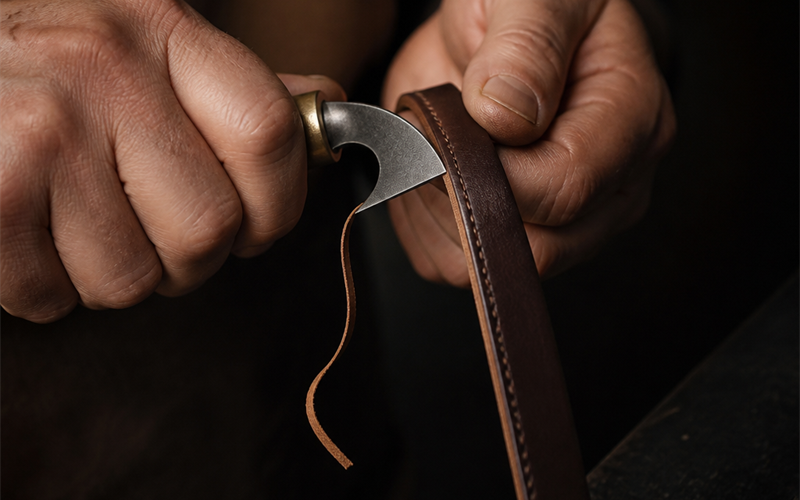
Italian Edge Painting vs Edge Burnishing: Which Belt Edge Wins?
TL;DR:
- Edge painting coats the leather edge in pigmented resin — sharp, glossy, dressy.
- Edge burnishing seals the edge with wax, water, and friction — natural, soft, casual.
- Painted edges look like a luxury watch. Burnished edges look like a worn-in saddle.
- Neither is "better." They solve different problems for different belts.
Walk into any Tuscan workshop and you'll find two artisans doing very different things to the same kind of leather strap.
One is dabbing a tiny brush in colored resin and tracing the edge like they're painting eyeliner.
The other is rubbing the edge with a piece of canvas so fast their elbow's blurring. There's water. There's wax. There's a faint smell of something burning. They smile and keep going.
Both are finishing the edge of a belt. Both will produce a belt that lasts a decade. They are not interchangeable.
This post walks through what each technique actually does, where it shines, where it fails, and how to pick the right one for the belt you're buying. If you want background first, our edge painting belts explainer covers the basics.
Painted or Burnished Edge: Match Your Belt
The edge decision, by use:
| Your situation | Go with |
|---|---|
| Dress belt, luxury-watch aesthetic | Painted edges — the sharp glossy line that reads boutique. |
| Daily-wear, heritage taste | Burnished — wax-and-friction sealing that wears in, not off. |
| Worried about chipping | Valid for paint at years 2–4 — burnished edges can be refreshed at home with wax and a cloth. |
| Judging edge quality in hand | Good edges feel sealed and smooth either way — raw fuzzy edges mean the maker stopped early. |
Finished edges on every strap: BELTLEY's men's collection.
What Is Edge Painting on a Leather Belt?
Edge painting is the process of sealing a leather belt's cut edge with multiple thin coats of pigmented resin or acrylic paint, sanded between layers, then heat-set and polished. The finished edge looks glossy, perfectly straight, and has a sharp color contrast — usually black, brown, or matched to the belt face.

The technique came out of high-end French and Italian leather goods houses in the early 20th century. It was a way to make luggage and handbag edges look "finished" without showing the raw fiber underneath. Belts picked it up later, especially dress belts.
A proper Tuscan edge-paint job involves 4 to 8 separate coats:
- Filler coat to fill the fiber pores
- Color coat 1 for base color
- Sanding pass with 600-grit
- Color coat 2
- Sanding pass with 1000-grit
- Color coat 3
- Heat polish with a hot iron tool
- Final wax if the belt design calls for it
Each coat dries before the next one goes on. That's why a painted-edge belt takes 2–3 days just for the edge — the rest of the belt is done in hours.
What Is Edge Burnishing in Belt Craft?
Edge burnishing is the process of sealing a leather belt's edge using moisture, friction, and natural wax — no paint involved. The artisan wets the edge, rubs it with a hardwood slicker or canvas pad until the fibers compress and gloss up, then locks the seal in with beeswax or carnauba.
Burnishing is the older technique. It predates edge paint by roughly two centuries and was the standard finish for saddlery, work belts, and rugged leather goods. You'll still find it on traditional Italian casual belts, vintage-style straps, and pretty much anything that's meant to age and patina rather than stay sharp.
A typical burnishing pass goes like this:
- Bevel the edge with a hand beveler
- Sand with 220, 400, and 600 grit
- Apply gum tragacanth or a water-and-saddle-soap mix
- Rub with a wooden slicker — by hand or with a Dremel-style burnisher
- Wait. Apply beeswax. Rub again.
- Final buff with a soft cloth
The result is an edge that feels almost like polished horn. Smooth, warm, slightly darker than the belt face, and absolutely no paint line.
You'll find this finish on belts like our vintage dark brown distressed belt and other raw-edge pieces in the handmade belts collection.
Which Finish Looks More Premium — Painted or Burnished?
Neither finish is universally more premium — they signal different kinds of luxury. Painted edges read as formal, modern, and precise, the look you see on Hermès dress belts and high-end Italian leather goods. Burnished edges read as traditional, artisanal, and quietly expensive, the look on hand-stitched saddlery and old-money casual belts.

It's the difference between a tuxedo and a Savile Row tweed jacket. Both are top tier. Different rooms.
Here's a quick visual matrix:
| Trait | Edge Painting | Edge Burnishing |
|---|---|---|
| Visual | Sharp, glossy, contrasting | Soft, warm, blended |
| Best for | Dress belts, plaque buckles | Casual belts, brass buckles |
| Color options | Wide — any pigment | Limited — darker than belt face |
| Durability | 5–10 years if quality | 10+ years, ages gracefully |
| Repair | Specialist required | DIY with wax & cloth |
| Cost to produce | Higher labor & material | Lower material, similar labor |
For more on which belt types pair with which finish, see our 4 quality markers in calfskin belts guide.
How Long Does Each Edge Finish Actually Last?
A well-applied painted edge lasts 5–10 years before showing wear, while a properly burnished edge can last 10+ years and often looks better with age. The difference comes down to how each finish fails: paint cracks, burnish softens. Cracking is ugly. Softening looks like character.
The honest version: a cheap painted edge can fail in 12 months. We've seen it. The paint chips off near the buckle fold, then peels in strips along the long edge. Once that starts, there's no fixing it without a full re-paint by a leather specialist.
A burnished edge, even a so-so one, just gets shinier over time as your hands and clothes keep buffing it. The worst failure mode is the wax wearing down — and you fix that with a $5 tin of beeswax and a cotton rag.
Britannica's leather article covers how finishing technique interacts with hide chemistry — both edge methods can excel, and both can fail miserably if rushed.
When Should a Belt Have a Painted Edge?
A belt should have a painted edge when the design calls for a clean, sharp, color-contrasting line — typically dress belts, formal plaque-buckle belts, and reversible belts where two different colored faces meet at the edge. Painted edges are also the right call when the belt color is unusual (red, purple, navy) and you want the edge to match exactly.
Real-world cases where painted edges win:
- Dress belts with a tucked shirt. The shirt edge brushes the belt edge. You want it sharp, not fuzzy.
- Reversible belts. Painting hides the seam where two leathers meet.
- Statement colors. A burgundy belt with a perfectly matched burgundy edge looks intentional. A burnished version looks accidental.
- High-contrast designs. White-stitched black belts often get a black painted edge to keep the visual story tight.
You'll see this approach on dress-leaning pieces in our dress belts collection and on Italian-style plaque belts.
When Is Burnishing the Better Choice?
Burnishing is the better choice for casual belts, work belts, vintage-style designs, and any belt where the leather is meant to develop a patina. The technique respects the natural grain and lets the leather age into something more interesting than a fresh belt ever looks.

Examples:
- Pull-up leather. Belts like our Italian Brutti pull-up brown belt are designed to bruise and bloom. Painted edges would fight that story.
- Bridle leather casual belts. Heavy oils + paint = chemical war. Burnish wins.
- Raw edge designs. Some belts skip even burnishing and leave a raw, slightly furred edge — see our raw edge women's belt for context.
- Brass-buckled rugged belts. The whole vibe is "honest tool." Burnish supports that.
If you're not sure which camp your belt falls into, the rule of thumb is: if you wear it with a suit, paint; if you wear it with jeans, burnish.
Can You Repair a Painted or Burnished Edge at Home?
You can repair a burnished edge at home with basic supplies, but a painted edge usually requires a leather specialist. Burnishing is forgiving — you can re-wax, re-rub, and refresh the gloss with hand tools. Edge paint is unforgiving — touching it up without proper color matching and heat-setting equipment leaves a visible patch.
DIY burnish refresh:
- Wipe the edge with a damp cloth
- Rub a small amount of beeswax along the edge
- Buff vigorously with canvas or cotton for 60 seconds
- Wait an hour, repeat once more
DIY painted-edge repair? Don't. Take it to a cobbler who handles luxury leather. The fix usually costs $30–$60. The DIY version usually ruins the belt.
For long-term belt care across both finishes, our leather care page covers conditioning, storage, and what to avoid.
What Do Italian Workshops Use Most Often?
Most traditional Tuscan workshops use both techniques — painted edges on dress belts, burnished edges on casual and vintage belts — and they switch based on the leather, not the customer. This is the part that confuses people who think "Italian = painted edges." The truth is, Italian = whichever finish the leather demands.

A workshop running 100 belts a week might do 60 burnished and 40 painted. A workshop focused purely on luxury dress belts might run 90% painted. The geography matters less than the product mix.
The skill ceiling is also different. Master burnishers and master edge-painters are not the same people. Edge paint is a clean-room, brush-and-iron skill. Burnishing is a friction-and-feel skill. Workshops that excel at both usually have separate artisans for each.
We work with both kinds of Tuscan workshops at BELTLEY, which is why our full-grain leather belts collection includes pieces with each finish — we match the finish to the belt, not the marketing.
Does Edge Finish Affect Belt Price?
Edge finish affects belt price by 10–30%, depending on technique quality, number of coats, and how much hand labor goes into the polish. Painted edges with 6+ coats and heat polish can add $20–$40 to a belt's wholesale cost. Hand-burnished edges with multiple wax passes add $10–$25.
Cheap belts often skip the edge entirely — they spray-seal it with one coat, call it a day, and let the customer figure out it was a corner cut about 18 months later. Wikipedia's leather article explains how surface finishing relates to overall hide durability — the edge is where corners get cut most often.
How Can You Tell a Good Edge From a Bad One?
You can tell a good edge from a bad one by running your finger along it and looking at the transition between belt face and edge. A good edge — painted or burnished — feels smooth, looks clean, and has no visible glue line or paint smear on the face of the belt. A bad edge feels grainy, looks uneven, and often has paint slop running onto the leather.

Five-second test:
- Painted: Hold under light. Does the edge have a perfectly straight color line, or does it look "feathered"? Feathered = bad.
- Burnished: Press your fingernail into the edge. Does it dent and stay dented? Wax was rushed. Should bounce back.
- Both: Look at the back of the buckle fold. Cheap belts skip edge work in this hidden zone. Quality belts finish it the same as everywhere else.
The Bottom Line
Painted edges and burnished edges are doing different jobs. Painted edges are surgery — clean lines, glossy finish, formal energy. Burnished edges are massage therapy — soft, warm, and aging with you.
The mark of an actual artisan workshop isn't which finish they use. It's whether they reach for the right one for that belt. At BELTLEY we keep both in the toolkit because dress belts and casual belts deserve different answers. If you want the painted-edge sharpness, start with our dress belts collection. If you want the burnished-edge story, head to handmade belts.
Frequently Asked Questions
Q: What's the difference between edge paint and edge sealer?
Edge sealer is a single-coat, low-pigment finish — basically primer with a hint of color. Edge paint is a multi-coat, fully pigmented system that builds up a real surface layer. Sealer fades fast. Paint, done well, doesn't.
Q: Can a belt have both painted and burnished elements?
Rarely. Some hybrid finishes use a thin burnish base under a paint topcoat for extra adhesion, but it's uncommon. Most workshops pick one and commit.
Q: Does edge painting use real paint or special leather paint?
Special leather edge paint — water-based acrylic resin systems formulated to flex with the leather. Regular paint cracks within months because it doesn't move with the hide.
Q: Why do some burnished edges look almost black?
Burnishing compresses the fibers and the natural tannins darken when exposed to friction heat and wax. A vegetable-tanned belt edge often ends up 2–3 shades darker than the belt face, especially on lighter browns.
Q: Does a painted edge mean the belt is fake leather?
No — quality painted edges are common on top-tier real leather belts. The confusion comes from cheap PU belts that also use heavy edge paint to hide their plastic core. The leather itself, not the edge finish, tells you what you're buying.
Q: Will a burnished edge work on exotic leather like crocodile?
Yes, but it's tricky. Crocodile and alligator scales make burnishing harder, and most luxury exotic belts get painted edges for cleaner lines. See our crocodile belt collection for examples.