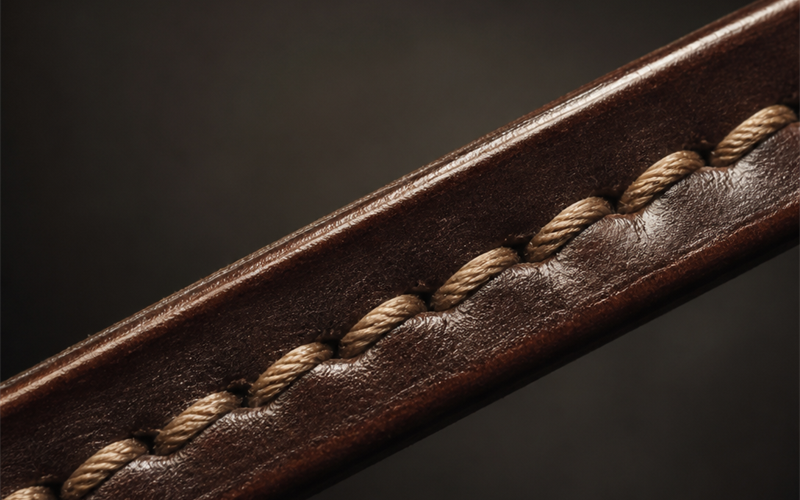
Italian Stitching Standards: 7–8 SPI and the Hand-Finished Tell
TL;DR:
- The Italian standard is 7–8 stitches per inch (SPI) using waxed linen thread.
- That spacing is tight enough to look refined, loose enough to let the leather flex.
- Hand-finished saddle stitching doesn't unravel — if one stitch breaks, the rest hold.
- Machine lockstitching is fine. Saddle stitching is forever.
There's a number tucked inside every well-made Italian belt that almost no one talks about.
It's 7. Sometimes 8.
That's how many stitches per inch (SPI) a traditional Italian workshop runs along the belt's edge. Not 4. Not 5. Not 12. Specifically 7 to 8. The number isn't arbitrary — it's the result of two centuries of leather workers finding the sweet spot between "looks expensive" and "actually performs."
This post is a deep look at why Italian stitching looks the way it does, what materials they use, and how to spot a real hand-finished belt versus a machine-stitched copy. For wider context on Italian craftsmanship, our why Italian leather belts cost more post is the place to start.
What Does 7–8 SPI Actually Mean on a Belt?
7–8 SPI means there are seven to eight individual stitches in every inch of stitched edge on the belt. Each stitch sits about 3–3.6 mm apart. That spacing is dense enough to look intentional and elegant, but open enough that the thread doesn't perforate the leather into a tearable line.

Why not denser?
- At 10+ SPI, the holes start to merge into a perforation line. The belt edge can crack along the stitch.
- At 12+ SPI, you're basically punching out a strip — used on fine wallets, not belts.
Why not looser?
- At 5 SPI, the stitches look industrial and the belt face has visible "gaps" between threads.
- At 4 SPI or less, it's bargain-bin territory. The belt face looks unfinished.
7–8 is the Goldilocks zone for a 1.5" leather belt. It's been the Italian default since the late 1800s.
Why Do Italian Workshops Use Waxed Linen Thread?
Italian workshops use waxed linen thread because it's strong, naturally weather-resistant, and gets stronger in the holes as the wax sets and bonds with the surrounding leather. Synthetic threads like polyester are cheaper and easier to machine-feed, but they don't lock into the leather the same way and they shine in a way that looks plasticky next to vegetable-tanned leather.
The full case for waxed linen:
- Strength. Linen fiber has a tensile strength comparable to many synthetics at the same thickness.
- Bond. The beeswax coating melts slightly under needle friction and re-hardens around the thread, gripping the leather.
- Aging. Linen darkens and softens with age, matching how vegetable-tanned leather behaves.
- Repairability. A broken linen stitch can be re-pulled and re-knotted by a skilled worker without obvious patching.
Wikipedia's saddle stitch article covers the technique itself — the two-needle, hand-passed method that linen thread was made for. It's the same method used on traditional leather saddles, which is why the stitch is named that way.
For more on how stitching interacts with the rest of belt quality, our why belt stitching matters guide goes deeper.
What's the Difference Between Saddle Stitching and Lockstitching?
Saddle stitching uses two needles and one continuous thread passed by hand through pre-punched holes, creating an X-pattern that locks each stitch independently. Lockstitching uses a sewing machine with one top thread and one bobbin thread that interlock through each hole, creating a chain that depends on every other stitch to stay together.

The practical difference shows up when something breaks.
| Scenario | Saddle Stitch | Lockstitch |
|---|---|---|
| One stitch is cut | Adjacent stitches stay locked | Whole row can unravel |
| Belt is flexed repeatedly | Holds tension evenly | Tension can loosen over time |
| Production speed | 4–8 inches per minute by hand | 60+ inches per minute by machine |
| Repair difficulty | Hand-repairable | Often requires re-stitching whole edge |
| Look | Slight thread angle (X pattern) | Flat parallel thread |
Wikipedia's lockstitch entry explains how Singer-era sewing machines made this the industrial default. It's not bad — it's just different. Top-end Italian dress belts often use carefully tuned machine lockstitch at 7–8 SPI with waxed linen, and the result is genuinely excellent. The premium pieces still go saddle-stitched by hand because the failure mode matters at that price.
Can You Spot Hand Saddle Stitching by Looking at the Belt?
Yes — you can spot hand saddle stitching by looking at the angle of each thread on both sides of the belt. Hand-stitched threads sit at a slight diagonal (about 30–45°) on both faces because the artisan pulls each pass through at an angle. Machine stitches sit flat and perfectly parallel.

A 30-second authentication routine:
- Hold the belt face up under a desk lamp. Look at the long-edge stitching at a shallow angle.
- Check the thread direction. Hand stitches lean slightly — and the lean alternates depending on which needle pulled through first.
- Flip the belt. A real hand saddle stitch looks similar on both sides. Machine lockstitch often has a different pattern back vs front.
- Check the start and end. Hand-stitched belts usually have a small back-stitch lock at each end, often nearly invisible. Machine stitches end with a thread tail or bar tack.
A skilled eye can spot a hand-stitched belt across a room. Once you know what to look for, you can't unsee it.
You'll find this hand approach on pieces in our handmade belts collection and across higher-end full-grain dress styles.
How Long Does It Take to Hand-Saddle-Stitch a Belt?
Hand-saddle-stitching a full 42" belt takes a skilled artisan roughly 40–60 minutes from the first hole to the final knot. That includes pre-marking the stitch line, punching the holes with a pricking iron, threading two needles, and pulling each stitch through with consistent tension.
The labor breakdown looks like this:
- Stitch line marking: 2–3 minutes
- Hole punching with pricking iron: 8–12 minutes
- Threading and waxing: 3–5 minutes
- Hand stitching the full length: 25–35 minutes
- End knots and trimming: 2–3 minutes
That's why hand-stitched belts cost more. The math is hard to escape. A workshop that pays a skilled artisan a fair wage can't produce hand-stitched belts at the same per-unit cost as machine-stitched ones.
The trade-off is that the hand-stitched belt is, structurally, the best version of itself that exists. Britannica's leather article touches on how leather goods longevity tracks closely with the joining method — and saddle stitching is still the gold standard 200 years after it was named.
Are All Italian Belts Hand-Stitched?
No — most production Italian belts are machine-stitched, and that's perfectly normal. Hand saddle-stitching is reserved for premium pieces, special editions, and workshops that specifically market the technique. A machine-stitched Italian belt at 7–8 SPI with waxed linen thread is still excellent — and far better than most American factory belts.

The hierarchy looks like this:
| Tier | Stitching Method | Typical Italian Belt Price |
|---|---|---|
| Entry | Machine lockstitch, polyester thread, 5–6 SPI | $40–$80 |
| Mid | Machine lockstitch, waxed linen, 7–8 SPI | $90–$200 |
| Premium | Hand saddle stitch, waxed linen, 7–8 SPI | $250–$600 |
| Bespoke | Hand saddle stitch, custom thread color | $500+ |
The mid-tier is the sweet spot for most buyers. You get the Italian standard (7–8 SPI, waxed linen, vegetable-tanned leather) without paying the hand-labor premium that bespoke commands.
You can see the mid-tier construction across our Italian-style dress belts and the broader full-grain leather belts collection.
What Color Stitching Do Italian Workshops Use?
Italian workshops most often use tonal stitching — thread color that matches or closely shades the leather — for dress belts, and contrast stitching (cream, ivory, or natural tan thread on dark leather) for casual or vintage-style pieces. The choice is dictated by the belt's intended use and the workshop's house style.

Quick guide:
- Tonal black on black leather: Formal dress belts, plaque buckles.
- Tonal dark brown on brown leather: Business casual, traditional.
- Cream/ivory on dark brown or black: Vintage, heritage, country-western feel.
- Natural tan on natural tan leather: Tonal but visible — a "raw" look popular on pull-up leather.
Our tonal vs contrast stitching guide covers the styling implications in detail. For a real-world example of contrast stitching, see the brown vintage brass buckle belt with white topstitching.
The Bottom Line
7 SPI. Waxed linen. Tonal or contrasting depending on the belt. That's the Italian stitching grammar, and it shows up across nearly every quality Italian belt regardless of which workshop made it.
Once you know the standard, you can walk through any belt rack and read the construction in about ten seconds. Count stitches in an inch. Look at the thread color and material. Check the angle. The belt will tell you exactly what it is. At BELTLEY we hold our Italian workshops to the 7–8 SPI standard with waxed linen because it's the line between a belt that fades and a belt that ages. Browse our handmade belts collection to see the standard in person.
Frequently Asked Questions
Q: How do I count stitches per inch on a belt I already own?
Place a ruler along the stitched edge. Count the number of individual stitches between two inch-marks. Italian dress belts will show 7 or 8. Anything below 6 is a cost-cutting belt. Anything above 9 is unusually fine, often a wallet-style finish.
Q: Is waxed linen thread better than waxed polyester?
For traditional leather goods, yes — linen bonds with the wax and the leather in a way polyester doesn't. For sportswear and outdoor goods, polyester can outperform linen on UV resistance. Italian belt makers stick with linen because the bonding behavior is more important than UV exposure.
Q: Can a broken belt stitch be repaired?
A saddle-stitched belt can usually be repaired by a leather worker by re-tying the broken thread and re-stitching the immediate area. A machine-lockstitched belt is harder to repair because the whole section may need to be re-run on a machine. Either way, take it to a cobbler who handles leather goods, not a tailor.
Q: Why don't Italian belts use heavier thread for extra strength?
Because thread strength isn't the limiting factor — the leather is. A thicker thread requires bigger holes, which weakens the leather edge faster than the stitches strengthen the belt. Italian workshops use thread sized appropriately to the leather thickness, not the maximum possible.
Q: Does machine stitching mean a belt is low quality?
No — quality machine stitching at 7–8 SPI with waxed linen on full-grain leather is excellent and accounts for the majority of premium belts on the market. The "hand-stitched only" idea is a luxury market premium, not a quality minimum.

%20using%20waxed%20linen%20thread.%0AThat%20spacing%20is%20tight%20enough%20to%20look%20refined,%20loose%20enough%20to%20let%20the%20leather%20flex.%0AHand-finished%20saddle%20stitch...)