Why Belt Stitching Matters: Types, Thread, and Quality Explained
TL;DR:
- Stitching is the construction element that determines whether a belt holds together for two years or twenty — the leather grade and buckle material only tell half the story.
- Saddle stitching (two-needle hand method) is the strongest and most durable stitch type; machine lock stitching is faster but fails progressively once a single thread breaks.
- Quality belts use 10–12 stitches per inch (SPI) with bonded nylon or waxed linen thread; belts dropping below 8 SPI lose 30–40% of tear resistance at stress points.
Pick up a cheap leather belt and a well-made one and they can look nearly identical from across the room. Same width, same color, similar buckle. The difference becomes obvious after 18 months: one holds its edge, sits flat, and shows no sign of coming apart. The other has loose threads at the tip, visible gaps in the stitch line, and edges beginning to separate.
That gap comes down to stitching — how it was done, what thread was used, and how many stitches per inch were put in. These aren't details that show up on a product description, but they determine the structural integrity of the belt more than most buyers realize.
Why Does Stitching Matter on a Leather Belt?
Stitching holds the layers of a belt together, locks the edge finish in place, and distributes stress away from the leather's weakest points — the edges and holes. Without quality stitching, a belt delaminates at the edges, loses its shape at the buckle attachment point, and eventually separates at the layers. On a single-layer belt, stitching locks the edge treatment and reinforces the strap against buckling stress.

The edge is the most vulnerable part of any leather belt. Every flex compresses and releases the outer fibers, and without stitching to hold the edge tight, that movement causes the leather to fray, crack, or peel from the inside out. As Hoplock Leather's construction guide documents, even on full-grain leather — where the hide is naturally dense and durable — stitching plays a load-bearing structural role that gluing and burnishing alone cannot replace.
For layered or double-thickness belts, stitching is even more critical: it is the primary bond holding two pieces of leather together under constant lateral stress. Our double layer belts use reinforced stitching through both layers precisely because the stitching is what keeps the construction unified over years of wear.
What Are the Main Types of Belt Stitching?
There are three primary stitching types used in leather belt construction: saddle stitching, lock stitching, and double stitching. Each differs in method, strength, and failure behavior. Saddle stitching is the strongest because each stitch is structurally independent; lock stitching is faster to produce but unravels progressively; double stitching adds a redundant seam for stress-point reinforcement.
Saddle Stitching
Saddle stitching is the oldest and most respected technique in leatherwork. It uses two needles — one on each end of a single length of waxed thread — passed through the same pre-punched hole from opposite sides simultaneously. The result is an X-pattern viewed from inside the leather: each stitch locks independently of the others.
The critical advantage is failure behavior. If a single stitch breaks in a saddle-stitched seam, that stitch fails in isolation — the surrounding stitches hold. There is no chain reaction. This is categorically different from machine stitching. As Sunteam Bags explains, a belt with a broken saddle stitch needs one stitch repaired; a belt with a broken machine stitch can unravel the entire seam from that break point outward.
The trade-off is time. A single saddle-stitched belt takes 45–60 minutes of skilled hand labor. This is why it's associated with small-batch, handcrafted production — the economics don't work at scale. At BELTLEY, our handmade leather belts use this method because the construction integrity it provides is the foundation of a belt that can carry a 10-year warranty.
Lock Stitching (Machine Stitch)
Lock stitching is what a standard sewing machine produces. An upper thread and a bobbin thread interlock at each hole, creating a visually clean line that looks similar to saddle stitching from the surface. The difference is structural: both threads are required to complete each stitch. When the upper or bobbin thread breaks, the interlocking mechanism fails — and that failure can propagate stitch by stitch along the seam under tension.
Lock stitching is not inherently poor quality. Industrial-grade lock stitching with heavy bonded thread, proper tension, and dense SPI (see below) produces belts that last years. The issue is that the bar for "good enough" machine stitching is higher than most manufacturers meet. At lower thread quality and looser SPI, the failure risk rises significantly.
You can identify lock stitching by looking at the back of the belt: machine stitching shows a continuous bobbin thread running parallel to the seam. Saddle stitching shows a crossed thread pattern on both faces.
Double Stitching
Double stitching refers to running two parallel rows of stitching along the same edge rather than one. It is a reinforcement technique rather than a distinct stitch type — the individual stitches can be saddle or machine. The advantage is load distribution: two rows of thread share the same lateral stress, so if one row is compromised, the second maintains integrity.
Double stitching is most valuable at high-stress locations: the buckle attachment point, the tip of the belt, and the keeper loop. On lower-quality belts, double stitching sometimes compensates for weak thread or low SPI. On quality belts, it's a genuine structural enhancement at the points that need it most.
What Is the Strongest Stitch for Leather Belts?
Saddle stitching is the strongest stitch for leather belts. Its two-needle construction creates an independent locking mechanism at each hole, meaning the seam cannot unravel from a single break. A hand saddle-stitched seam can withstand thread damage that would cause a machine-stitched seam to fail progressively — making it the standard in heritage leatherwork and the method used by all top-tier artisan belt makers.

That said, industrial lock stitching done at high quality — dense SPI, bonded thread, proper tension — comes close. The gap between quality machine stitching and quality saddle stitching is smaller than the gap between either of those and low-quality machine stitching. As Ostrich2Love's craftsmanship breakdown notes, the superiority of hand stitching is most pronounced at the edges and buckle attachment points — exactly where belts fail first.
This is one reason the truth about leather belt durability isn't reducible to a single factor. The strongest stitch on the weakest leather still produces a belt that fails early. Stitching quality and leather grade compound each other.
How Many Stitches Per Inch Should a Quality Belt Have?
A quality leather belt should have 10–12 stitches per inch (SPI). This density provides optimal tear resistance at stress points without over-perforating the leather. Budget belts frequently drop to 6–8 SPI, which reduces tear resistance by 30–40% at the edge seam — the first place delamination and loosening appear under daily wear.
SPI (Stitches Per Inch) is a measurable quality indicator that requires only a ruler to check. According to Hoplock Leather's SPI research, stitch density directly controls both the physical strength and visual finish of the seam. Higher SPI means more thread holding each inch of seam, smaller individual holes (less leather removed), and a tighter visual line.
The practical test: press your thumbnail against the stitching on a belt edge. At 10+ SPI, the thread feels dense and firm with minimal movement. At 6–7 SPI, you'll feel the individual stitches as distinct nodes with visible gaps between them. That gap is where the seam begins to open under long-term stress.
What Thread Is Best for Leather Belt Stitching?
Bonded nylon is the strongest and most durable thread for leather belt stitching. It is coated in polyurethane resin that bonds the fibers together, preventing untwisting and fraying as the thread passes through tight leather holes under machine tension. For hand saddle stitching, waxed linen is the traditional choice — the wax lubricates the thread during stitching and hardens after, bonding the thread to the leather.

The common thread types in order of durability:
| Thread Type | Best For | Strength | Notes |
|---|---|---|---|
| Bonded Nylon | Machine stitching | Very High | Polyurethane coating prevents fraying, resists abrasion |
| Waxed Linen | Hand saddle stitching | High | Traditional, hardens in place, natural material |
| Waxed Polyester | Machine or hand stitching | High | Synthetic, UV and moisture resistant |
| Standard Polyester | Budget machine belts | Moderate | No coating, more prone to fraying at holes |
| Cotton | Decorative only | Low | Absorbs moisture, degrades under stress |
Thread weight also matters. Heavier thread (lower number on the gauge scale — 69, 92, 138 weight) handles more load per stitch. Premium belts use 92–138 weight thread; lighter weights look fine initially but show wear faster under the lateral stress of daily buckling.
One of the most common reasons belts keep breaking earlier than expected is under-weight thread applied at low SPI — a cost-cutting combination that looks identical to quality stitching until the seam fails.
How to Spot Quality Stitching on a Leather Belt
Quality belt stitching is identifiable before you buy if you know what to look for. You don't need to be a leatherworker — you just need to check five things.

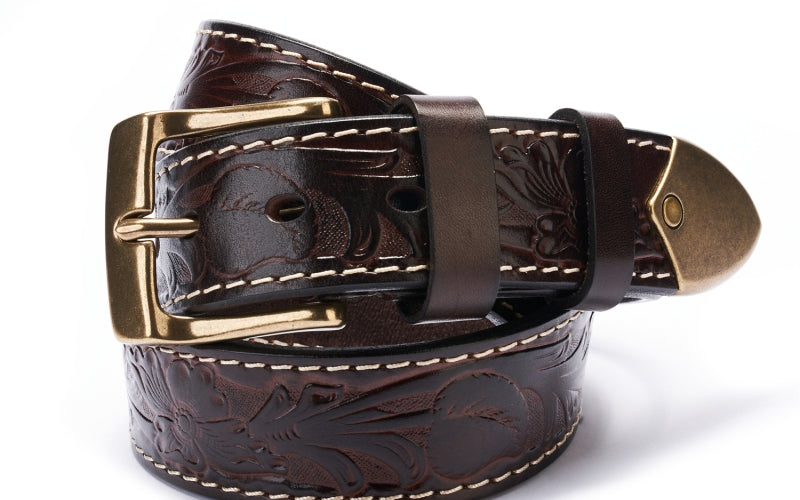
1. Stitch spacing consistency Run your eye along the full stitch line. Quality stitching is perfectly even — identical gaps between every stitch from the buckle end to the tip. Irregular spacing indicates inconsistent machine tension or rushed hand work.
2. Thread tension The thread should sit in the leather surface, not loop above it or pull the leather into puckers. Over-tightened thread tears the leather over time. Under-tightened thread lifts off the surface and catches on things.
3. No skipped stitches A skipped stitch — a gap in the line where a hole was missed — is a structural weak point. Even one skipped stitch in a machine-sewn seam creates an anchor for progressive failure.
4. Edge seam tightness Squeeze the edge of the belt between thumb and forefinger. On a well-stitched belt, the edge feels solid and uniform. On a poorly stitched belt (or one held primarily by adhesive), you'll feel slight give or separation.
5. Back-face thread pattern Flip the belt over and look at the stitching from the underside. Machine lock stitching shows a parallel bobbin thread running along the seam. Saddle stitching shows the same cross-pattern on both faces. If the underside shows loose, visible loops, the bobbin tension was set incorrectly.
These signals are why knowing what makes a leather belt most durable requires looking beyond the leather grade on the label. Stitching quality is the part of construction that's hardest to fake on inspection — which is exactly why it separates fast-fashion belts from ones worth owning long-term.
The Bottom Line
Belt stitching is where construction quality either holds up or falls apart — literally. Saddle stitching is the gold standard: two needles, independent locking stitches, and a failure mode that stays contained rather than propagating. Machine lock stitching is acceptable when done at 10+ SPI with bonded nylon thread; unacceptable when done at 6 SPI with standard polyester on a bonded leather edge.
The practical takeaway for buyers: turn the belt over and look at the stitching from both sides. Count the stitches per inch. Squeeze the edge seam. These 30 seconds tell you more about how long a belt will last than any product description. At BELTLEY, our handmade leather belts and full-grain leather belts are built to a standard where the stitching holds for a decade — backed by our 10-year warranty on materials and construction. That warranty only works if the stitching does.
Frequently Asked Questions
Q: What is saddle stitching on a belt?
Saddle stitching is a two-needle hand technique where a single length of thread is passed through each pre-punched hole from both sides simultaneously. The result is a self-locking stitch where each hole is independently secured — if one stitch breaks, the seam does not unravel. It is the strongest and most durable belt stitching method.

Q: Is hand stitching stronger than machine stitching on a leather belt?
Yes, in terms of failure resistance. A hand saddle-stitched seam fails one stitch at a time — breaks do not propagate. Machine lock stitching can unravel progressively from a single break because both threads are required to maintain each stitch's integrity. High-quality machine stitching narrows the gap considerably, but saddle stitching remains the structural standard.
Q: How many stitches per inch should a leather belt have?
A quality leather belt should have 10–12 stitches per inch (SPI). Belts with 6–8 SPI have 30–40% less tear resistance at the edge seam. You can verify SPI by holding the edge up and counting the stitches across one inch of seam — a quick, reliable quality check before buying.
Q: What thread is used for leather belts?
Premium leather belts use bonded nylon (machine stitching) or waxed linen (hand saddle stitching). Bonded nylon is coated with polyurethane resin to prevent fraying as it passes through tight leather holes. Waxed linen is the traditional hand-stitching thread that hardens in place after work, bonding to the leather over time.
Q: How do you tell if a leather belt has quality stitching?
Check for five things: (1) perfectly even stitch spacing along the full length; (2) thread sitting flush in the leather, not looping or puckering; (3) no skipped stitches; (4) a firm, solid edge seam that doesn't give when squeezed; (5) consistent thread pattern on the back face. All five visible to the naked eye in under a minute.