Single Prong vs. Double Prong Belt Buckle: Which Should You Buy?
TL;DR:
- A single prong buckle is the correct choice for dress, formal, and most everyday belts — cleaner profile, easier to fasten, and the standard in quality menswear.
- A double prong buckle distributes load across two points, making it slightly more secure under stress — relevant for lifting belts or heavy-duty work belts, not for everyday fashion.
- For quality leather belts, double prong adds no meaningful strength advantage — a single prong on full-grain leather with solid hardware will outlast a cheap double-prong strap every time.
The prong is the part of the buckle nobody talks about until they have a strong opinion about it. Mention double prong in a powerlifting forum and you'll get a debate that runs 40 posts. Ask a tailor, and they'll tell you a dress belt should never have two prongs. Both camps are right — for their context.
If you're shopping for a leather belt and aren't sure which configuration to pick, the answer is almost always a single prong. But that answer only holds if you understand why, and when it doesn't. This guide covers both.
Single or Double Prong: The Short Answer by Use
This one's mercifully simple once you match it to your use case:
| Your situation | Go with |
|---|---|
| Dress, formal, office wear | Single prong — cleaner profile, easier to fasten, the menswear standard |
| Everyday belt on quality leather | Single prong — on full-grain leather it outlasts a cheap double-prong every time |
| Heavy-duty work or lifting belt | Double prong — two load points genuinely matter under stress here |
| You like the rugged workwear look | Double prong — just know it's an aesthetic choice, not a strength upgrade |
| In doubt | Single. It's the right answer ~90% of the time |
Every belt in the full-grain collection pairs solid hardware with leather that earns it. Why the prong count matters less than you'd think:
What Is the Difference Between a Single Prong and Double Prong Belt Buckle?
A single prong buckle has one metal pin attached to the center bar of the buckle frame, which passes through a single hole in the leather strap to secure it. A double prong buckle has two pins side by side on the same center bar, passing through two parallel holes punched into the strap. Both function identically; the double prong simply distributes holding force across two contact points instead of one.

That mechanical difference sounds significant, but in practice its importance depends entirely on how much load the belt is carrying. For a dress belt holding up trousers, a single prong is more than adequate — the load is negligible. For a 13mm powerlifting belt braced against 300+ lbs of intra-abdominal pressure, the distinction matters more.
A full comparison of belt buckle types and mechanisms shows that the prong count is just one variable — buckle material, frame width, and center bar thickness all affect overall strength more than single vs. double.
Is a Double Prong Belt Buckle Stronger Than Single Prong?
A double prong buckle distributes holding force across two pins instead of one, making it mechanically more resistant to the prong bending or pulling out under extreme load. However, for everyday fashion belts — where stress on the buckle is minimal — the difference is negligible. The real determinant of belt durability is material quality, not prong count.
As Cardillo USA documents, a well-made single prong on a quality leather belt will last virtually indefinitely under normal wear. The double prong's advantage appears specifically when a belt is worn under significant tension — think heavy lifting, thick work gear, or extreme body compression. For standard dress and casual use, adding a second prong solves a problem that doesn't exist.
The failure point in most belts isn't the prong snapping — it's the leather holes stretching. And that problem is determined by leather quality, not prong count. Our full-grain leather belts resist hole stretch far better than bonded or split-leather alternatives, regardless of whether the buckle has one prong or two.
Which Prong Style Is Better for Formal and Dress Wear?
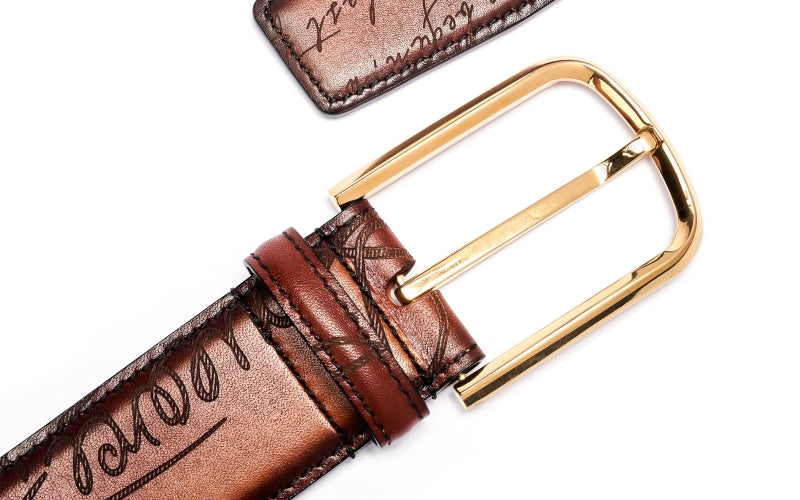
Single prong is the correct choice for formal and dress belts. Classic menswear convention calls for a small, flat, single-prong frame buckle — polished in silver or gold — on a narrow leather strap. The single prong produces a cleaner center-bar silhouette that sits flush against the waistband, making it appropriate for suits, dress trousers, and professional attire.

A double prong buckle on a formal belt is considered a style error in traditional menswear. The second prong makes the center bar bulkier, and the two-hole punch pattern on the strap creates a visual imbalance that reads as casual — not the intention when wearing tailored clothing. As Real Men Real Style's belt guide notes, formal belt buckles should be minimal: understated hardware lets the shoe-belt match do the visual work, not the buckle itself.
For a dress belt, the relevant specs are:
- Single prong — always
- Strap width: 1"–1.38" (25–35mm) to sit cleanly under belt loops
- Buckle finish: polished silver or gold, matching your watch and cufflinks
- Leather: smooth, full-grain in black or dark brown
Our dress belt collection is built to these specs — single prong hardware, refined finishes, full-grain leather. The kind of belt that doesn't draw attention to itself, which is exactly the point.
Which Prong Style Is Better for Casual and Everyday Wear?
For casual everyday belts, single prong remains the more practical choice — but double prong becomes a legitimate stylistic option. Casual belts tolerate a bulkier buckle profile without looking out of place, and the double prong reads as more rugged, which suits denim, chinos, and relaxed outerwear.

That said, the styling difference between a single and double prong casual belt is subtle unless you're going for a deliberate Western or workwear aesthetic. Double prong buckles appear frequently in Western belts, motorcycle gear, and certain heritage workwear styles — contexts where the chunky, no-nonsense hardware is part of the look. For standard casual leather belts, either works; the strap leather and width matter more than prong count.
One practical note: double prong belts require two aligned holes rather than one, which means the buckle takes slightly longer to fasten — a minor friction point that adds up if you're putting a belt on and off multiple times a day. As GCS Seatbelt's breakdown notes, this ease-of-use gap is small for everyday belts, but significant in contexts like the gym where you're bracing hard and need quick release.
Single Prong vs. Double Prong for Lifting Belts
This is where the single vs. double prong debate actually matters in a meaningful way — and even here, the answer isn't obvious. Lifting belts operate under forces that everyday fashion belts never encounter: intra-abdominal pressure bracing for heavy squats and deadlifts can approach hundreds of pounds of radial force.

Double prong lifting belts spread that load across two pins and two holes, reducing the stress on any single contact point. They're also considered more secure for maximal efforts — less chance of the belt slipping under peak load. The trade-off, as Repel Bullies explains, is that getting a double prong belt on extremely tight — which is the whole point — is considerably harder than a single prong. When you're 90% through a deadlift and need the belt off quickly, two prongs take meaningfully longer to release.
Single prong lifting belts are actually preferred by many competitive powerlifters and experienced strength athletes because they're faster to get on and off, especially under the high tension required for bracing. Juggernaut Training Systems notes that for most lifters, a single prong on a quality 10–13mm leather lifting belt provides all the security needed. The double prong's redundancy only becomes relevant at extreme loads where failure of the single prong is a realistic concern — which for most gym-goers, it isn't.
The bottom line for lifting: if you train at high intensity and want maximum redundancy, double prong gives you a margin of safety. For most people, a single prong on quality leather is simpler, faster, and equally effective.
Does Double Prong Mean Better Quality?
No. Double prong does not indicate higher quality — it indicates a different design choice. A single prong buckle on a well-constructed leather belt from a quality tannery will outperform a double prong on a cheap bonded leather strap in every measurable way: durability, hole integrity, overall lifespan.
Quality markers to actually look for in a belt buckle:
- Solid metal construction — brass or stainless steel, not zinc alloy or hollow frames
- Prong pivot security — the prong should rotate cleanly on a tight pin, not wobble
- Center bar width — should match the strap width without significant gap
- Surface finish — solid finish (not plating over base metal) resists tarnish and flaking
And on the leather side, the most durable leather belts use full-grain hides — where the natural grain surface is intact — rather than top-grain, genuine leather, or bonded leather alternatives. This determines how long the holes last far more than whether the buckle has one prong or two.
Our box & prong buckle belts use solid-metal hardware and full-grain leather precisely because the combination makes the "do I need two prongs?" question irrelevant. The system is overbuilt at one prong already.
The Bottom Line
Single prong or double prong — the honest answer is that for 90% of buyers, it doesn't matter as much as the buckle material and the leather quality. But when it does matter:

- Formal belts: Single prong, always. The double prong is a style mismatch with tailored clothing.
- Casual belts: Either works. Single prong is cleaner; double prong reads more rugged if that fits your aesthetic.
- Lifting belts: Single prong for convenience; double prong for maximum redundancy at extreme loads.
- Quality signal: Neither. A single prong on full-grain leather beats a double prong on cheap leather every time.
At BELTLEY, we build our box & prong leather belts around solid single-prong hardware because it's the right configuration for a belt engineered to last — not a compromise or a cost cut. Browse our men's belt collection to find the right strap, buckle, and leather for how you actually dress.
Frequently Asked Questions
Q: Is a single or double prong belt better?
For everyday fashion and dress wear, a single prong belt is better — it's cleaner, easier to fasten, and correct for formal contexts. For high-load applications like powerlifting, a double prong offers marginally more security. For most buyers, single prong on quality leather is the right call.
Q: Why do some belts have two prongs?
Double prong belts distribute holding force across two pins instead of one, providing a redundant point of contact under tension. They originated in heavy-duty and workwear contexts — military belts, lifting belts, Western belts — where extra security under load was a real need. In fashion, the double prong is primarily a stylistic choice.
Q: Can you wear a double prong belt with a suit?
No — a double prong buckle with a suit is a style mismatch. The second prong makes the center bar bulkier and the two-hole pattern on the strap reads as casual or workwear, which clashes with tailored clothing. A slim, polished single-prong frame buckle is the dress belt standard.
Q: Are double prong belts harder to put on?
Yes, slightly. A double prong belt requires threading two prongs through two aligned holes simultaneously, which takes more effort than a single prong — especially when worn tight. The difference is minor for everyday belts but becomes noticeable in lifting contexts where the belt is worn under high tension and needs quick release.
Q: Does the number of prongs affect belt quality?
No. Prong count is a design choice, not a quality indicator. Belt quality is determined by the leather grade (full-grain vs. genuine), the buckle metal (solid brass or stainless vs. zinc alloy), and the construction quality (stitching, hole reinforcement, finish). You can find excellent single prong belts and poor double prong belts in the same price range. Read our guide on dress belt vs. casual belt to understand which specs actually matter.