What Is Pebble Grain Leather — and Is It Good for Belts?
TL;DR:
- Pebble grain leather is any leather embossed with a small, rounded bumpy texture after tanning — it is a surface finish, not a leather grade. The base material (full-grain, top-grain, or genuine leather) determines actual quality.
- For belts, pebbled leather is an excellent choice for casual and everyday wear — it hides scratches well, requires less maintenance than smooth leather, and withstands heavy use. It is not the right choice for formal or dress belt applications.
- Always verify the base leather grade before buying pebbled leather — the texture can disguise low-quality hides just as easily as it can enhance a good one.
Pebble grain leather shows up on everything from Coach bags to work boots to everyday belts — and it generates a consistent amount of buyer confusion. Is it a type of leather? A quality tier? A brand-specific treatment? The name sounds premium, the texture looks interesting, and the price point varies wildly from $30 fast-fashion belts to $200+ quality goods.
The confusion is understandable because pebble grain describes how leather looks, not what it's made from. And that distinction determines whether a pebble grain leather belt is worth buying — or a clever way to hide cheap hide.
Pebbled or Smooth for Your Belt?
A texture decision with clear lanes:
| Your situation | Go with |
|---|---|
| Everyday casual belt, hard wear | Pebbled — the texture hides scratches smooth leather would broadcast. |
| Dress belt for suits | Smooth — pebble grain caps out at business casual. |
| Low-maintenance preference | Pebbled again — it forgives skipped conditioning sessions. |
| Want texture with more prestige | Real crocodile scales ($118–$289) — nature's texture, not an embossing plate's. |
Check the base grade either way — full-grain pebbled beats top-grain smooth. Both honest versions: BELTLEY's collection.
What Exactly Is Pebble Grain Leather?
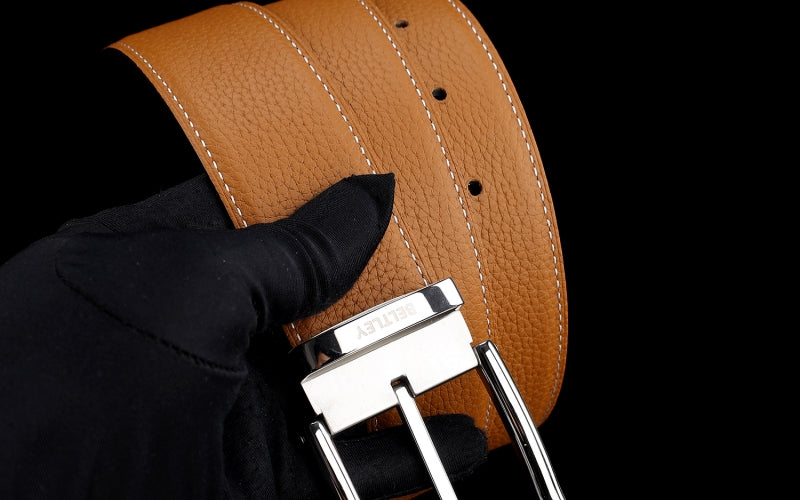
Pebble grain leather is leather that has been embossed with a pattern of small, rounded, irregular bumps that resemble the surface of a pebbly riverbed. The texture is applied mechanically after tanning — it is a surface finish, not a natural property of the hide. Any leather grade, from full-grain to split leather, can technically be embossed with a pebble pattern.

The key distinction buyers often miss: "pebble grain" describes the surface texture, not the leather quality. A full-grain pebble leather belt and a bonded leather pebble belt look nearly identical in product photos, but the underlying materials are worlds apart in terms of durability, aging, and how they fail over time. As Beckett Simonon's leather guide explains, the embossed pebble effect can be applied to virtually any animal hide — the base leather grade is the variable that matters.
How Is Pebbled Leather Made?
Pebbled leather is made by pressing a tanned hide through an industrial embossing press — a hydraulic machine with a metal plate etched with the pebble pattern — which stamps the texture permanently into the leather surface under high pressure and heat.
The process happens in three stages. First, the raw hide is tanned and dyed using whichever method the tannery uses (vegetable-tanned, chrome-tanned, or combination). Second, the finished leather sheet is fed through the embossing press, where the patterned plate stamps the pebble texture into the surface — the pressure is high enough to permanently deform the fiber structure into the bumped shape. Third, finishing treatments (sealants, waxes, or topcoats) are applied to lock in the texture and provide the surface's final hand feel.
The embossed pattern is permanent under normal use conditions. Unlike a natural grain, which is the hide's own fiber structure, an embossed pebble pattern is mechanically applied — but because the pressure deforms the leather fibers themselves rather than just the surface, it does not simply "rub off" the way a painted finish might. According to LeatherNeo's manufacturing breakdown, quality embossing penetrates enough into the leather that the texture remains stable through years of normal wear.
Is Pebbled Leather Real Leather?
Yes — pebbled leather is real leather. The embossing process is applied to genuine animal hide after tanning; it does not alter the fundamental nature of the material. A pebbled leather belt made from full-grain cowhide is as real as any smooth full-grain belt. What matters is confirming the base material before buying.

The confusion often arises because the pebble texture can mask lower-quality base materials. A belt made from bonded leather (compressed leather fiber scraps mixed with adhesive) or split leather (the weak underside of a hide) can be embossed with a pebble pattern that looks premium at a glance. The texture successfully hides the lower-quality grain — or absence of grain — that would otherwise be visible on the surface.
This is why looking at the belt's product description matters more than its texture. Phrases like "genuine leather," "bonded leather," or "PU leather" applied to a pebble-textured belt are red flags. Phrases like "full-grain" or "top-grain" indicate the embossing was applied to a legitimate base. Our guide to full-grain leather vs. genuine leather covers these distinctions in detail — it is the most important thing to understand before buying any leather belt, pebbled or otherwise.
Is Pebble Grain Leather Good for Belts?
For casual and everyday belts, pebble grain leather is an excellent choice. The embossed texture hides scratches, scuffs, and minor abrasions that would be immediately visible on smooth leather — making it ideal for daily use where the belt takes regular wear. For formal dress belts worn with suits or tailored trousers, smooth leather is the correct choice and pebble grain reads as too casual.
The texture's practical advantages are real and measurable. Szoneier Leather's durability testing documents that pebbled leather withstands up to 9,000 abrasion cycles in lab conditions — and because the surface's irregular bumps scatter light rather than reflecting it directly, minor scuffs don't create the high-visibility bright marks that smooth leather shows immediately. A pebble leather belt used daily for two years can look nearly new alongside a smooth belt that looks visibly aged from the same wear.
Advantages of pebble grain leather for belts:
- Scratch concealment — the bumpy surface hides light scratches and scuffs that would be immediately obvious on smooth leather
- Reduced maintenance cadence — surface imperfections don't show, so conditioning is needed less frequently (quarterly rather than monthly for heavy use)
- Durability under abrasion — the raised texture distributes friction across multiple contact points rather than concentrating wear on a flat surface
- Grip — textured surface stays in place against belt loops and clothing better than smooth leather
- Casual versatility — works across business-casual, smart casual, and weekend wear without looking overly formal or too rough
Limitations of pebble grain leather for belts:
- Not appropriate for formal wear — dress belts require smooth leather; pebble grain reads as casual regardless of belt quality
- Limited patina development — the embossed surface texture does not develop the rich, deep patina that aged full-grain smooth leather produces; connoisseurs of leather aging typically prefer smooth
- Quality disguise risk — the texture makes it easier for manufacturers to use lower-grade hides without it being immediately visible; the buyer must verify the base leather grade
- Slightly higher cost — the embossing process adds a manufacturing step, making pebble grain belts 10–20% more expensive than comparable smooth leather versions
Pebble Grain Leather vs. Smooth Leather: Which Is Better for a Belt?
Neither is universally better — the right choice depends on the belt's intended use. Smooth leather is the standard for formal and dress belts; pebble grain outperforms smooth leather for everyday casual use because it hides wear better and requires less maintenance. Many buyers keep one of each.

| Factor | Pebble Grain | Smooth Leather |
|---|---|---|
| Formal wear | Not appropriate | Standard choice |
| Casual / everyday wear | Excellent | Good |
| Scratch visibility | Low (texture hides marks) | High (marks show immediately) |
| Patina development | Minimal | Rich — develops character over years |
| Maintenance frequency | Quarterly | Monthly for heavy use |
| Durability (lab abrasion) | Up to 9,000 cycles | 6,000–7,000 cycles (smooth full-grain) |
| Estimated lifespan | 10–12 years with care | 6–8 years (smooth, heavy daily use) |
| Visual formality | Casual to smart casual | Casual to formal |
As Steel Horse Leather's comparison summarizes, pebbled leather's texture provides a practical durability advantage for everyday applications, while smooth leather's uninterrupted surface allows the natural aging and patina that leather enthusiasts value most. For a casual belt worn with jeans or chinos, pebble grain is a smart choice. For a dress belt paired with a suit or formal trousers, smooth full-grain leather is correct.
Does Pebbled Leather Develop a Patina?
Pebbled leather develops a limited patina compared to smooth full-grain leather. The embossed surface texture scatters light and masks the gradual color deepening and surface character that define patina — so while the leather does age, the visual aging is less dramatic and less prized than on smooth hides.
This is one of the genuine trade-offs of pebble grain leather for buyers who value the aging characteristics of fine leather. A smooth full-grain leather belt worn daily for five years develops a depth and character — darker at the buckle end, worn to a softness at flex points — that is considered a mark of quality. Von Baer's leather guide notes that some leather aficionados actively avoid pebbled leather for this reason: the embossing interrupts the surface story the leather would otherwise tell.
For buyers who prioritize low-maintenance appearance over aging character, this is a feature rather than a limitation. The pebble texture keeps the belt looking relatively consistent over its life rather than transforming dramatically. Neither approach is wrong — they serve different buyers.
Understanding what makes a leather belt durable means separating durability from patina. Pebble grain leather can be highly durable without developing the same visual aging as smooth leather — and for daily-use buyers, that consistency is often exactly what they want.
How Do You Care for a Pebbled Leather Belt?
Pebbled leather belts require the same fundamental care as smooth leather — conditioning, cleaning, and storage — but tolerate a less frequent schedule because the texture hides surface dirt and minor wear. Condition quarterly with a neutral leather cream, wipe down with a slightly damp cloth as needed, and store flat or rolled, away from direct heat and sunlight.

Practical care steps for a pebble grain leather belt:
- Clean — wipe with a barely damp microfiber cloth to lift surface dust; avoid soaking the leather
- Condition — apply a small amount of neutral leather conditioner or cream every 3–4 months; the texture means you'll need to work the product into the grooves between bumps with a soft brush
- Brush — a soft horsehair brush helps distribute conditioner evenly across the pebbled surface without over-saturating any single area
- Protect — an annual application of a leather protector spray adds a moisture barrier without altering the texture
- Store — hang or roll loosely; avoid folding, which creates permanent creases at the fold point
The same core principles from our leather care guide apply to pebbled leather — the main adaptation is using a soft brush to work products into the textured surface rather than just wiping flat.
The Bottom Line
Pebble grain leather is a legitimate and practical choice for belts — with two important caveats. First, always check the base leather grade: full-grain pebbled leather is excellent; genuine or bonded leather with pebble embossing is a texture applied over a weak foundation. Second, match the texture to the context: pebble grain belongs on casual and everyday belts, not on dress belts for formal occasions.
Done right — quality base leather, solid construction, quality hardware — a pebbled leather belt outperforms its smooth equivalent for daily use. It hides wear better, needs less maintenance, and holds up to the kind of abrasion that scuffs smooth leather visibly. That makes it a smart choice for anyone who wants a belt that looks good after two years of real use, not just on day one.
BELTLEY's full-grain leather belts and exotic leather options are built on the same principle: the base material has to be right before anything else matters. Browse our full leather belt collection and find the leather type that fits how you actually wear your belt.
Frequently Asked Questions
Q: What is the difference between pebble grain and full-grain leather?
"Full-grain" refers to the leather grade — it means the outermost layer of the hide is intact, with the natural grain surface preserved. "Pebble grain" refers to a surface texture created by embossing. A belt can be full-grain pebbled leather (high quality) or genuine-leather pebbled (low quality). The terms describe different characteristics and are not interchangeable.

Q: Is pebbled leather durable?
Yes — pebbled leather on a quality base hide is highly durable. Lab testing shows it can withstand up to 9,000 abrasion cycles, and estimates put its lifespan at 10–12 years with proper care. The texture distributes friction across multiple raised contact points rather than concentrating it on a flat surface, which genuinely extends wear life compared to smooth leather under equivalent daily use.
Q: Does pebbled leather scratch easily?
Pebbled leather is more scratch-resistant in appearance than smooth leather because the textured surface hides light scuffs and marks that would be immediately visible on a flat surface. It is not impervious to deep scratches, but under normal daily wear conditions, it shows wear much less visibly than smooth leather does.
Q: Can you wear a pebbled leather belt with a suit?
Pebble grain leather is not appropriate for formal suits or tailored attire. The texture reads as casual — it does not provide the clean, refined profile that formal dress codes require. A slim, smooth full-grain leather belt in black or dark brown is the correct choice for suits. Pebble grain works well for smart-casual looks: chinos, blazers, business-casual settings.
Q: How do you tell if pebbled leather is good quality?
Check for the base leather grade (full-grain or top-grain — not "genuine" or "bonded"), the stitching density and thread quality, and the buckle hardware material. Flex the belt gently — quality pebbled leather flexes cleanly without cracking or showing white stress marks. Poor-quality pebbled leather will crack at flex points within months of daily use, revealing the bonded or split-leather base beneath the embossed surface.