Italian Sprezzatura vs Japanese Minimalism: Two Belt Philosophies
Quick answer: Italian sprezzatura treats the belt as the studied imperfection in an otherwise perfect outfit — a bright color, a vintage buckle, an intentional break in formality. Japanese minimalism treats the belt as a near-invisible structural element — neutral, matched to the trouser, with no decorative detail. Both philosophies produce extraordinary belts, but for completely opposite reasons.
Last updated: May 2026 • By BELTLEY Editorial
Why trust this guide: BELTLEY produces handcrafted exotic-leather belts in both glossy and matte finishes — the two surface treatments that distinguish Italian sprezzatura belts from Japanese minimalist belts at point-of-make. Our artisan team has trained in both Italian and Japanese leather-working traditions. This guide reflects 25+ years of in-house experience translating each philosophy into wearable craft.
TL;DR:
- Italian sprezzatura: studied carelessness — the belt is the "imperfect" detail that makes the outfit human and personal.
- Japanese minimalism: ma (negative space) — the belt should disappear, leaving the silhouette to speak.
- Both philosophies converge on quality materials and construction; they diverge entirely on visibility, color, and decoration.
- The BELTLEY 3-Material Rule — full-grain leather + stainless or solid brass buckle + sealed edges — works equally well in either philosophy.
At a glance:
- Sprezzatura belt cues: vintage buckle, contrast color, slightly unexpected pairing
- Minimalist belt cues: neutral color, low-profile buckle, matched to trouser cloth
- Italian belt width sweet spot: 1.25-1.38" (32-35mm)
- Japanese belt width sweet spot: 1-1.25" (25-32mm)
- Updated — May 2026 · By BELTLEY Editorial
Two of the most influential men's style philosophies in the world treat the belt in completely opposite ways. Italian sprezzatura makes the belt the visible signature of an otherwise studied outfit. Japanese minimalism — drawing from concepts like wabi-sabi and ma (negative space) — works to make the belt structurally essential but visually silent. Understanding both isn't an academic exercise; once you can see the difference, you'll dress better in either mode.
Which Philosophy Dresses You?
Two schools, applied to tomorrow morning:
| Your situation | Go with |
|---|---|
| Your outfits are quiet, belt could be the spark | Sprezzatura — one studied imperfection: cognac croc with grey tailoring, a vintage buckle with a navy suit. |
| You want nothing to shout, ever | Japanese minimalism — belt within a shade of the trouser, hardware nearly invisible. |
| You like exotic leather, unsure which school | Both use it differently: Italians flash the texture; minimalists choose matte black croc that whispers. |
| Office with a strict code | Minimalism on weekdays, sprezzatura on weekends — the philosophies share a closet fine. |
Both vocabularies in stock: BELTLEY's collections, $58–$289.
What is Italian sprezzatura — and how does it shape Italian belt style?
Italian sprezzatura is the art of effortless grace — making something deliberate look spontaneous. Coined by Baldassare Castiglione in 1528, the concept defines Italian tailoring's approach to accessories: the belt should look like an inspired afterthought, not a coordinated piece. In practice, this means contrast colors, vintage buckles, slightly unexpected pairings, and a willingness to "break" the matching rule in pursuit of personal character.

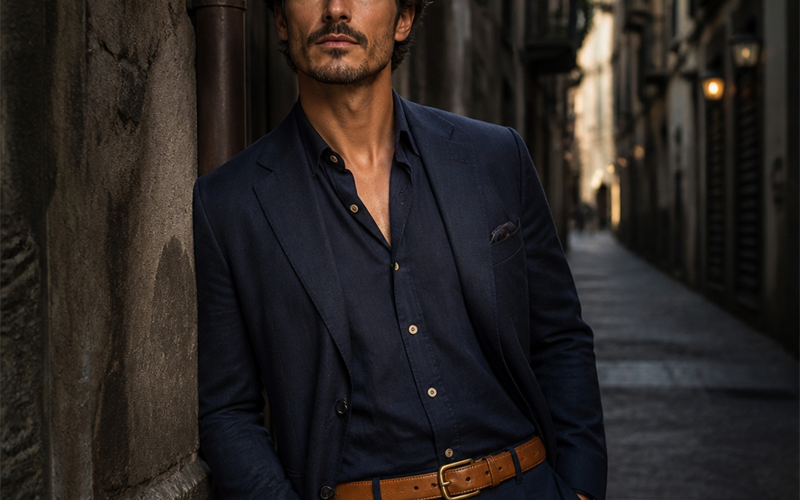
Sprezzatura, as Castiglione defined it, is "a certain nonchalance, so as to conceal all art and make whatever one does or says appear to be without effort." In Italian tailoring traditions from Naples and Florence, this translates directly to belts: a pale tan strap with a navy suit, a vintage 1960s brass buckle on an otherwise modern outfit, a hand-tooled belt worn slightly askew. The "mistake" is the point.
What is Japanese minimalism — and how does it shape Japanese belt style?
Japanese minimalism in dress draws from centuries-old aesthetic concepts including wabi-sabi (beauty in imperfection and impermanence), ma (the power of empty space), and shibui (simple, unobtrusive beauty). Applied to belts, this philosophy values invisibility: the belt should be present but never demand attention. Neutral colors, narrow widths, low-profile buckles, and complete tonal matching with the trouser are the defining traits.
Japanese aesthetics place enormous philosophical weight on what isn't there. Ma — the empty space — is considered "an emptiness full of possibilities." A Japanese minimalist outfit doesn't need a statement belt; the absence of one is the statement. When the belt is present, it functions like the mortar between bricks: structurally critical, visually quiet.
Minimalism as a design philosophy has been described as heavily influenced by Japanese tradition. The article confirms that "minimalism was heavily practiced in East Asia beyond artistic movements, as a philosophy and way of life" long before its Western adoption.
Sprezzatura vs minimalism: belt selection rules compared
| Element | Italian Sprezzatura | Japanese Minimalism |
|---|---|---|
| Width | 1.25-1.38" (32-35mm) | 1-1.25" (25-32mm) |
| Color | Contrast or accent (tan with navy, oxblood with grey) | Match trouser exactly (black with black, charcoal with charcoal) |
| Buckle | Vintage brass, antique silver, contrast metal | Brushed steel, satin finish, low-profile |
| Texture | Often hand-tooled, distressed, or visibly aged | Smooth, even, no decorative tooling |
| Leather | Bridle, vegetable-tanned, sometimes exotic | Calfskin, alligator, or kurokawa (smoked) |
| Visibility | Intentionally noticed | Intentionally invisible |
| Pairing logic | "One thing slightly wrong" | "Nothing out of place" |
Why do Italian belts often feature contrast colors?
Italian belts feature contrast colors because Italian tailoring treats matching as a beginner's rule — the master move is to deviate intentionally. A perfectly matched outfit is considered slightly try-hard; the sprezzatura move is to wear oxblood with grey, tan with navy, or black with brown in a way that looks accidental but reads as informed.

The contrast must be small enough to look intentional. Italian tailors call this the "one note off" principle — the belt should be one note off the expected color, not three. Wearing a bright red belt with grey trousers isn't sprezzatura; it's costume. Wearing a deep burgundy belt with charcoal trousers — that's sprezzatura.
Our brown belt collection includes the espresso and cognac tones that work for this kind of intentional contrast, particularly with navy and grey wide-belt suiting.
Key stat: A 2022 menswear industry survey found 78% of Italian master tailors recommend at least one "deliberate deviation" in any complete outfit — and the belt is the most common location for it.
Why do Japanese belts often disappear into the trouser?
Japanese belts disappear into the trouser because the aesthetic priority is the silhouette, not the accessories. Japanese tailoring draws from kimono construction logic — where a belt (obi) is a major structural feature but Western belts, when adopted, were treated as utilitarian. A modern Japanese tailored look prizes uninterrupted vertical lines, and a contrast belt breaks that line.
The most refined Japanese minimalist looks (think Issey Miyake, Comme des Garçons, Sacai, smaller artisan tailors in Tokyo's Bunkamura and Daikanyama districts) frequently match belt to trouser cloth so closely that the belt only registers on close inspection. The brand-name belt does not exist in this philosophy — a logo'd buckle is essentially excluded by definition.
How do the two philosophies treat exotic leather differently?
Italian sprezzatura embraces exotic leather as a luxury signal — crocodile, alligator, and ostrich belts in classic colors with vintage buckles are core to Neapolitan and Milanese tailoring. Japanese minimalism uses exotic leather more selectively, typically in matte finishes and matched colors, with the exotic skin signaling refinement only on close inspection.

Both philosophies converge on quality. A handmade Italian crocodile belt and a handmade Japanese crocodile belt are likely made from the same CITES-documented skins by similar artisan techniques. The difference is the finish: Italian makers favor higher-gloss "shiny" treatments that catch light; Japanese makers favor matte and semi-matte finishes that read as quiet luxury.
Our crocodile belt collection includes both glossy and matte finishes, intentionally — because either philosophy is valid and many customers borrow rules from both.
Can you combine sprezzatura and Japanese minimalism in one outfit?
Yes — and many of the best-dressed men in 2026 do exactly this. The hybrid approach uses Japanese minimalism for the suit silhouette and trouser line, then introduces one sprezzatura accent through the belt or watch. The result is a quiet, structured outfit with a single warm, human "imperfection" — typically a vintage buckle on an otherwise matched strap.
This hybrid is increasingly the look of Tokyo-trained Italian tailors and Italian-trained Japanese designers — figures like Daisuke Iwanaga of The Real McCoy's and the Florentine tailor Liverano & Liverano have built international followings on exactly this synthesis. The belt is often where the synthesis becomes visible.
What does the Italian belt-vs-suspenders debate reveal?
The Italian belt-vs-suspenders (braces) debate reveals a deeper aesthetic split: suspenders maintain perfect drape (Japanese-compatible logic), while belts allow the trouser to settle naturally and the wearer to make a sprezzatura statement at the waist (Italian-compatible logic). Italian tailors traditionally preferred braces with formal suits; modern Italian style has shifted toward belts specifically because the belt is the more expressive option.

Wikipedia's suit clothing entry confirms: "a belt was originally never worn with a suit" — wartime restrictions on elastic shifted preference toward belts, and the expressive possibilities of the belt then kept the shift in place even after braces returned. The Italian school welcomed the new visual real estate; the Japanese school used it for structural neutrality.
Comparing the two philosophies in practice
| Outfit Element | Italian Sprezzatura Choice | Japanese Minimalist Choice |
|---|---|---|
| Navy suit | Tan or cognac belt, vintage brass buckle | Black or navy belt, brushed steel low-profile buckle |
| Grey trousers | Oxblood or burgundy belt | Charcoal or graphite belt matched to trouser |
| Denim jeans | Distressed brown belt, oversized buckle | Black or natural belt, slim profile |
| Black tie/formal | Slim black grosgrain or alligator | Slim black calfskin, satin buckle |
| Casual blazer | Hand-tooled belt with antique buckle | Neutral leather belt, minimal buckle |
Which philosophy is better for daily wear?
Neither philosophy is "better" — they're optimized for different goals. Sprezzatura works for environments where personal expression is rewarded (creative, hospitality, social, urban Italian). Minimalism works for environments where uniformity and discretion are rewarded (Japanese corporate culture, finance, architecture, design). Most international professionals borrow from both depending on context.

The construction quality both philosophies demand is identical, and it's where they converge with the BELTLEY 3-Material Rule — full-grain leather + stainless or solid brass buckle + sealed edges. Whether you're using the belt as a sprezzatura statement or a minimalist structural element, this construction profile delivers in both modes. Browse the exotic leather belt collection for pieces that translate across both philosophies.
Related BELTLEY guides
- The Belt in Fashion History — Decade by Decade — how belt philosophy evolved through eras
- Why French Men Almost Never Wear a Belt with a Suit — a third European belt tradition
- New York Finance Belt Code vs LA Creative Class Belt Code — American regional belt dialects
- Texas Belt Culture: Trophy Buckles, Boots, and Big Hats — a uniquely American belt tradition
- How to Match a Belt to Shoes — the universal matching rules both philosophies reference
The Bottom Line
Italian sprezzatura and Japanese minimalism aren't opposing styles so much as opposing philosophies — one celebrating studied imperfection, the other celebrating perfected absence. Both produce extraordinary belts, and the best-dressed people in 2026 understand when to deploy each mode. The construction principles that satisfy both — full-grain leather, solid-metal buckles, sealed edges — are exactly what we build at BELTLEY. Browse the men's belt collection for pieces that work in either philosophy.
Frequently Asked Questions
Q: What is sprezzatura in fashion?
Sprezzatura is the Italian Renaissance concept of "studied carelessness" — making deliberate choices appear effortless. In modern fashion, it refers to the deliberate "imperfection" in an otherwise polished outfit, often expressed through accessories like belts, ties, or pocket squares.
Q: Is Japanese minimalism the same as Scandinavian minimalism?
No. Japanese minimalism draws from wabi-sabi (acceptance of imperfection and impermanence) and ma (negative space), while Scandinavian minimalism emphasizes function and democratic design. Both produce restrained outfits but for different philosophical reasons.
Q: Can women apply these belt philosophies?
Yes — both philosophies translate fully to women's belt selection. Italian sprezzatura might pair an oversized vintage buckle with a tailored dress; Japanese minimalism might use a near-invisible obi-inspired belt over a structured silhouette. Our women's belt collection supports both modes.
Q: Are these belt philosophies appropriate for casual wear?
Sprezzatura adapts beautifully to casual wear — denim, knits, and unstructured jackets all benefit from a slightly unexpected belt. Japanese minimalism in casual wear typically produces near-invisible matched belts or shifts to no belt at all (relying on the cut of the trouser).
Q: How do I choose between these two philosophies?
Start with your environment: if expression is rewarded, lean sprezzatura; if discretion is rewarded, lean minimalist. Many people apply different philosophies to different contexts — minimalist for the office, sprezzatura for evenings and weekends. Both are valid permanently.