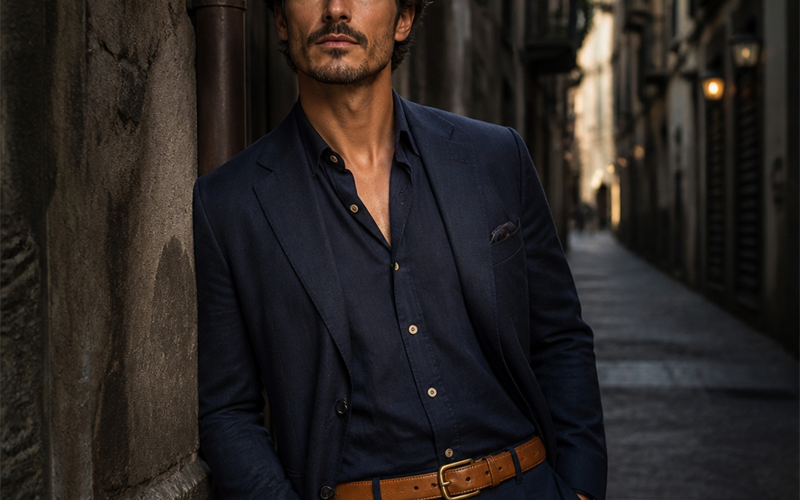
Italian Sartorial Belt vs Sneaker Belt: Two Belts Every Italian Man Owns
TL;DR:
- Italian men typically own two foundational belts — a sartorial dress belt and a casual sneaker belt.
- The sartorial belt is 30 mm, smooth, dressy, paired with suits and dress shoes.
- The sneaker belt is 35–38 mm, rugged, casual, paired with jeans, chinos, and sneakers.
- Together they cover 95% of an Italian man's wardrobe. You don't need 10 belts. You need these two.
There's a wardrobe principle in Italian menswear that goes against everything American belt shopping teaches you.
You don't need a lot of belts.
You need two belts. The right two. Bought once, properly. Worn for decades. The Italian man at the espresso bar in his beautifully cut blazer isn't choosing from a closet of fifteen belts each morning. He owns two real belts — maybe three — and they handle his entire wardrobe.
This post breaks down what those two belts actually are, why the two-belt system works, and how to build it. For wider Italian style context, our Sprezzatura rule for Italian leather belts post is the foundation read.
Build Your Own Two-Belt System
The Italian formula, fitted to your closet:
| Your situation | Go with |
|---|---|
| Suit-heavy week | Sartorial slot first: 30mm smooth calf, black or espresso, polished prong. |
| Denim-heavy week | Sneaker slot first: 35–38mm full-grain in brown, matte finish. |
| Building both at once | Black sartorial + brown sneaker covers 95% of outfits — the whole system runs $160–$250 at DTC pricing. |
| Adding the Italian flourish | Slot three is sprezzatura: a croc or colored strap ($118–$289) for the days that deserve it. |
Both slots and the flourish: BELTLEY's men's collection.
What's an Italian "Sartorial" Belt?
An Italian sartorial belt is a refined dress belt designed to pair with tailored clothing — suits, blazers, dress trousers, and quality leather dress shoes. It's typically 28–32 mm wide, made from smooth Italian calf or vegetable-tanned leather, finished with a plain or minimal plaque buckle in solid brass or polished stainless steel. The word "sartorial" refers to its tailoring-aligned purpose.

Sartorial belt characteristics:
- Width: 28–32 mm (narrower aligns with dress trouser loops)
- Leather: Smooth Italian calf or fine vegetable-tan
- Color: Black or dark brown (the formal essentials)
- Buckle: Plain solid brass, polished stainless, or simple plaque
- Stitching: Tonal, refined, 7+ SPI
- Edge: Hand-painted multi-coat or finely burnished
- Overall feel: Refined, subtle, dressy
Wikipedia's sartorialism article covers the broader Italian tradition of fine tailoring that the sartorial belt is built to complement. Our Italian 30mm vs American 38mm belts post covers why the narrower width matters specifically.
What's an Italian "Sneaker" Belt?
An Italian sneaker belt is a casual belt designed to pair with jeans, chinos, and sneakers — the everyday weekend and smart-casual uniform. It's typically 35–38 mm wide, made from thicker full-grain veg-tan or pull-up leather, finished with a solid brass casual buckle. The name "sneaker belt" reflects its primary pairing context, though it works equally well with loafers or boots in casual styling.
Sneaker belt characteristics:
- Width: 35–38 mm (matches casual trouser loops)
- Leather: Full-grain veg-tan, pull-up, or rugged calf
- Color: Brown (warm or cool tones), occasionally tan or cognac
- Buckle: Solid brass, often vintage-style or heritage casual
- Stitching: Tonal or subtle contrast, sturdy
- Edge: Often hand-burnished, sometimes raw
- Overall feel: Rugged, lived-in, casual
This is the belt Italian men reach for on weekends, after work, and on travel. It's the one that develops the most patina because it gets the most casual wear.
For sneaker belt examples, our casual belts collection and brass buckle belts collection cover the typical style range.
Why Just Two Belts? Why Not Five or Ten?
Italian style favors two foundational belts because the binary system covers every realistic wardrobe context cleanly: dressed up (sartorial) or dressed down (sneaker). Adding more belts beyond these two creates decision fatigue and dilutes investment. Better to own two truly excellent belts than seven mediocre ones.

The two-belt system advantages:
- Total wardrobe coverage. Suit days = sartorial. Casual days = sneaker. Done.
- Investment concentration. Buy two great belts instead of seven okay ones.
- Quality compounds. Each belt gets worn often enough to develop real patina.
- Mental simplicity. No daily belt decision. The trousers decide for you.
- Wardrobe coherence. Outfits stay consistent because the belt rotation is consistent.
For more on the long-ownership logic, our How Long Does a Properly Made Italian Leather Belt Last? post covers the lifespan that supports buying-once-and-keeping.
What Specific Pairings Does Each Belt Cover?
The sartorial belt covers suits, dress trousers with blazers, business casual with dress shoes, and any context requiring a tucked-in shirt with formal footwear. The sneaker belt covers jeans, chinos, casual trousers, smart casual with loafers or boots, and anything paired with sneakers or casual leather footwear.
A practical coverage matrix:
| Outfit | Sartorial Belt | Sneaker Belt |
|---|---|---|
| Business suit + oxford shoes | Yes | No |
| Sport coat + dress trousers + derbies | Yes | No |
| Sport coat + jeans + loafers | No | Yes |
| Polo + chinos + sneakers | No | Yes |
| Tuxedo + patent shoes | Yes (or specialty thin) | No |
| Untucked shirt + jeans + sneakers | No | Yes |
| Office casual + chinos + leather sneakers | No | Yes |
| Wedding guest + suit + dress shoes | Yes | No |
The split lines up with the formal/casual divide your trousers and shoes are already declaring.
Do You Need Both in Black and Brown?
For maximum coverage, yes — most Italian men eventually build out the two-belt system with both color options: black sartorial, brown sartorial, brown sneaker. (Black sneaker belts are less common because casual contexts rarely require black.) Three belts cover essentially every wardrobe need.

The three-belt full coverage set:
- Black sartorial belt — for black-shoe formal contexts
- Brown sartorial belt — for brown-shoe business and dress contexts
- Brown sneaker belt — for all casual wear
Optional fourth: an exotic or character belt for special occasions (vintage brass, crocodile, or family heirloom). But the three-belt core handles 95% of dressing.
Our brown leather belts collection and black leather belts collection cover both color sides. Our dress belts collection focuses on the sartorial tier specifically.
How Do You Choose Between Sartorial and Sneaker Belt Each Day?
You don't really choose — the trousers and shoes decide for you. If the outfit includes tailored trousers and leather dress shoes, the sartorial belt is automatic. If the outfit includes jeans, chinos, or sneakers, the sneaker belt is automatic. The belt is responsive to the rest of the outfit, not a primary decision point.

The decision flow:
- Pick trousers. Dress trousers = sartorial direction. Jeans/chinos = sneaker direction.
- Pick shoes. Dress shoes confirm sartorial. Sneakers/casual shoes confirm sneaker.
- Grab the matching belt. The choice is already made.
- Adjust color. Brown shoes = brown belt. Black shoes = black belt.
- Done. 15 seconds of decision-making.
This is the efficiency of the two-belt system. The decision is automatic because the system is small and clear. The Italian man at the espresso bar didn't agonize over his belt — he just grabbed the right one for his trousers.
What Width and Hardware Suit Each Belt?
The sartorial belt should be 28–32 mm with a refined buckle (solid brass, polished stainless, or simple plaque). The sneaker belt should be 35–38 mm with a more substantial casual buckle (solid brass, vintage-style, or heritage casual hardware). The hardware on each belt signals the belt's formality tier as much as the leather does.
Hardware comparison:
| Feature | Sartorial Belt | Sneaker Belt |
|---|---|---|
| Buckle material | Brass or stainless | Solid brass |
| Buckle style | Plain or subtle plaque | Casual heritage or vintage |
| Buckle weight | Light to medium | Medium to heavy |
| Buckle finish | Polished or brushed | Antique or polished |
| Pin style | Single pin | Single pin, heavier |
| Branding | None or minimal | None |
For the formal hardware side, see our stainless steel buckle belts collection. For the casual side, our brass buckle belts collection covers the typical sneaker-belt hardware approach.
Can You Build the Two-Belt System for Under $400?
Yes — a quality two-belt system from DTC Italian or premium artisan brands can be built for $300–$400 total. The sartorial belt typically costs $150–$200, and the sneaker belt $130–$200. Building this system once and keeping it for 20+ years works out to less than $20 per year — cheaper than a single low-quality belt that needs replacing every 2 years.

The annualized math:
- Two quality belts: $400 total, 20 years of wear = $20/year
- Five mid-range belts replaced every 4 years: $400 total per cycle, $100/year ongoing
- Ten cheap belts replaced every 2 years: $300 total per cycle, $150/year ongoing
The two-belt system is the cheapest long-term option per year. Our Is a $200 Italian Leather Belt Better Than a $50 American Full-Grain Belt? post covers the broader value-per-dollar math.
The Bottom Line
The Italian two-belt system isn't about minimalism for its own sake — it's about concentrating quality investment in the pieces that actually need to be high-quality. Two excellent belts covering all wardrobe contexts beats ten mediocre belts every time. The sartorial belt handles your tailored life. The sneaker belt handles your casual life. Together they handle everything.
If you're starting from scratch, build the sartorial belt first (the one you'd wear with your nicest outfit), then add the sneaker belt within the next year. Pick a third belt only after you've worn both for at least a year and identified a specific gap. At BELTLEY, our dress belts collection covers the sartorial tier and our casual belts collection covers the sneaker tier — the two-belt system in one shopping trip.
Frequently Asked Questions
Q: What color should I buy first if I can only afford one belt?
Brown sartorial — it's the most versatile single belt because it covers both business and casual contexts when paired with brown shoes. Black sartorial is more formal but less versatile. Brown sneaker only works in casual contexts. Start brown sartorial, expand from there.
Q: Can the sneaker belt work for business casual?
Yes — a quality brown sneaker belt paired with chinos and leather sneakers is a legitimate business casual look in many Italian contexts. The key is matching the belt's casualness to the rest of the outfit. Don't pair a sneaker belt with formal dress shoes.
Q: What about a third belt — should I add a black sneaker belt?
Usually not. Black casual belts have niche use cases. Most casual outfits work better with brown or tan leather. If you find yourself wanting black with jeans regularly, then yes — but most men don't.
Q: Are exotic belts (crocodile, etc.) included in the two-belt system?
No — exotic belts are specialty additions for specific occasions, not foundational pieces. Build your sartorial-and-sneaker core first, then consider exotic for special-occasion wear. See our exotic leather belts collection for the category.
Q: How often should I rotate between the two belts?
Daily, based on the outfit. The sartorial belt gets worn on suit days and dress days; the sneaker belt gets worn on casual and weekend days. Each belt probably sees 2–4 days of wear per week depending on your lifestyle balance.
Q: Will both belts age at the same rate?
Different rates. The sneaker belt typically patinates faster because it gets harder daily wear. The sartorial belt patinates more slowly because it's worn in gentler contexts. Both should look beautiful after 10 years, just with different character. Our How Long Does a Properly Made Italian Leather Belt Last? post covers the longevity side.