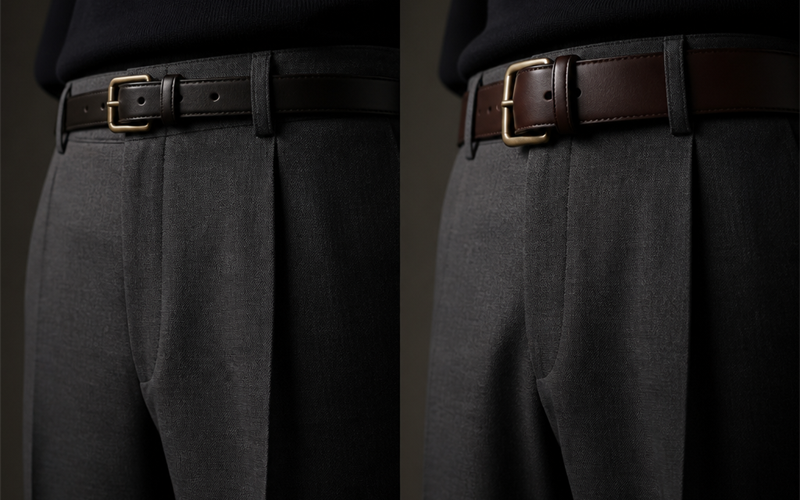
Why Italian Men Prefer 30 mm Belts to American 38 mm Belts
TL;DR:
- Italian men default to 30–35 mm (1.18–1.38 inch) belts for most wear, including business.
- American men default to 38 mm (1.5 inch) belts for almost everything.
- The Italian width fits dress trousers better and reads as more refined and European.
- The American width fits casual trousers better and reads as more rugged and traditional.
You're standing at a belt rack. The American rack has belts. They're all 38 mm wide. Maybe a few 35 mm if you're lucky. Done.
You walk into an Italian belt shop. There are six different widths. 25, 28, 30, 32, 35, 38 mm. The salesperson asks you what trousers you'll wear it with. You blink. You didn't know that was a question.
That difference — width awareness — is one of the quietest but most distinctive markers of Italian belt culture. American belt-buying is one-size-fits-most. Italian belt-buying matches width to occasion. Once you know the rules, the American default of 38 mm starts to look as strange as wearing one shoe size for every kind of foot.
This post breaks down what's actually different and which approach makes sense for your wardrobe. For wider Italian context, our why Italian leather belts cost more post is a useful starter.
30mm or 38mm: Which Closet Are You?
The transatlantic width question, personalized:
| Your situation | Go with |
|---|---|
| Suits and dress trousers weekly | 30–35mm — the Italian instinct is correct; dress loops are cut for it. |
| Jeans-dominant wardrobe | 38mm — the American default exists because denim loops swallow narrow straps. |
| One belt across both | 35mm — the crossover width both traditions quietly agree on. |
| Converting your whole rotation | Don't — own both widths instead; the rule is matching loops, not picking a nationality. |
Every width, clearly listed: BELTLEY's men's collection.
What's the Real Difference Between Italian and American Belt Widths?
The real difference is the relationship between belt width and trouser belt-loop size. Italian dress trousers are tailored with belt loops sized for 30–35 mm belts. American trousers — even dress trousers — are commonly cut with belt loops sized for 38 mm belts. The default width follows the local tailoring standard.

A quick width-to-loop alignment chart:
| Belt Width | Trouser Belt Loop | Common Use |
|---|---|---|
| 25 mm (1") | Tight dress loops | Tuxedo, formal evening |
| 30 mm (1.18") | Italian dress loops | Italian business, dress |
| 32 mm (1.25") | Mid-width loops | Smart casual |
| 35 mm (1.38") | American dress loops | American business, mixed |
| 38 mm (1.5") | Casual / workwear loops | Jeans, chinos, work pants |
When the belt width doesn't match the loop width, the belt either rides loose (too narrow), pulls the loops (too wide), or refuses to thread through entirely. Width is a fitting issue, not just a style choice.
Why Did Italian Tailoring Standardize on Narrower Belts?
Italian tailoring standardized on narrower belts because Italian dress trousers are traditionally cut with a slimmer waistband, lower rise, and finer belt loops sized for refined hardware. The slimmer width reads as more elegant, more proportional to the trouser cut, and more aligned with Italian dress shoes which themselves tend toward slimmer profiles than American dress shoes.
The Italian tailoring logic:
- Slimmer waistband. Italian trousers often have a 35–40 mm waistband; the belt should be roughly the same width or slightly narrower.
- Lower rise. Mid-rise Italian trousers position the belt visually at the natural waist, where slimmer is more elegant.
- Finer hardware. Italian belts often use 28–32 mm buckles, which look proportional only on similarly sized belts.
- Dress-shoe alignment. Italian dress shoes (Loake, Edward Green Italian, Bontoni) are typically slim — the belt mirrors that.
Wikipedia's Italian fashion article covers the broader tailoring tradition. The narrower belt is part of an integrated proportion system, not a standalone choice.
Why Did American Belts Standardize on 38 mm?
American belts standardized on 38 mm because American trouser tailoring leans toward heavier fabric, higher rise, wider belt loops, and a more rugged aesthetic that traces to workwear and Western styles. The 1.5-inch (38 mm) belt fits jeans, chinos, work pants, and the wider waistband cuts that dominate American off-the-rack production.

The American width context:
- Wider belt loops. American jeans and chinos default to ~40 mm loops sized for 38 mm belts.
- Higher rise / fuller cut. Traditional American trousers sit fuller at the waist, supporting wider hardware.
- Western/workwear influence. American belt design borrows from cowboy, military, and work belts — all traditionally wider.
- One-belt-for-everything market. American retail historically pushed a single width to maximize compatibility.
Both standards are internally consistent — they just optimize for different tailoring traditions. Wikipedia's American fashion history covers the broader American clothing heritage that shaped wider-belt defaults.
Which Belt Width Should You Actually Wear?
You should wear the belt width that matches your trouser type. For Italian or slim-tailored dress trousers, 30–32 mm. For American business or mid-tailored dress trousers, 35 mm. For jeans, chinos, and casual workwear, 38 mm. Most well-dressed men own belts in multiple widths because they own multiple trouser types.
A practical width-by-occasion chart:
| Outfit | Belt Width |
|---|---|
| Tuxedo / black tie | 25–28 mm |
| Italian-cut suit | 30–32 mm |
| American suit | 32–35 mm |
| Business casual with dress trousers | 30–35 mm |
| Sport jacket + chinos | 32–35 mm |
| Jeans / casual chinos | 35–38 mm |
| Workwear / utility pants | 38 mm + |
Our casual belts collection covers the 35–38 mm casual zone. Our 1.18" (30mm) skinny belts, 1.25" (32mm) belts, 1.38" (35mm) belts, and 1.5" (38mm) belts cover the full Italian width range.
What Goes Wrong When You Wear the Wrong Width?
The wrong belt width creates visible problems: a too-wide belt won't thread through narrow loops or pulls them visibly, while a too-narrow belt slides loosely in wide loops and looks proportionally wrong. Beyond fit issues, the wrong width signals a mismatched dress code — a 38 mm belt with a tailored suit reads as casual; a 30 mm belt with cargo shorts reads as confused.

Common width-mismatch problems:
| Mismatch | Visible Problem |
|---|---|
| 38 mm belt with Italian suit | Belt looks bulky, ruins suit silhouette |
| 30 mm belt with jeans | Belt looks delicate, slides in loops |
| 25 mm belt with chinos | Belt looks accidental, too formal |
| 35 mm belt with tuxedo | Belt looks heavy, breaks formal proportion |
The most common error: defaulting to 38 mm for everything regardless of trouser type. It's the American habit imported into outfits that should follow Italian proportions.
How Do You Choose Belt Width for a Suit?
For a suit, choose belt width based on the suit's cut origin: Italian-cut suits pair with 30–32 mm belts, American/English-cut suits pair with 32–35 mm belts, and very slim modern suits can go down to 25–28 mm for the tightest proportional match. The belt should never look wider than the suit's lapel notch height or the shoe's heel stack.

Width rules for suits:
- Italian suit (Brioni, Kiton, Caraceni cut): 30 mm
- English suit (Savile Row cut): 32–35 mm
- American suit (J.Press, Brooks Brothers cut): 35 mm
- Slim modern suit: 28–32 mm
- Double-breasted suit: Same as single-breasted, no wider
A useful eyeball check: the belt should look proportional to the dress shoe heel stack. A 1-inch heel pairs with ~30 mm belt; a 1.5-inch heel can carry ~35 mm. For dress shoe pairing context, our Italian pebble-grain vs smooth-calf belt comparison covers belt-shoe coordination in more depth.
Does Belt Width Affect Durability?
Belt width has a minor effect on durability — wider belts distribute waist tension across more leather surface area, which marginally reduces stress per unit, while narrower belts concentrate stress and can wear faster at the buckle pin holes. The effect is small and matters less than leather grade, hardware quality, or stitching standard.
What actually drives belt durability:
- Leather grade
- Hardware material
- Stitching quality
- Edge construction
- Care routine
- ... (everything else)
- Width
Our 4 quality markers in calfskin belts and The Truth About Leather Belt Durability posts cover the real lifespan drivers. Don't sacrifice proper width for marginal durability gain.
Should You Convert From American 38 mm to Italian 30 mm?
If you wear suits or business attire regularly, yes — adding a 30–32 mm belt to your rotation will visibly improve how your formal outfits sit. If you primarily wear jeans, chinos, and casual workwear, stick with 35–38 mm. The right answer depends on what you actually put on most days, not on what's more "stylish" in the abstract.

A practical migration path:
- Week 1: Identify your dress trousers. Check belt loop width.
- Week 2: Buy one 30 or 32 mm belt in the color that matches your most-worn dress shoes.
- Month 1: Wear it with your dress trousers, leave 38 mm for casual.
- Month 3: Notice if your suit-and-belt proportions look better. They will.
- Year 1: Add a second width-correct belt in the opposite shoe color.
Our Italian designer vs artisan belts post covers the broader Italian belt buying logic that complements width selection.
The Bottom Line
The Italian 30 mm preference isn't snobbery — it's a tailoring tradition that solves a real proportion problem. Wider American belts work great with American trousers. Narrower Italian belts work great with Italian trousers. The mismatch shows up immediately when you try to wear one with the other.
If you wear suits, build out at least one 30–32 mm belt. If you wear casual most of the time, 38 mm stays your default. Most balanced wardrobes need both. At BELTLEY, we carry the full Italian width range — from 1" slim belts for the most formal occasions through 1.5" (38mm) belts for casual wear — so you can match width to outfit instead of forcing one width into every context.
Frequently Asked Questions
Q: Is 30 mm too narrow for a man's belt?
No — 30 mm is the standard Italian dress belt width and looks proportional with dress trousers and suits. It only looks "too narrow" if paired with jeans or wide-loop casual pants. Width is about context, not about masculinity.
Q: Can I wear a 38 mm belt with a suit?
You can, but it'll look slightly off. The proportion fights the suit's tailoring. American suits tolerate 35 mm; Italian suits really don't tolerate 38 mm. If formality matters, drop the width.
Q: Do Italian women's belts also default to narrower widths?
Italian women's belts run the full width range from 20 mm to 50 mm+ depending on style — they're not constrained by the dress trouser tradition the same way men's belts are. Italian women's fashion uses belt width as a styling tool. See our women's belts collection for examples.
Q: How do I measure my trouser belt loop width?
Lay the trouser flat, find a belt loop, measure the inside opening with a ruler. Add 2-3 mm of clearance for the belt to slide. So 32 mm loops fit belts up to 30 mm; 40 mm loops fit belts up to 38 mm.
Q: Will a 30 mm belt look weak on a larger build?
Not necessarily — belt width should match the trouser, not the body. A larger man in a tailored Italian suit still looks correct in a 30 mm belt because the suit's proportions are what's leading the visual. A larger man in jeans, however, looks better in 38 mm because that's what jeans want.
Q: Why do some Italian belts come in odd widths like 28 mm?
Because Italian belt makers cut to specific tailor specifications. A particular workshop or trouser maker may use 30 mm loops standard but 28 mm loops on a slim-line model — so the belt maker offers 28 mm. The fine width gradations exist because the trouser-making industry uses them.

%20belts%20for%20most%20wear,%20including%20business.%0AAmerican%20men%20default%20to%2038%20mm%20(1.5%20inch)%20belts%20for%20almost%20everything.%0AThe%20Italian%20width%20fits%20dress%20...)