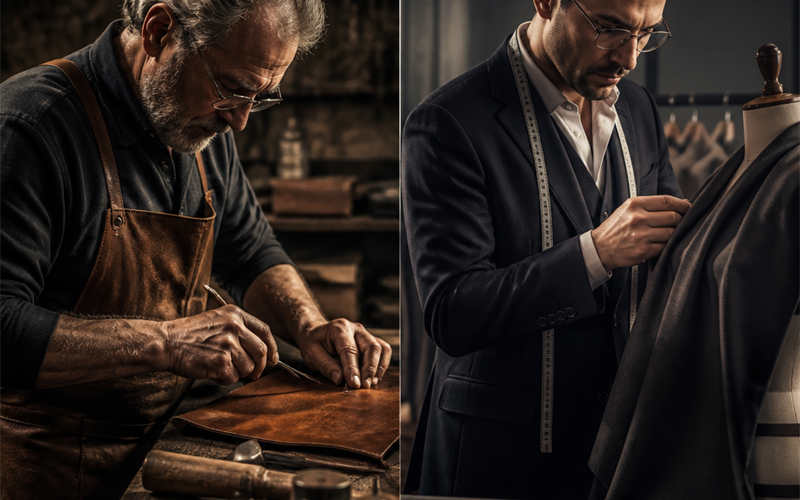
Why "Made in Florence" Means Something Different From "Made in Milan"
TL;DR:
- Florence = Tuscan craft tradition. Slow vegetable tanning, family workshops, heritage aesthetic.
- Milan = Northern Italian fashion industry. Chrome-tanned dress leather, designer collaboration, modern aesthetic.
- Both are "Made in Italy" but they're producing completely different categories of belt.
- The city on the tag is a real signal about what's actually in the belt.
There's a subtle but important quality signal hiding in plain sight on a lot of Italian belts.
It's the city, not the country.
"Made in Italy" tells you the belt was constructed somewhere in Italy. That's a useful start, but it's a wide net. "Made in Florence" tells you something much more specific — and so does "Made in Milan." The two cities sit at opposite ends of the Italian leather story, and the belts they produce are recognizably different.
This post breaks down what each city actually means for belt makers, what to expect from each, and how to use the city-of-origin signal in your shopping. For wider Italian context, our why Italian leather belts cost more post is the foundation read.
Reading the City Tag: What to Do With It
The label signal, converted to buying moves:
| Your situation | Go with |
|---|---|
| Heritage veg-tan, patina taste | Florence-made — Tuscan tanning tradition is the real thing behind the tag. |
| Designer dress aesthetic | Milan-made — chrome-tanned fashion leather, modern finishing. |
| Tag says only "Made in Italy" | Ask which workshop and tannery — vagueness about geography usually means assembly-only. |
| Craft values without the city premium | Judge tanning method and grade directly — the spec sheet outranks the postcard. |
Spec-sheet-first belts: BELTLEY's collections, from $58.
What's the Core Difference Between Florence-Made and Milan-Made Italian Belts?
The core difference is craft tradition versus fashion industry. Florence sits inside Tuscany — Italy's vegetable-tanned leather capital — and produces belts in a tradition that emphasizes leather quality, hand finishing, and slow craft. Milan sits inside Lombardy and operates as Italy's fashion capital, producing belts that emphasize design, brand collaboration, and dress-leather precision.

The shorthand:
- Florence belt = leather + craft.
- Milan belt = design + fashion.
Wikipedia's Florence article covers the city's deep leather heritage going back to medieval guilds. Wikipedia's Milan article covers Milan's role as one of the global fashion capitals alongside Paris, New York, and London.
Why Is Florence So Important for Italian Leather Belts?
Florence has been the heart of Italian leather craftsmanship for over 800 years, with a guild-based system of family workshops that has continuously produced leather goods since the medieval period. The surrounding Tuscan region — particularly Santa Croce sull'Arno — hosts the Tuscan Vegetable-Tanned Leather Consortium, which sets the standards for premium veg-tan production worldwide.
Florence's leather DNA includes:
- Medieval guild tradition. The Arte dei Cuoiai (Leather Guild) dates to the 1100s
- Tuscan vegetable-tanned leather access. Direct supply chain to top tanneries
- Family workshop scale. Small operations passed across generations
- Heritage aesthetic. Belts that look like belts always have
- Tourist craft economy. Visible artisan studios in central Florence
Our 18 Italian tanneries and the real leather belt industry post walks through the major Tuscan producers. The Tuscan Vegetable-Tanned Leather Consortium site covers the regional certification body.
A Florence-made belt isn't automatically vegetable-tanned, but it's much more likely to be — and the workshop is much more likely to follow traditional finishing methods like edge burnishing, filetto creasing, and waxed-linen stitching.
Why Is Milan Different From Florence?
Milan is the center of Italian fashion industry rather than Italian leather craft, which means Milan-made belts come out of a design-led system focused on dress aesthetics, designer collaboration, and runway-relevant production. The leather is often chrome-tanned for color uniformity and seasonal flexibility. The workshops tend to be larger and more design-focused.

Milan's belt-making context:
- Fashion week capital. Hosts Milan Fashion Week twice yearly
- Designer house base. Prada, Armani, Versace, Dolce & Gabbana, and others
- Chrome-tan industry access. Veneto and Lombardy chrome tanneries
- Dress belt specialty. Most Milanese workshops focus on formal dress belts
- Modern production scale. Larger workshops, semi-automated lines
Our Italian designer vs artisan belts post covers the broader designer-vs-craft distinction that often correlates with Milan vs Florence production. Wikipedia's Italian fashion article covers Milan's central role in the global fashion industry.
What Kind of Belts Come Out of Each City?
Florence-made belts tend toward casual, heritage, vegetable-tanned, hand-finished, and brass-buckle aesthetics. Milan-made belts tend toward dress, designer, chrome-tanned, machine-finished, and plaque-buckle aesthetics. The split isn't absolute, but the regional defaults are real and predictable.
Belt-type-to-city pairings:
| Belt Style | Likely City |
|---|---|
| Vintage brass-buckle casual | Florence |
| Tuscan veg-tan pull-up | Florence |
| Hand-burnished casual | Florence |
| Heritage daily-driver | Florence |
| Plaque-buckle formal dress | Milan |
| Designer logo belt | Milan |
| Sleek dress-shoe pairing | Milan |
| Saffiano-finished dress | Milan |
| Fashion-cycle seasonal | Milan |
Of course, exceptions exist — there are Florentine fashion workshops and Milanese heritage artisans. But the geographic pattern holds across the vast majority of Italian belt production.
Do Florence-Made Belts Always Use Tuscan Leather?
Not always — but usually. A Florence-based workshop has natural supply-chain access to Tuscan vegetable-tanned leather, but they can technically source leather from any tannery. Many Florentine workshops do work with non-Tuscan leather for specific belt projects, especially when working with exotic leathers or specialty calf.

The likelihood of Tuscan leather in a Florence-made belt:
| Belt Type | Likelihood of Tuscan Leather |
|---|---|
| Vegetable-tanned heritage belt | ~95% |
| Hand-finished casual belt | ~85% |
| Dress belt | ~40% |
| Exotic leather belt | ~25% |
| Fashion-collaboration belt | ~30% |
For more on what counts as authentic Tuscan vegetable-tanned leather, our Are All Italian Leather Belts Vegetable-Tanned? post covers the detailed identification markers. Wikipedia's Tuscany article covers the broader regional industry context.
How Do You Tell Where Inside Italy a Belt Was Actually Made?
You can sometimes tell where inside Italy a belt was made by looking at workshop stamps, tannery certifications, brand origin documentation, and finishing-style signatures. Belts from artisan workshops typically include a workshop mark or city-specific label. Belts from larger production usually only list "Made in Italy" without further geographic detail.

Specific indicators by city:
Florence-made tells:
- Workshop stamp with "Firenze" or "Florence"
- Pellealvegetale certification logo
- Hand-burnished or hand-painted edge
- Solid brass buckle with no logo
- Earth-tone color palette
Milan-made tells:
- Workshop stamp with "Milano" or "Milan"
- Designer house affiliation
- Machine-applied multi-coat edge paint
- Plaque buckle with brand logo
- Wider seasonal color range
You can find more on the specific hand-craft markers in our posts on Italian hand-skiving, Italian stitching standards, and the filetto detail — all of which are more commonly found on Florentine production.
Are There Other Italian Cities That Matter for Belt Making?
Yes — Bologna, Vicenza, and Naples also have significant Italian leather industries, each with their own specialties. Bologna excels at footwear and small leather goods, Vicenza is a major exotic leather and dress-belt center, and Naples is famous for handmade tailoring accessories including bespoke belts.
Other Italian leather cities to know:
| City | Region | Specialty |
|---|---|---|
| Florence | Tuscany | Vegetable-tan, heritage belts |
| Milan | Lombardy | Designer, dress, fashion belts |
| Bologna | Emilia-Romagna | Footwear, small leather goods |
| Vicenza | Veneto | Exotic leather, dress belts |
| Naples | Campania | Bespoke tailoring accessories |
| Florence (Tuscany region) | Santa Croce sull'Arno | Veg-tan tannery cluster |
| Arzignano | Veneto | Chrome-tan industrial leather |
Wikipedia's Made in Italy article covers the legal and economic context of Italian-origin manufacturing labels. The regional differences are real and worth knowing when shopping.
Should the City of Origin Affect Your Buying Decision?
The city of origin should affect your buying decision if you specifically want a certain style or production tradition. Florence-made suggests heritage craft and vegetable-tanned leather. Milan-made suggests designer aesthetics and dress refinement. Other cities suggest their respective specialties. If the city is listed on the belt, it's a real signal worth considering.

Buying-decision implications:
- You want a heritage casual belt: Look for Florence-made or Tuscan workshops.
- You want a designer formal belt: Look for Milan-made.
- You want exotic leather: Look for Vicenza or specialty workshops.
- You want bespoke tailored accessories: Look for Naples-made or similar Southern Italian.
- You only care about general Italian quality: "Made in Italy" alone is fine.
At BELTLEY, our Italian production sources from Tuscan and surrounding workshops because that aligns with our heritage-craft brand DNA. See our handmade belts collection and brass buckle belts collection for examples of Florence/Tuscan-style production.
The Bottom Line
"Made in Italy" is the start of a quality signal — but the city of origin is where the real story is. Florence and Milan represent two complete different Italian belt-making traditions. One leans into ancient leather craft. The other leans into modern fashion design. Both produce excellent belts. They're just answering different questions.
If your taste runs toward heritage, patina, and hand-finished detail, you want Florence-made or Tuscan workshop production. If your taste runs toward designer, dress, and fashion-cycle relevance, you want Milan-made or similar Northern Italian production. The city tells the story before you even pick up the belt. At BELTLEY we work in the Florence-Tuscan tradition because the craft heritage matches our brand promise — see our full-grain leather belts collection for the result.
Frequently Asked Questions
Q: Is a Florence-made belt always better than a Milan-made belt?
No — they're different, not better. Florence-made belts are usually better for heritage and craft aesthetics. Milan-made belts are usually better for formal dress and fashion contexts. The "better" answer depends entirely on what you're shopping for.
Q: Do most Italian belts say which city they were made in?
No — most "Made in Italy" labels don't specify the city. Workshop-direct or artisan-focused brands often do specify, while mass-produced and luxury house belts usually leave it at "Made in Italy" for brand-flexibility reasons. The specification itself is a quality signal.
Q: Can I trust city-of-origin claims on Italian belts?
Generally yes, when the brand specifies a city it's usually accurate because the legal cost of misrepresenting is significant. The "Made in" labeling is regulated more strictly than marketing language about craftsmanship.
Q: Why is the Tuscan veg-tan tradition so concentrated near Florence?
A combination of medieval guild concentration, access to specific water chemistry, proximity to Mediterranean tannin sources (chestnut, oak), and 800+ years of continuous production tradition. The geographic specificity is real and protected by the Pellealvegetale Consortium.
Q: Are there belt makers outside Florence and Milan worth knowing?
Yes — Vicenza (Veneto), Bologna (Emilia-Romagna), and Naples all have significant leather industries with their own specialties. For most belt buyers, the Florence-Tuscan vs Milan distinction is the most useful, but the broader Italian map is worth exploring for specific belt types.
Q: Does the city affect price more than the country alone?
Slightly. Florence-made artisan belts often carry a small premium over "generic Italy" labeling because of the heritage marketing weight. Milan-made designer belts carry the largest premium because of brand markup. The city is a price modifier on top of the country-of-origin base price.


