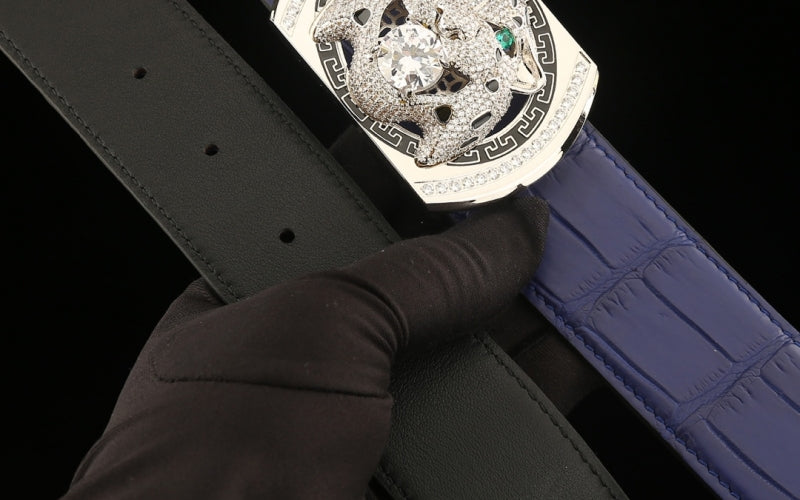
Dyed-Through vs Surface-Dyed Crocodile Leather: The Test
TL;DR:
- Dyed-through (drum-dyed) crocodile means the color soaks the entire hide thickness; a scratch reveals the same color underneath.
- Surface-dyed crocodile is sprayed or painted on top; a scratch shows a pale, raw center — fine for fashion brights, weak for daily wear.
- The fastest test: look at the cut edge of the belt strap. Uniformly dark = dyed-through. Pale core = surface.
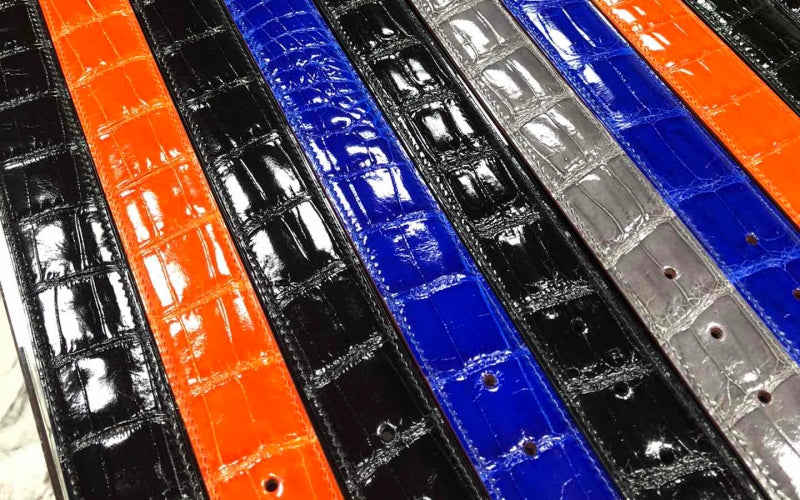
- Some pigments (neon orange, electric blue, true white) must be surface-applied — chemistry won't penetrate. Demand disclosure.
- BELTLEY drum-dyes every classic crocodile belt; surface dyes are reserved for fashion brights and clearly labeled.
There is a quiet test every serious crocodile buyer should run before paying four figures: flip the belt over and study the cut edge of the strap. That thin sliver of leather will tell you, in about three seconds, whether you're holding a hide that was dyed through or a hide that was simply painted. One ages with grace. The other turns into a scratched, two-toned reminder that color is not the same as craft.
This guide explains the difference between dyed through crocodile and surface-dyed crocodile, why it matters for longevity, when surface dye is genuinely unavoidable, and how the premium tanneries we work with actually make the call. If you'd rather see finished examples first, our crocodile belt collection shows what drum-dyed depth looks like under studio light.
Which Dye Job Should You Accept?
Run the buyer's version of the test:
| Your situation | Go with |
|---|---|
| Daily-wear belt in a classic color | Dyed-through only — scratches stay invisible because the color goes all the way down. |
| Fashion bright (neon, true white) | Surface dye is legitimate here — those pigments can't drum-dye; just treat the belt gently. |
| Belt in hand, 30 seconds | Look at the cut edge of the strap: uniform dark core = dyed-through; pale center = surface. |
| Seller won't answer the dye question | That IS the answer. Honest tanneries state it plainly. |
Drum-dyed classics from $118: BELTLEY's crocodile belts.
Quick Facts
| Dyed-through method | Drum-dyeing — hides tumble in dye baths for 8-24 hours |
| Surface-dyed method | Spray gun, roller, or hand-pigment over a finished hide |
| Edge test result (dyed-through) | Cut edge is the same color as the surface |
| Edge test result (surface) | Cut edge shows pale beige/grey core |
| Best for | Dyed-through: classic black, brown, espresso, navy. Surface: fashion brights, neons, true white |
| Lifespan under daily wear | Dyed-through ages cleanly for 10+ years; surface shows wear in 12-24 months |
What does dyed-through crocodile leather actually mean?
Dyed-through crocodile is hide that has been drum-dyed — tumbled inside a rotating wooden drum filled with aniline dye liquor for 8 to 24 hours, until pigment migrates fully through the leather's cross-section. When the finished strap is sliced, the core is the same color as the grain.

This is the slow path. Drum-dyeing requires soft, low-tannin crust leather (so the dye can travel), patient tannery operators, and aniline-class dyes that bond chemically with collagen rather than sitting on top of it. The Leather Working Group audits this process at certified tanneries because it's also the most water- and chemistry-intensive stage of finishing. The reward is a hide that, when scratched by a belt loop or a car seatbelt, simply reveals more of the same color underneath. No betrayal.
What is surface-dyed crocodile, and why is it cheaper?
Surface-dyed crocodile is hide whose color is applied only to the outer grain layer — usually by spray gun, sometimes by hand-padding pigment paste. The dye sits on top of a sealed finish. Underneath, the leather is its raw, undyed crust color: pale beige, grey, or chalky white.
It's cheaper for three reasons. First, it's fast — a spray booth finishes a hide in minutes, not a day. Second, it works on cheaper, harder crust leather that wouldn't accept drum dye evenly. Third, it allows brilliant, opaque colors that aniline dyes physically cannot achieve. The trade-off shows up on month six of daily wear, when the inevitable belt-loop scuff exposes a pale streak that no conditioner will hide. If you've ever wondered why one crocodile belt costs $500 and another $5,000, dye penetration is one of the silent line items.
How do you test a crocodile belt for dye penetration in 30 seconds?
Look at the cut edge of the strap — the thin side profile where the leather has been sliced and either burnished or painted. If the edge color matches the surface color from grain to flesh side, it's dyed through. If you see a pale beige or grey core sandwiched between two thin colored layers, it's surface-dyed.
Three caveats from the workshop bench. (1) Many surface-dyed belts have their edges hand-painted to mimic dyed-through depth — scratch the edge gently with a thumbnail; painted edges flake. (2) Burnished edges on dyed-through hides will still show slight color variation because the flesh side is naturally less saturated — that's normal, not a defect. (3) The keeper loop and the inside of the buckle fold are also honest tell-tales: tanneries rarely bother surface-painting hidden zones, so the truth shows there. For a deeper finish breakdown, see our guide on glazed vs matte vs semi-matte crocodile.
Why does dyed-through crocodile age better than surface-dyed?
Because crocodile leather is structurally designed to be scratched. Daily belt-loop friction, jacket hems, and seatbelt buckles will inevitably abrade the surface. On a dyed-through hide, that abrasion exposes more of the same color, so wear reads as patina. On a surface-dyed hide, the same abrasion exposes the pale crust, and wear reads as damage.

There is also a chemistry argument. Aniline dyes used in drum-dyeing bond covalently with the collagen fibers, which means the color fades slowly and uniformly under UV exposure — much like the way traditional vegetable tanning ages a saddle. Surface pigments, by contrast, are bound mechanically to a finish layer; UV breaks the binder before it touches the pigment, and the whole color film starts to crackle. This is why ten-year-old drum-dyed crocodile from a serious atelier still looks intentional, while ten-year-old surface-dyed crocodile usually doesn't survive that long.
When is surface dye actually the right choice?
Surface dye is the correct, honest choice for any color that aniline chemistry physically cannot produce: true white, neon orange, electric blue, hot pink, lime green, and most pastels. The dye molecules that penetrate hide are inherently transparent and earth-toned; opaque, high-chroma colors require pigment particles that are too large to migrate through the cross-section.
This is why a $4,000 fashion-house crocodile belt in fluorescent yellow is also surface-dyed — there is no other option. The difference between a luxury surface dye and a budget one is the substrate underneath (whether it's Porosus or Niloticus crocodile), the number of pigment coats, and the quality of the topcoat sealant. At BELTLEY, when we offer fashion-bright crocodile belts in our exotic leather edit, we disclose the dye method on the product page. We think buyers paying premium prices deserve to know which trade-off they're choosing.
How do you know if a tannery is being honest about dyeing?
Ask two questions: "Is this drum-dyed or surface-finished?" and "Can you show me a photo of the cut edge?" Reputable tanneries — particularly the French and Singapore houses that supply most luxury maisons — will answer both without hesitation. Vague answers ("our proprietary finishing process") are usually surface dye in a marketing dress.

The trade press tracks this surprisingly closely; Business of Fashion has covered tannery transparency repeatedly as part of the broader exotic-leather sustainability conversation. For comparison shopping, our breakdown of Singapore vs French tanned crocodile explains how each tradition handles dyeing. And if you suspect a "crocodile" belt might not be crocodile at all, our guide to embossed cowhide vs real crocodile covers the other half of the authentication puzzle — because no amount of dye honesty matters if the substrate is printed cow.
Key Takeaways
- The cut edge tells the truth. Three seconds of inspection separates dyed-through from surface dye.
- Dyed-through ages as patina; surface-dyed ages as damage. The difference shows up at the 12-month mark.
- Surface dye is not inherently bad — it's the only way to make true white, neon, or pastel crocodile.
- Demand disclosure. A tannery that won't say which method was used is telling you the answer indirectly.
- BELTLEY standard: drum-dyed for all classic colorways; surface-dyed only for fashion brights, always labeled.
The Bottom Line
The difference between dyed through crocodile and surface-dyed crocodile is not academic — it is the difference between a belt that becomes more beautiful with wear and a belt that quietly self-destructs. Drum-dyeing costs more, takes longer, and rewards the buyer who plans to actually use the thing. At our atelier, every classic-color crocodile belt is built on drum-dyed hide because our 10-year warranty wouldn't survive any other choice; the math simply doesn't work otherwise. Surface dye remains in our toolkit for the brights that chemistry forbids us to drum-dye, and we say so on the page. If you're shopping seriously, browse our crocodile belt collection — and run the edge test on whatever else you're considering before you commit.
Frequently Asked Questions
Q: Can a surface-dyed crocodile belt be repaired once it scratches?
A scratched surface-dyed belt can be touched up by a leather refinisher with matched pigment, but the repair sits on top of the original finish and rarely matches under daylight. Drum-dyed belts usually need only a conditioning rub — the color is already there.

Q: Does dyed-through crocodile cost significantly more than surface-dyed?
Yes, typically 20-40% more at the hide level, which is one reason surface dye dominates the mid-market. The cost reflects longer drum time, higher-grade crust leather, and more expensive aniline dyes — all of which a 10-year-warranty brand has to absorb anyway.
Q: How can I tell if my existing crocodile belt is dyed through?
Find a hidden spot — the underside of the belt tip or the inside of the buckle fold — and look at the cut edge with a flashlight. Uniform color through the cross-section means dyed-through. A pale center stripe means surface-dyed.
Q: Are alligator and crocodile dyed the same way?
Yes. The drum-dye versus surface-dye distinction applies identically to alligator, caiman, and Nile or Porosus crocodile. The hide species affects scale pattern and price, not which dye method is chemically possible.
Q: Why do some luxury brands sell surface-dyed crocodile at premium prices?
Usually because the color requested (white, neon, pastel) cannot be drum-dyed at all. A reputable house will disclose this; a less reputable one will lean on the brand name and hope you don't ask.
%C2%A0crocodile%20means%20the%20color%20soaks%20the%20entire%20hide%20thickness;%20a%20scratch%20reveals%20the%20same%20color%20underneath.%0A%0ASurface-dyed%C2%A0crocodile%20is%20sprayed%20or%20painted%20on%20top;%20a%20scr...)