Why Glossy Crocodile Belts Crack Faster Than Matte?
TL;DR:
- The high-shine "glazed" finish on crocodile belts is the most fragile, not the most durable.
- Glossy belts typically begin micro-crazing at 5-10 years if neglected, 15+ years if cared for properly.
- Matte and semi-matte finishes flex with the leather and age more gracefully.
- Conditioning a glazed belt is risky — wrong product can lift the gloss or cloud the surface.
- Choose finish for use case: glossy for dress occasions, matte for daily wear and longevity.
A buyer walked into our workshop last spring holding a 12-year-old glossy black caiman belt. Tiny silver lines ran across the scales like cracked glaze on old pottery. "Did I do something wrong?" he asked. The honest answer: no — he did everything right. The finish itself is engineered to look incredible the day you buy it, and to slowly betray you afterward. This guide covers glossy crocodile cracking — what causes it, when it starts, and how to manage it. If you want the broader finish overview first, see our glazed vs matte vs semi-matte crocodile belt comparison.
Quick Facts
| Question | Answer |
|---|---|
| Primary cause of cracking | Hard glaze layer flexing less than leather underneath |
| First visible crazing | 5-10 years (poor care), 15+ years (good care) |
| Most vulnerable spots | Buckle holes, scale edges, fold lines |
| Best finish for daily wear | Semi-matte or matte |
| Best finish for dress use | Hand-glazed glossy |
| Conditioning glossy belts | Risky — only specialized exotic creams |
What Causes Glossy Crocodile Cracking?
Glossy crocodile cracking happens because the lacquered or hand-glazed surface forms a hard, low-elasticity skin on top of leather that wants to flex. Every time you bend the belt around your waist or through a buckle, the rigid top layer stresses against the soft hide beneath, eventually splitting into hairline cracks at the points of highest movement.

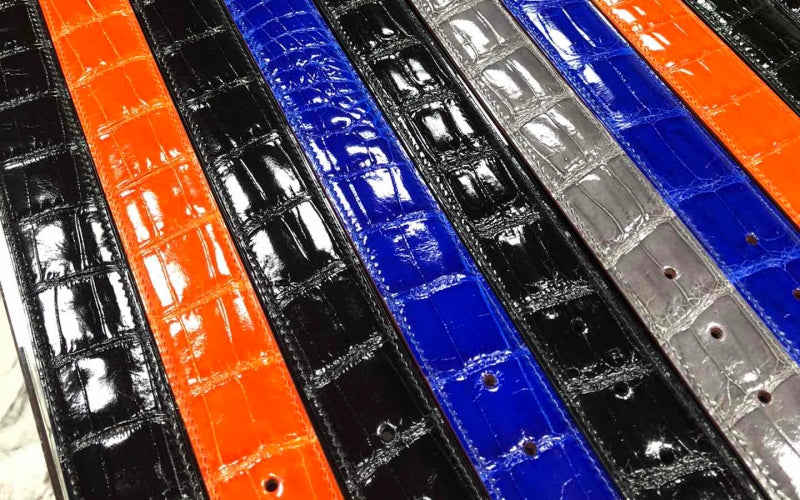
The mechanics are straightforward. Crocodile leather is made of dense collagen fibers — strong, but naturally porous. To create high gloss, tanners either flood the surface with resin and lacquer (factory finish) or burnish it for hours with a polished agate stone (the traditional method covered in our hand-glazed agate stone process guide). Both compress the top fibers into a sealed, mirror-flat skin.
That skin looks spectacular. It also has different mechanical properties from the leather it sits on. According to standards published by the Leather Working Group, surface treatments significantly affect long-term flex performance — a fact every serious tannery accounts for during finish selection.
At What Age Do Glossy Belts Start Crazing?
A well-made glossy crocodile belt typically shows first hairline crazing between 5 and 10 years of regular wear if maintained casually. With disciplined care — proper rotation, climate-controlled storage, and the right conditioner — the same belt can stay crack-free for 15 to 20 years or longer. Cheap factory-lacquered belts can craze within 2 to 3 years.

The variance comes from three factors: the original tanning quality, the climate it lives in, and how often it gets flexed when dry. Dry leather behaves like dry rubber — the tanning process leaves natural oils in the hide, but those evaporate over years. Once the hide loses moisture, the gap in flexibility between glaze and leather widens, and crazing accelerates.
We've inspected vintage Porosus crocodile belts from the 1980s with glaze still intact, and three-year-old fashion-house belts already showing fault lines. Tannery quality matters more than age.
Why Does Matte Crocodile Age Better?
Matte and semi-matte finishes age better because they leave the surface fibers loose enough to flex with the leather underneath. Without a hardened glaze layer, there's no mechanical mismatch, no tension at the surface, and therefore no micro-cracking. The trade-off is appearance — matte reads as understated rather than formal.
A matte finish is essentially the leather showing its true grain with light buffing and minimal sealant. The surface still has natural texture, which scatters light instead of reflecting it. This is the same logic behind brushed vs polished crocodile finishes — less surface tension, longer life.
Industry observers at Business of Fashion have noted a quiet shift among collectors toward matte exotics over the past five years, partly driven by durability awareness, partly by the broader move away from logo-driven shine.
Should You Condition a Glossy Crocodile Belt?
Conditioning a glossy crocodile belt is a gamble. The wrong cream — anything oil-heavy, beeswax-based, or designed for smooth calfskin — can lift the glaze, cloud the surface, or leave permanent streaks. Use only conditioners explicitly formulated for glazed exotic leather, applied with a soft cloth in the thinnest possible layer, no more than twice a year.

This is where buyers get hurt. They've heard "leather needs conditioning," they reach for the same product they use on dress shoes, and within minutes the mirror finish is dulled or smeared. The glaze acts as a barrier — it blocks moisture from leaving the hide, but it also blocks most conditioners from getting in.
Our workshop's approach: rotate belts so any single piece rests at least 24 hours between wears, store in a breathable cotton sleeve away from direct sun, and condition only when the leather visibly tightens. Less is always more. For a deeper look at why this matters at the price tier, see why crocodile belts cost $500 vs $5,000 — care protocol is part of what separates the categories.
The Honest Trade-Off: Dressy vs Long-Lived
Glossy crocodile is dressier, more formal, and more visually striking — it pairs naturally with tuxedos, dark suits, and evening events. Matte crocodile is more versatile, more durable, and ages with character rather than failure. There is no "better" finish, only the right finish for how you'll actually wear the belt.

If you wear an exotic belt twice a month to formal events and store it carefully between, glossy will serve you for decades. If you wear it three times a week with denim, blazers, and travel, matte or semi-matte will keep its dignity longer. The mistake is buying glossy because it looks expensive in the box, then wearing it like a daily driver.
Key Takeaways
- Glossy ≠ tougher. The shine layer is the weak link, not the strong one.
- Crazing is a flex problem. It starts where the belt bends most: buckle holes, fold lines, scale edges.
- Matte ages, glossy fails. One develops patina; the other develops cracks.
- Care can double the lifespan. Proper rotation and storage matter more than expensive conditioner.
- Match finish to use case. Glossy for occasion wear, matte for daily life.
The Bottom Line
The reason most buyers don't hear about glossy crocodile cracking is that the people selling glossy belts have no incentive to mention it. We started BELTLEY in 1999 and went DTC in 2025 specifically because we got tired of watching the Brand Tax buy silence. Every belt we ship is in stock, handcrafted within 2-3 days of order, and backed by our 10-year warranty — so we'd rather tell you the truth about finish trade-offs upfront than refund you in year seven. If you want a daily belt that ages well, browse our exotic leather belt collection or the broader alligator belt range. And if you want to know more about how we think, our About Us page lays it out.
Frequently Asked Questions
Q: Can a cracked glossy crocodile belt be repaired?
Once the glaze layer cracks, it cannot be perfectly restored. A skilled exotic-leather specialist can reglaze sections, but the repair is always visible under close inspection. Prevention through proper care is the only real solution.
Q: Does humidity affect glossy crocodile cracking?
Yes. Very dry environments (under 30% humidity) accelerate crazing because the leather loses moisture and stiffens, widening the flexibility gap with the glaze. Aim for 40-55% relative humidity during storage.
Q: Are factory-lacquered glossy belts the same as hand-glazed?
No. Factory lacquer is sprayed resin that sits on the surface and craze early. Hand-glazing with agate stone compresses the leather's own fibers and lasts dramatically longer, though both will eventually craze with enough flex cycles.
Q: Will a glossy crocodile belt crack if I never wear it?
Less likely, but still possible. Even unworn leather slowly loses moisture over decades, and gravity-induced sag in storage can create faint stress lines. Storage flat or hung loosely with periodic inspection is best.
Q: Is matte crocodile less valuable than glossy?
Not inherently. The market has historically priced glossy higher because of its formal-wear association, but collector demand for matte and semi-matte has risen sharply. Quality of hide and craftsmanship drive value more than finish.