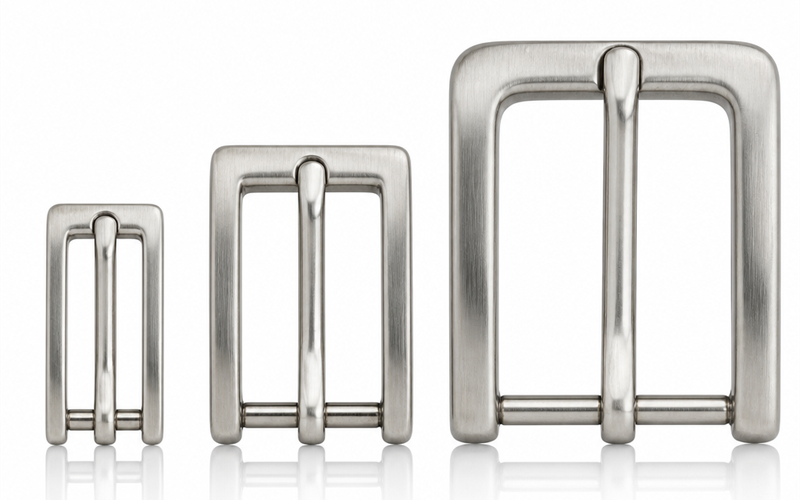
Belt Buckle Size Guide — How Big Is Too Big for You?
Quick answer: The right belt buckle size scales to two things: your body frame and the formality of the outfit. As a rule, a buckle wider than about 3 inches reads as a statement piece, while dress buckles stay under 2 inches. Smaller frames suit slimmer, lower-profile buckles; larger frames can carry more substantial ones. If the buckle draws the eye before your outfit does, it's too big for that setting.
Last updated: June 2026 • By BELTLEY Editorial
TL;DR:
- Buckle size should be proportional to your frame — slim builds suit smaller buckles, larger builds carry bigger ones.
- Formality sets a ceiling: dress buckles stay small and flat; statement/Western buckles run large.
- A buckle over ~3" wide is a deliberate statement, not an everyday default.
- Always match the buckle's bar width to the strap first — then judge overall buckle size.
"How big is too big?" is the question every belt buckle eventually raises. A buckle that flatters one person at one occasion looks comical on another, and the difference comes down to proportion — to your body frame and to the formality of what you're wearing. There's no single correct size, but there are reliable guardrails: dress settings demand restraint, casual settings allow more presence, and statement buckles are a choice you make on purpose. This guide gives you a practical sizing framework so your buckle complements your build and outfit instead of overwhelming them. It works alongside our size guide and the rule that buckle width must match strap width.

Size Your Buckle to You, Not the Rack
The proportions check:
| Your situation | Go with |
|---|---|
| Dress contexts | Under 2" — the buckle defers to the outfit. |
| Smaller frame | Slim low-profile buckles — oversized hardware wears you instead. |
| Larger frame | You carry substantial buckles naturally — 2–3" reads proportionate, not loud. |
| Statement intent | 3"+ is deliberately a statement — commit, and quiet everything else. |
Every scale, strap-matched: BELTLEY's buckle range.
How big should a belt buckle be for your body frame?
Match the buckle to your build. Slimmer or shorter frames look best with smaller, lower-profile buckles that don't dominate the midsection. Larger or taller frames can balance a more substantial buckle. The buckle should feel proportional — present but not the first thing people notice in an everyday setting.

Proportion is the governing idea. A large buckle on a slim frame visually shortens the torso and pulls focus, while a tiny buckle on a broad frame can look lost. The goal is balance, the same principle behind choosing belt width — Art of Manliness's complete guide to men's belts and Real Men Real Style's belt buying guide both stress scaling the buckle to your frame and outfit. For body-proportion styling more broadly, see our guides on how to wear a belt with a belly, whether wide belts make you look thinner, and the best belt for short men.
What buckle size is right for dress vs casual vs statement?
Dress buckles stay small and flat — typically under 2 inches — so they slip under a jacket unnoticed. Casual buckles can be a bit larger and more textured. Statement and Western buckles run 3 inches or wider and are meant to be seen. The setting sets the ceiling: the more formal the occasion, the smaller and simpler the buckle.

Here's a practical sizing framework by context and frame:
| Setting | Buckle width (approx.) | Profile | Best frames |
|---|---|---|---|
| Formal / suit | Under 2" (≤50mm) | Flat, minimal | All; essential for slim |
| Business casual | ~2" (50mm) | Low to medium | All |
| Everyday casual | 2–2.5" (50–65mm) | Medium | Medium to large |
| Western / statement | 3"+ (75mm+) | Bold, raised | Larger; deliberate choice |
For polished, lower-profile options, browse the plaque buckle belts and dress belts. For everyday wear with more presence, the casual belts collection strikes the balance.
When is a belt buckle too big?
A buckle is too big when it overpowers your frame or clashes with the formality of your outfit. Signs include the buckle extending past the natural width of your fly area, drawing the eye before your clothes do, or feeling heavy enough to drag the belt down (a bulky buckle can also pinch your stomach when you sit). In a formal setting, anything beyond a clean, flat buckle is usually too big.

Key stat: Dress belt buckles typically stay under 2 inches (50mm) wide and low-profile, while Western "trophy" buckles can exceed 4 inches (100mm) — a difference that signals two completely different dress codes at a glance.
The honest test is attention: in everyday and formal wear, the buckle should support the outfit, not star in it. Statement buckles break this rule on purpose and that's fine — Western, vintage, and fashion contexts celebrate a bold buckle. But for a default belt you reach for daily, restraint reads as confidence. To understand the buckle-as-accessory mindset, see is a belt buckle considered jewelry.
Does buckle size depend on the strap width?
Yes — the two are linked. The buckle's center bar must match the strap width, so a wider strap naturally pairs with a larger buckle and a slim strap with a smaller one. You can't put a tiny dress buckle on a 38mm work strap, or a massive Western buckle on a 30mm dress strap. Width sets the baseline; then you choose the buckle's overall presence within that.

This is why width and size decisions happen together. A 38mm casual strap already implies a more substantial buckle, while a 32mm dress strap caps how large the buckle can reasonably be. Get the width match right first — using our standard belt width in mm guide — then judge whether the buckle's footprint suits your frame and setting. BELTLEY sorts belts by exact width so the strap-and-buckle pairing is handled, leaving you to choose presence and style.
The Bottom Line
There's no universal "right" belt buckle size — there's the right size for your frame and your outfit. Slim builds and formal settings call for smaller, flatter buckles under 2 inches; larger frames and casual wear can carry more substantial hardware; statement and Western buckles over 3 inches are a deliberate choice, not a default. The simplest test: if the buckle grabs attention before your clothes do in an everyday setting, size down. And always match the buckle bar to your strap width first. BELTLEY offers buckle sizes and profiles for every frame and occasion, all on full-grain leather. Find your proportion in the dress belts and casual belts collections.
Frequently Asked Questions
Q: How wide should a men's belt buckle be?
For dress wear, under 2 inches (about 50mm) and low-profile. For casual wear, up to about 2.5 inches. Statement and Western buckles run 3 inches or more but are a deliberate style choice. Match the buckle bar to your strap width as the starting point.
Q: Are big belt buckles out of style?
Oversized buckles have moved in and out of fashion, but they remain a strong statement in Western, vintage, and bold casual looks. For formal and business settings, a smaller, cleaner buckle is timeless. Choose big buckles intentionally, not as an everyday default.
Q: How do I know if my belt buckle is too big for me?
If it extends past the natural center of your waistband, drags the belt down by its weight, or pulls focus from your outfit in a non-statement setting, it's too big for your frame. Size the buckle so it feels proportional and balanced.
Q: Should a shorter person wear a smaller belt buckle?
Generally yes. Smaller and shorter frames look more balanced with slimmer, lower-profile buckles that don't visually cut the torso or dominate the midsection. Larger buckles tend to overwhelm a smaller frame, especially in formal wear.


