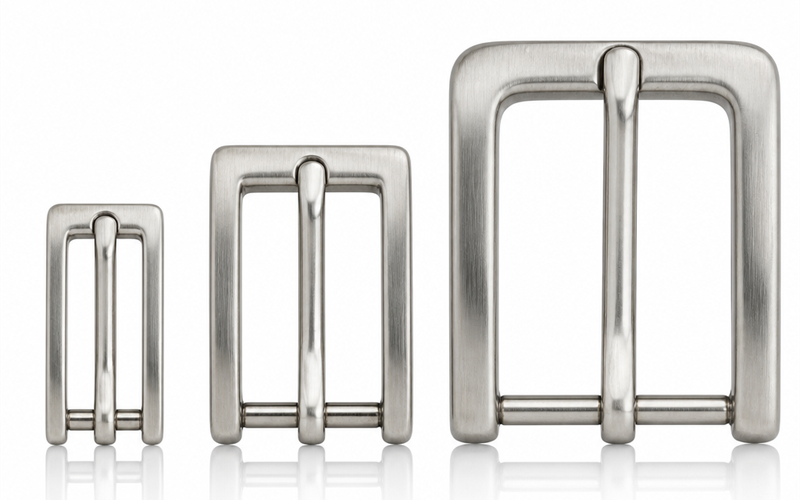
Buckle Width Must Match Strap Width — The Unwritten Rule
Quick answer: A belt buckle must match the strap width because the strap physically threads through the buckle's center bar — if the buckle is too wide, the strap slides and looks sloppy; too narrow, it won't fit at all. The rule of thumb: dress belts run ~30–35mm (1.18"–1.38") with slim buckles, casual belts run ~38mm (1.5") with chunkier buckles. Buckle and strap should always be the same width.
Last updated: June 2026 • By BELTLEY Editorial
TL;DR:
- The buckle's center bar and the strap must be the same width — it's physical, not just stylistic.
- Dress = slimmer (30–35mm); casual = wider (38mm); the buckle scales with the strap.
- A mismatched buckle either won't slide on or leaves the strap shifting loosely.
- When buying a replacement buckle, measure your strap in millimeters first.
There's a reason a dress belt and a work belt look so different, and it isn't only style — it's geometry. A belt strap threads through the buckle's center bar, so the two have to be the same width to fit and sit right. Get it wrong and a too-wide buckle leaves the strap rattling side to side, while a too-narrow one simply won't accept the strap. Menswear has quietly enforced "buckle width matches strap width" for over a century because it's both a fit requirement and a polish signal. This guide gives you the exact measurements, the dress-versus-casual logic, and how to match a replacement buckle perfectly. It builds on our standard belt width in mm guide.

Width-Match Check Before Checkout
The unwritten rule, written as decisions:
| Your situation | Go with |
|---|---|
| Buying belt and buckle together | Non-issue — complete belts are pre-matched; that's the easiest route. |
| Buying a buckle separately | Measure the strap width exactly — 35mm strap takes a 35mm buckle, no rounding. |
| Strap slides side-to-side in the frame | Buckle's too wide — replace one or the other; the slop never settles. |
| Dress vs casual planning | 30–35mm pairs slim buckles; 38mm carries chunkier hardware. Match the system, not just the pieces. |
Pre-matched widths throughout: BELTLEY's men's collection.
Why does buckle width have to match strap width?
Because the strap passes through the buckle's center bar — they're mechanically linked. If the buckle bar is wider than the strap, the leather shifts laterally and looks loose; if it's narrower, the strap won't thread through at all. Matching the widths makes the strap sit snug and centered, which is both the functional and the polished look.

This isn't a fashion opinion — it's how the hardware works. A buckle's frame and bar are sized to a specific strap, and a buckle frame "holds the other parts of the buckle together" around that strap. A few millimeters of mismatch creates visible play. Real Men Real Style's belt buying guide and Art of Manliness's men's belt guide both treat width as the first fit decision. That play is also a leading cause of belts that feel like they slip or come loose, which ties into whether you can put a buckle on any belt.
What's the right buckle width for a dress belt vs a casual belt?
Dress belts run slimmer — about 30–35mm (1.18"–1.38") — with a low-profile buckle that slides under a suit. Casual and work belts run wider — about 38mm (1.5") — with a larger, chunkier buckle. The buckle scales with the strap, so a formal belt gets a refined buckle and a rugged belt gets a substantial one.

The width signals the occasion before anyone reads the buckle. Here's the standard reference:
| Strap width | Common name | Typical use | Buckle style |
|---|---|---|---|
| 25mm (1") | Slim | Women's, very formal | Small, delicate |
| 30mm (1.18") | Skinny dress | Dress, slim trousers | Slim, understated |
| 32mm (1.25") | Dress | Business, suits | Refined |
| 35mm (1.38") | Versatile dress | Dress-to-smart-casual | Medium |
| 38mm (1.5") | Standard casual | Jeans, chinos, work | Larger, sturdier |
| 40mm+ | Heavy/Western | Workwear, Western | Big, statement |
BELTLEY organizes belts by exact width so the match is automatic — see the 1.5" casual belts and slimmer 1.25" dress belts. For the full breakdown, the dress belt vs casual belt guide covers when to wear each, and the belt buckle size guide covers overall buckle proportion.
How do you measure your strap width to match a buckle?
Lay the belt flat and measure the strap's width (not length) in millimeters at the middle, away from the tapered tip. That number is your buckle width. Common widths are 30, 32, 35, and 38mm. When buying a replacement buckle, match that measurement to the buckle's center-bar opening, not the visible frame size.

Key stat: The two most common men's belt widths are 35mm (1.38") for dress and 38mm (1.5") for casual — a difference of just 3mm that nonetheless makes a buckle fit one strap perfectly and refuse the other.
People often measure the wrong thing — the buckle's outer frame instead of the bar opening the strap passes through. It's the bar that must match the strap. If you're swapping a buckle, confirm both the width and the attachment style; our guide on whether you can put a buckle on any belt covers compatibility, and the size guide confirms overall fit.
Does the matching rule apply to women's belts too?
Yes, the same mechanical rule applies — the buckle bar must match the strap width — but women's belts span a wider range, from delicate 15–25mm straps to bold statement widths. The buckle simply scales to whatever strap width you choose. A skinny belt gets a small buckle; a wide waist belt gets a larger one.

Women's styling allows more deliberate width contrast as a fashion choice, but the buckle still has to physically fit its own strap. Statement and waist belts lean wide; layering belts under blazers lean slim. Explore the range in the women's belts collection, and for trend context see what kind of belts are in style for women in 2026.
The Bottom Line
The unwritten rule that buckle width must match strap width is really two rules in one: a mechanical requirement, because the strap threads through the buckle bar, and a style signal, because slim widths read formal and wider widths read casual. Dress belts cluster around 30–35mm with refined buckles; casual belts sit at 38mm with sturdier hardware; women's belts span a wider range but follow the same fit logic. Measure your strap in millimeters before buying any replacement buckle, and match the bar — not the frame. BELTLEY sorts every belt by precise width so the match is built in. Find your width in the belt width collections and pair it with the right buckle from the belt buckles collection.
Frequently Asked Questions
Q: What happens if a buckle is wider than the belt strap?
The strap shifts side to side within the buckle, creating a loose, sloppy look and making the prong misalign with the holes — which feels like the belt is slipping. A buckle narrower than the strap simply won't thread on at all. Match the widths to avoid both.
Q: What's the most versatile belt width?
35mm (1.38") is the most versatile single width — slim enough for most suits and substantial enough for smart-casual wear. If you want one belt to cover the widest range of outfits, 35mm with a clean buckle is the safest pick.
Q: How do I know my belt's strap width?
Measure across the strap (the short dimension) in millimeters, in the middle of the belt away from the tapered tip. That measurement is your strap width and the width any new buckle must match. Most men's belts are 32, 35, or 38mm.
Q: Can I put a casual buckle on a dress belt?
Only if the widths match and the strap fits the buckle bar. Even then, a chunky casual buckle on a slim dress strap looks off-balance. For a polished result, keep both the width and the formality level of the buckle consistent with the strap.