Can You Put a Buckle on Any Belt? (Not Exactly — Here's Why)
TL;DR: Quick Answer and main takeaways
- No — not any buckle fits any belt. Width compatibility and attachment method both have to align.
- Belts designed for interchangeable buckles have a snap, bar-end, or screw system at the strap end. Standard folded-end belts are not built for buckle swapping.
- The buckle frame opening must match the strap width exactly — a 1.5" buckle on a 1.25" strap will shift and look sloppy.
The short answer to "can you put a buckle on any belt" is: it depends. Not on luck or effort, but on two specific things — whether the strap is built for buckle swapping, and whether the buckle's frame opening matches the strap width. Get both right and a buckle swap is straightforward. Get either wrong and you end up with a buckle that won't seat properly, a strap that's been punched with holes it didn't need, or a belt that looks fine until you move.
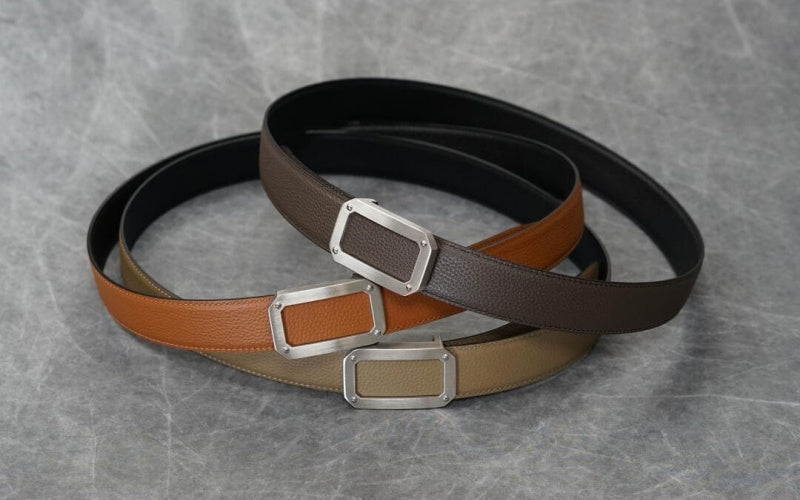
The longer answer is worth knowing if you want to build a small collection of interchangeable buckles around a quality leather strap — a smart approach that BELTLEY customers use to get more mileage out of a single full-grain leather belt by switching from a dress buckle to a casual one depending on the day.

Will Your Buckle Swap Work?
Check your belt's end before you buy that buckle:
| Your situation | Go with |
|---|---|
| Belt has snaps behind the buckle | You're in business — unsnap, swap, done. This is the interchangeable system. |
| Belt end is stitched/folded shut | Not built for swapping. A cobbler can convert it, but it usually costs more than it's worth. |
| Buckle is wider than the strap | Stop — a 1.5" buckle on a 1.25" strap shifts, rattles, and looks borrowed. Widths must match exactly. |
| You want a swap-ready setup from scratch | Buy a snap-end strap and build a small buckle wardrobe — one strap, three personalities. |
Strap-and-buckle combinations across every width: BELTLEY's men's collection.
Can You Put a Buckle on Any Belt?
No — you cannot put just any buckle on any belt. A buckle and strap are compatible only when the strap has a mechanism designed for buckle attachment (snap, bar-end slot, or screw/rivet system), and when the buckle's frame opening matches the strap width precisely. Standard belts with sewn or permanently folded ends aren't designed to have their buckles swapped at all without leatherwork tools.
PinProsPlus confirms this clearly in their breakdown of belt buckle compatibility: the two variables that determine fit are the attachment mechanism and the width match. Both have to work. Width alone doesn't make a buckle compatible if the strap end isn't built for removal.

What Makes a Belt Strap Compatible with a Different Buckle?
Belt strap compatibility comes down to two things: the attachment method at the buckle end of the strap, and the width of the buckle frame.
A strap built for interchangeable buckles will have a clean, bare end — no sewn fold, no permanent hardware — and a mechanism (snap, bar-end slot, or screw hole) that allows the buckle to be attached and removed without stitching or special tools. The buckle's interior opening must also match the strap width exactly.
Most standard dress and casual belts are not designed this way. The buckle is attached during manufacturing — the strap end is folded back, stitched or riveted, and the buckle prong passes through a bar that's part of that fold.
That's a permanently attached setup. You can replace the buckle with leatherwork tools, but you can't just slide a new one on. Belts built for interchangeable systems are specifically designed with a removable end — often finished cleanly so the strap end looks intentional even when the buckle is off.

The Three Attachment Methods — And Which Belts Use Each
Understanding how your belt's buckle end is built tells you immediately whether you can swap the buckle, and how.
Snap-release straps are the most user-friendly interchangeable system. The strap has two snaps at the tip end — you press the buckle frame onto them and they click into place. Removing the buckle takes a fingernail and five seconds. This system is common on ratchet buckle belt systems and brands that explicitly sell separate straps and buckles. The downside is that snaps add a small amount of visible hardware near the buckle, which some people prefer to avoid on formal dress belts.
Bar-end / loop straps are the traditional approach used in higher-end interchangeable systems. The strap end slides through the buckle's bar loop — no snaps, no screws, just leather threading through a frame. This is the system Elliot Rhodes uses in their interchangeable belt lineup. It looks the cleanest because there's no visible fastening hardware, but it requires the strap end to be finished raw (not folded or sewn), and the buckle frame inner dimension must match the strap width to within a millimeter.
Chicago screw (rivet) attachment is the craftsman approach. The strap end is folded back on itself, a buckle bar is slipped inside the fold, and a Chicago screw — a two-part threaded fastener — is driven through both layers to hold everything in place. This is how leatherworkers attach custom buckles to strap blanks, and it's the method Weaver Leather Supply documents in their step-by-step buckle attachment guide. It's not a quick-swap system — you need a screwdriver and a keeper ring — but it's a permanent, clean result that looks just like a factory belt.
Standard permanently-folded straps — the majority of belts you'll find in stores — are not designed for buckle swapping without re-working the strap end. The fold is stitched closed. Removing the buckle requires cutting the stitching, which leaves holes in the leather. Attaching a new buckle requires re-folding and re-stitching or using a Chicago screw through the existing fold. It can be done by a leatherworker, but it's not a DIY-friendly process.

Does Belt Width Have to Match the Buckle?
Yes — the buckle's inner frame opening must match the strap width exactly. A 1.5" buckle frame on a 1.25" strap will have 6mm of play on each side, which causes the buckle to shift laterally and look misaligned. A 1.25" buckle on a 1.5" strap won't slide on at all without forcing it, which puts stress on both the leather and the buckle frame.
Standard belt widths and their buckle equivalents in millimeters:
| Belt Width | Millimeter Equivalent | Common Use |
|---|---|---|
| 1" (25mm) | 25mm buckle | Slim dress belts, women's belts |
| 1.18" (30mm) | 30mm buckle | Dress and smart-casual |
| 1.25" (32mm) | 32mm buckle | Versatile dress/casual |
| 1.38" (35mm) | 35mm buckle | Casual belts |
| 1.5" (38mm) | 38mm buckle | Casual, jeans, western |
BELTLEY's belt buckle collection lists frame dimensions clearly for this reason — matching strap and buckle width is non-negotiable for a clean result. Our buckles use stainless steel frames machined to exact tolerances, which means a 38mm buckle opening actually measures 38mm, not 39mm or 37mm. When the fit is tight, the buckle sits flush and doesn't shift.

Can You Put a Western Buckle on a Dress Belt Strap?
No — a large western plate buckle and a slim dress belt strap are not compatible. Western buckles are designed for straps 1.5" wide or wider and often thicker leather (8–10oz weight) that can handle the weight of a decorative plate without folding. Dress belt straps are typically 1" to 1.25" wide and cut from thinner, suppler leather that's not built to carry the structural load of a plate buckle. The result looks wrong and wears badly.
The reverse — putting a slim dress buckle frame on a western strap — is a width problem. A 1" or 1.25" buckle frame won't accept a 1.5" strap without forcing, which stresses the strap end and often bends the buckle bar. As Buckle My Belt's guide to changing a belt buckle notes, buckle and strap pairings should respect both the width specification and the functional category — dress hardware on dress straps, casual and western hardware on the appropriate heavier straps.
If you want to explore what's possible across buckle styles without buying multiple full belts, our post on types of belt buckles covers every major category — frame, prong, ratchet, plaque, western plate — and clarifies which strap types each one works with. And if you're thinking about whether a dress or casual setup is right for your needs, the dress belt vs. casual belt breakdown is worth a read before you start mixing hardware.

What to Look For If You Want an Interchangeable Belt System
If your goal is one quality strap with multiple buckles, the cleanest approach is to buy a strap that's explicitly designed for interchangeability — bare end, matching-width snap or bar system, and full-grain leather rather than bonded or corrected-grain, which doesn't hold up at the buckle attachment point over time.
At BELTLEY, we've been crafting leather belts since 1999, and the one consistent finding across 25+ years is that the attachment point is where low-quality belts fail first. Full-grain leather folded around a Chicago screw or bar will hold for years. Bonded leather at the same point cracks and delaminated within months because the compressed fibers at the fold can't handle repeated stress. If you're building an interchangeable system, invest in the strap — that's the piece doing the structural work.
Browse the men's belt collection to find full-grain straps in the width you need, or explore the stainless steel buckle belts if you want hardware that won't tarnish, corrode, or scratch easily over time. Every BELTLEY buckle uses stainless steel surgical-grade stainless — the same alloy used in marine hardware and medical instruments, not the plated zinc you'll find on most mass-market belts.

The Bottom Line
You cannot put a buckle on any belt. Whether a buckle and strap are compatible depends on the strap's attachment mechanism (snap, bar-end, screw, or permanently stitched) and whether the buckle frame opening matches the strap width exactly. Most off-the-shelf belts are permanently assembled and require leatherwork to swap buckles. Belts designed for interchangeable buckles have clean strap ends with a removable fastening system.
The practical path forward: if you want buckle flexibility, buy a strap built for it. Match the buckle width to the strap width to the millimeter. And invest in full-grain leather at the strap end — that's the point under the most stress and where inferior leather always fails first.

Frequently Asked Questions
Q: Can you put any belt buckle on any belt?
No. Belt buckle compatibility requires two things: the strap must have an attachment mechanism designed for buckle removal (snap, bar-end slot, or Chicago screw), and the buckle frame opening must match the strap width exactly. Standard dress and casual belts with stitched or folded ends are not built for buckle swapping without leatherwork.
Q: How do you attach a buckle to a belt strap?
The method depends on the strap design. Snap-end straps press directly onto snap hardware on the buckle frame. Bar-end straps thread through the buckle's bar loop. Permanently folded straps use a Chicago screw through the fold with the buckle bar inside — this requires folding the strap, inserting the bar, and driving a two-part threaded screw through both leather layers.
Q: Does belt width have to match buckle width?
Yes — the buckle's inner frame opening must match the strap width exactly. A 1.5" (38mm) buckle requires a 1.5" strap. Any mismatch causes the buckle to shift laterally or prevents the strap from sliding through at all. Standard widths are 1" (25mm), 1.25" (32mm), 1.38" (35mm), and 1.5" (38mm).
Q: Can you put a western buckle on a regular dress belt?
No. Western plate buckles are designed for 1.5" or wider straps cut from thick, heavy leather that can support the weight of a decorative plate. Dress belt straps are narrower (1"–1.25") and thinner — they can't handle the structural load of a western buckle. The width mismatch alone makes the combination incompatible.
Q: What belts are designed for interchangeable buckles?
Belts with interchangeable buckles have a clean, bare strap end with a snap, bar-end loop, or screw-hole system rather than a stitched fold. Brands that build explicit interchangeable systems include Elliot Rhodes and Buckle My Belt. When shopping, look for straps listed as "interchangeable" or "buckle-ready" — these are designed from the start to accept different buckle frames.