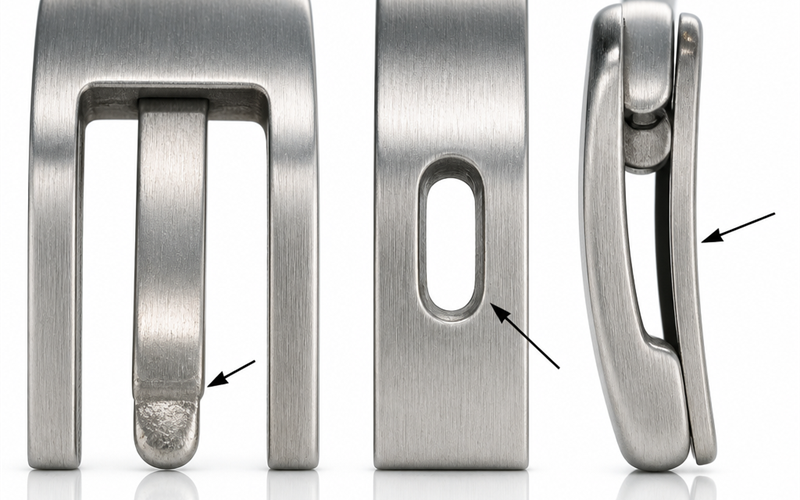
Why Does My Belt Tongue Slip Out of the Buckle?
Quick answer: A belt tongue slips out for three reasons: 1) the prong is worn down and no longer catches the hole securely, 2) the holes have stretched into ovals so the prong rotates free, or 3) the strap is too thin for the buckle's geometry, leaving slack at the prong. The fix depends on which cause — replace the worn prong (or whole buckle), re-punch fresh holes, or upgrade to a thicker strap. None of these require giving up on the belt if it's quality leather.
Last updated: May 2026 • By BELTLEY Editorial
Why trust this guide: BELTLEY's customer service team handles slipping-belt complaints across all leather grades and buckle types, and the root causes are consistent. We design our buckles with prong geometry matched to specific strap thickness and hole spec — which is why slip complaints on our pieces are rare. This guide reflects what actually causes slippage and the fixes that hold.
TL;DR:
- Belt slippage is almost always a worn prong, oval holes, or thickness mismatch.
- A worn prong on a quality buckle can sometimes be re-formed by a jeweler ($15-$30).
- Oval holes need re-punching, not adjustment.
- Cheap buckles often have soft prongs that wear visibly within months — replace the buckle.
At a glance:
- Diagnosis time: 30 seconds
- DIY fix cost: $0-$15 (rotary punch + edge paint)
- Cobbler/jeweler fix: $15-$50
- Success rate: ~85% (correct cause identified)
- Updated — May 2026 · By BELTLEY Editorial
A belt that slips loose during the day is the kind of low-grade wardrobe failure that ruins meetings, walks, and patience. The good news: the problem is mechanical, and one of three specific things is wrong. Once you identify which, the fix takes minutes. Below: how to diagnose your belt in 30 seconds, the three fixes that work, and why the wrong fix (forcing the prong harder) often makes the problem permanently worse.
Why does a belt tongue slip out of the buckle?
A belt tongue slips out when the mechanical connection between prong and hole has degraded — usually in one of three ways: 1) the prong is worn down, shortened or rounded by years of friction, so it no longer reaches deep enough into the hole, 2) the holes are stretched into ovals, giving the prong room to rotate and fall out, or 3) the strap is too thin for the buckle's geometry, so the prong sits in the hole at the wrong angle. All three look similar from outside but require different fixes.

The 30-second diagnosis: unbuckle the belt. Look at the prong straight-on — is the tip rounded, blunted, or visibly shorter than the original sharp point? That's wear. Look at the hole the prong was sitting in — is it round or oval? Oval = stretched. Compare the strap thickness to the depth of the buckle slot — if there's visible space around the prong, the strap is too thin. One or more of these will be true.
How do you fix a worn prong?
If the prong is solid brass or stainless, a jeweler can often re-form it — heating and gently re-pointing the tip with proper tools. Cost: $15-$30, 15 minutes at the bench. If the prong is plated zinc, re-forming usually doesn't hold because the underlying alloy is too soft; replacement of the whole buckle is the better path. On removable-buckle belts (chicago screws or rivets), a quality replacement buckle runs $20-$60. On mono-piece belts (sewn buckles), the whole belt needs replacement.
This is part of why we use stainless and solid brass exclusively for BELTLEY men's belts and women's belts — these alloys retain prong geometry indefinitely under normal wear. Plated zinc prongs visibly wear within months and become slipping-prone within 12-18 months.
How do you fix stretched (oval) holes?
Re-punch a new hole 0.5" away from the stretched one using a rotary leather punch ($8-$15) or a cobbler ($15-$25). The original oval hole stays in place but is no longer the primary use position. The new round hole catches the prong cleanly and stops the slip. Back-burnish the interior of the new hole with edge paint to prevent it from stretching too.

Full walkthrough in our guide on how to add an extra hole to a leather belt. The key is precise placement (use a ruler) and proper finishing — a fresh hole that's not back-burnished will stretch into the same problem within 1-2 years.
Key stat: A correctly re-punched and back-burnished belt hole on full-grain leather typically holds the prong securely for another 8-15 years — often outlasting the surrounding strap.
Belt slippage diagnosis and fix
| Symptom | Likely Cause | Fix | Cost |
|---|---|---|---|
| Prong falls out when you tug the strap | Worn prong tip | Jeweler reshape (quality buckle) or buckle replacement | $15-$60 |
| Prong sits in hole but spins/rotates | Oval/stretched hole | Re-punch new hole + back-burnish | $0-$25 |
| Slip happens only when you sit | Hole rotated by movement; oval stretch | Re-punch + condition leather to restore stiffness | $0-$25 |
| Strap moves freely in buckle slot | Strap too thin for buckle | Upgrade to thicker belt or smaller buckle | New belt |
| Slip immediately after fastening | Prong barely catches | Worn prong or oversized hole — diagnose with 30-second test | $0-$60 |
| Slip on a brand-new belt | Manufacturing defect — buckle/strap mismatch | Return under warranty | Free if covered |
Why does a too-thin strap cause slipping?
A too-thin strap causes slipping because the buckle slot was designed around a specific strap thickness — typically 3.5-4.5mm. When a thinner strap (under 3mm, often bonded leather) sits in that slot, there's slack between the strap and the buckle frame. The prong then enters the hole at a shallower angle and doesn't lock as deeply as designed. Even a perfect prong on a perfect hole will slip if the strap is wrong for the buckle.

This is why mixing-and-matching buckles and straps from different makers often produces slipping problems even when each component looks fine. The geometry is matched at manufacture; breaking the match usually breaks the function.
Should you force the prong harder into the hole?
No — forcing accelerates damage rather than solving it. Pushing a worn prong deeper into an already-stretched hole bends the prong further, expands the hole further, and produces a more permanent failure within weeks. The slip is mechanical evidence that something has changed; the right response is to identify what and fix that.

The instinct to push harder is almost universal and almost always wrong. Five minutes of diagnosis saves the belt.
When is a slipping belt a sign to replace the belt entirely?
Replace the belt when: 1) the buckle is plated zinc and the prong is visibly worn (the soft alloy won't take a repair), 2) multiple holes are stretched (suggesting the leather grade is failing), 3) the strap is delaminating (bonded leather end-of-life), or 4) the belt cost under $30 originally — the math rarely supports repair on a fast-fashion piece. Quality belts (over $80 retail, full-grain leather, solid metal buckle) are almost always worth repairing.
For exotic-leather pieces from our crocodile belt collection, buckle issues should always be handled through authorized brand repair rather than third-party fixes. The exotic strap is too valuable to risk during a DIY buckle swap.
Can prong wear be prevented?
Yes — three habits extend prong life by 5-10x: 1) never force the prong into a tight hole (this is the leading wear cause), 2) condition the leather so holes stay supple and the prong slides cleanly, and 3) use a buckle with solid brass or stainless prong. The third is the largest gain — quality alloy prongs essentially don't wear out under normal use, regardless of how you handle them.

This is part of the BELTLEY 3-Material logic — solid metal hardware doesn't fail, so prong wear simply isn't a concern on our belts. Cheap hardware fails predictably and slipping is the first visible symptom.
Related BELTLEY guides
- Why Did My Belt Buckle Snap? (And What Construction Prevents It) — companion hardware analysis
- The Belt Hole That Stretched: Should You Replace or Repair? — companion hole fix
- How to Add an Extra Hole to a Leather Belt (Without Ruining It) — re-punching walkthrough
- Replacing a Belt Buckle: Which Belts Can and Cannot — when buckle swap works
- Why Are My Belt Holes Wearing Out So Fast? — root-cause hole failure
The Bottom Line
A belt tongue that slips out of the buckle is solving a specific mechanical problem — worn prong, stretched hole, or wrong strap thickness. Diagnose in 30 seconds, fix in 15-30 minutes (or $15-$60 at a cobbler/jeweler), and the belt is back to silent reliability for years. At BELTLEY, solid metal prongs and matched strap thickness mean slipping problems are rare to begin with. Browse the men's belt collection for hardware that holds where it should.
Frequently Asked Questions
Q: How long should a belt prong last?
A solid brass or stainless prong should last 30-50+ years with normal daily wear — essentially the lifespan of the buckle itself. Plated zinc prongs typically show measurable wear in 12-24 months and lose secure-catch function within 18-36 months.
Q: Can I sharpen a worn belt prong myself?
Not safely — DIY filing can weaken the prong and accelerate failure. A jeweler with proper tools can reshape solid brass or stainless prongs cleanly. Plated zinc prongs aren't worth reshaping.
Q: Why does my belt only slip when I sit?
Sitting changes the strap angle inside the buckle, which can free a shallow prong from a stretched hole. The underlying cause is usually oval-stretched holes or worn prong tip — both fixable.
Q: Will conditioning the belt help with slipping?
Indirectly. Conditioning keeps leather supple, which helps the prong seat properly and reduces hole rotation. It won't fix already-stretched holes or already-worn prongs, but it can prevent slipping from getting worse.
Q: Are some buckle styles more prone to slipping than others?
Yes — plate buckles (where the prong is hidden inside) sometimes mask slipping until it becomes severe. Standard frame buckles with visible single-prong design make slipping easier to diagnose early and fix.


%20the%20prong%20is%20worn%20down%20and%20no%20longer%20catches%20the%20hole%20securely,%202)%20the%20holes%20have%20stretched%20into%20ovals%20so%20the%20prong%20rotates%20free,%20or%203)%20...)