Replacing a Belt Buckle: Which Belts Can and Can't
Quick answer: Two-piece belts are designed for buckle swapping — chicago screws or snaps allow the buckle to be removed and replaced in 5 minutes with a flat-head screwdriver. Mono-piece belts have the buckle permanently attached through saddle stitching or rivets and require a leather worker to swap. Ratchet and magnetic belts have integrated buckle mechanisms that aren't designed to be replaced at all. Check the billet — if you see chicago screws, you can swap. If you see only stitching, you can't (at home).
Last updated: May 2026 • By BELTLEY Editorial
TL;DR:
- Two-piece belts: easy DIY swap with chicago screws. 5-minute job.
- Mono-piece belts: requires a leather worker to detach and re-attach. $50–$150.
- Ratchet and magnetic belts: not designed for buckle replacement.
- Look at the billet — chicago screws = swappable; stitching only = permanent.
At a glance:
- Two-piece (chicago screws) — 5-minute DIY · $5–$10 (buckle only) · flat-head screwdriver
- Two-piece (snaps) — 5-minute DIY · $5–$10 · no tools needed
- Mono-piece (stitched) — 30–60 min labor · $50–$150 at leather worker
- Ratchet / magnetic belts — not designed for buckle replacement
- Standard chicago-screw spacing — 5/8" (16mm) or 3/4" (19mm) center-to-center
- Skill level — DIY for two-piece; professional for mono-piece
- Updated — May 2026 · By BELTLEY Editorial
The first question to answer about replacing a belt buckle is whether the belt is designed to be swapped in the first place. Most premium dress belts are mono-piece — the buckle is permanently stitched on and isn't intended to be swapped without significant leather work. Western, ranger, and modular casual belts are two-piece — designed from day one for buckle swapping via chicago screws. Ratchet and magnetic belts use integrated buckle mechanisms that can't be replaced at all. Knowing which type you have determines whether buckle replacement is a 5-minute DIY job or a leather-worker visit. Wikipedia's belt buckle entry covers the broader buckle category; the swappability question is specific to construction method. Our men's belts and dress belts collections include both types.
Can YOUR Belt Take a New Buckle?
Check the billet, find your row:
| Your situation | Go with |
|---|---|
| Chicago screws or snaps behind the buckle | Swap away — five minutes and a flat-head screwdriver. |
| Stitched or riveted (mono-piece) | A leather worker can convert it, but cost usually exceeds sense — keep the buckle it came with. |
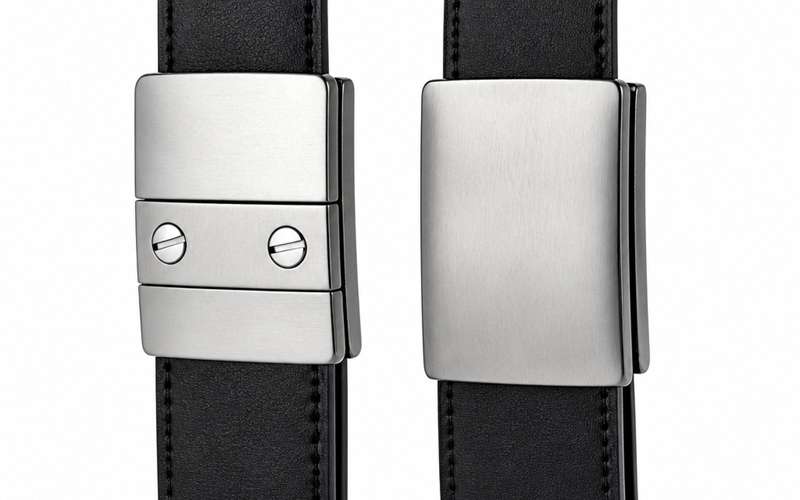
| Ratchet or magnetic mechanism | Not swappable by design — the buckle IS the belt's machinery. |
| Planning a buckle wardrobe from scratch | Buy a two-piece snap-end strap deliberately — one strap, several buckles, endless outfits. |
Straps and buckles across every width: BELTLEY's men's collection.
How do you tell if your belt has a swappable buckle?
Look at the billet — the short section between the buckle and the main strap body. Three visual signals tell you the construction:

- Chicago screws visible (two round-head screw caps on the billet, typically 1–2 inches from the buckle) → two-piece belt, buckle is swappable.
- Snap fasteners visible (round metal snap caps on the billet) → two-piece with snap closure, buckle is swappable.
- Only stitching visible (saddle stitching wrapping around the buckle's heel bar with no fasteners) → mono-piece belt, buckle is permanently attached.
The visual signal is immediate once you know to look. Western and ranger belts often emphasize the chicago screws as a deliberate design feature. Dress belts hide all hardware to maintain clean lines. See our mono-piece vs two-piece construction guide for the underlying construction distinction.
How do you replace a two-piece belt buckle?
The two-piece process is straightforward — 5 minutes with a flat-head screwdriver:

- Unscrew the chicago screws holding the current buckle to the billet. The screws have a slotted post that fits a small flat-head screwdriver (or sometimes a small coin).
- Lift the old buckle off the billet. The leather should be unmarked underneath.
- Place the new buckle in the same position on the billet.
- Insert the chicago screws through the new buckle's attachment holes and back into the leather's pre-punched holes.
- Tighten gently until the screws are snug but not over-torqued (over-tightening can crack the screw caps).
- Inspect for proper seating — the buckle should sit flat against the billet with no gaps.
The new buckle must have matching attachment-hole spacing to the original. Most standard chicago-screw spacing is 5/8" (16mm) or 3/4" (19mm) center-to-center between the two holes. Verify before buying a replacement buckle; mismatched spacing means the new buckle can't be attached without punching new holes (which is possible but adds complexity).
Can you replace a buckle on a mono-piece belt?
Yes, but it's a leather-worker job, not DIY. The process:
- Carefully unstitch the original buckle attachment — typically saddle stitching wrapping around the buckle's heel bar.
- Remove the old buckle without damaging the leather.
- Trim or reshape the billet if needed for the new buckle's dimensions.
- Wrap the leather around the new buckle's heel bar and stitch with saddle stitching matching the original technique.
- Reinforce as needed (sometimes with an additional rivet for stress relief).
A skilled leather worker can do this in 30–60 minutes for $50–$150 depending on the belt's complexity and the buckle dimensions. The result is usually nearly invisible — the new stitching matches the original within practical tolerances.
Key stat: Mono-piece belt buckle replacement runs $50–$150 at most leather workers, taking 30–60 minutes of skilled work. The same swap on a two-piece belt takes 5 minutes of DIY and costs only the price of the replacement buckle. The 10–30x labor difference is why two-piece construction is the right choice for wearers who anticipate buckle variety.
Buckle replacement — by belt type
| Belt construction | Replacement difficulty | DIY possible | Cost |
|---|---|---|---|
| Two-piece (chicago screws) | Easy | Yes | $5–$10 (replacement buckle only) |
| Two-piece (snaps) | Easy | Yes | $5–$10 |
| Two-piece (rivets) | Moderate | Partial — need rivet tool | $10–$25 |
| Mono-piece (saddle-stitched) | Hard | No (leather worker) | $50–$150 |
| Plate buckle (hook-attached) | Easy if compatible | Yes (slide swap) | $5–$10 |
| Ratchet belt | Not designed for swap | No | n/a (not replaceable) |
| Magnetic belt | Not designed for swap | No | n/a |
For more on belt anatomy and where the buckle integrates with the belt's structure, see our belt anatomy guide.
What about buckle replacement on ratchet and magnetic belts?
Ratchet belts use a buckle with an internal track mechanism that engages teeth on the underside of the belt strap. The buckle and strap are designed as a matched system — you generally can't replace the buckle with a non-matching one because the track mechanism is specific to the strap. Some ratchet brands sell replacement buckles that work with the same maker's straps; cross-brand swapping rarely works.

Magnetic belts use a magnetic closure mechanism integrated into the buckle and a metal plate within the strap. Same issue — the components are matched. Replacement is essentially limited to factory replacement parts from the original maker. See our magnetic belt buckles guide for more on this category.
Where do you buy replacement buckles?
Several sources for replacement buckles:

- The original belt maker — best for color and style matching. Most quality makers sell replacement buckles for their belts.
- Leather supply shops — Tandy Leather, Weaver Leather, and similar suppliers carry generic replacement buckles in standard sizes.
- Buckle specialty makers — Sterling Silver Buckle Company, custom engravers, Western buckle artisans for higher-end replacements.
- Online marketplaces — eBay, Etsy for vintage and unique buckle styles.
- Brand-specific retailers — for ratchet and magnetic belt brands.
Match the chicago-screw hole spacing (5/8" or 3/4" most common) and the belt width (1.5", 1.25", 1") of your original. A buckle sized for a different belt width will look visibly wrong and may not function properly.
Should you upgrade your buckle to a heavier metal?
A common DIY upgrade: replacing a plated buckle on a quality strap with a solid brass or stainless buckle. This is a meaningful long-term improvement because solid metal buckles last decades while plated buckles eventually wear through to the base metal. The cost is $30–$80 for a quality replacement buckle versus $5–$10 for a budget plated equivalent — but the upgrade is permanent.

For two-piece belts, the upgrade is genuinely DIY: unscrew the old buckle, install the new one, done. For mono-piece belts, the upgrade requires a leather worker (since the buckle is permanently attached), which adds $50–$150 to the cost. See our brass vs stainless vs nickel buckle wear test for the underlying material context.
The Bottom Line
Replacing a belt buckle is easy on two-piece belts (5 minutes, $5–$10 plus replacement buckle cost), a professional job on mono-piece belts ($50–$150 with a leather worker), and not really possible on ratchet or magnetic belts (replacement is limited to same-brand factory parts). The defining factor is construction: chicago screws or snaps mean DIY-swappable; permanent stitching means professional intervention. The visual signal is at the billet — if you see fasteners, you can swap; if you see only stitching, you can't (at home). At BELTLEY, our two-piece belts ship with chicago-screw construction precisely to enable buckle variety; our mono-piece dress belts are designed for permanent buckle-strap integration. Match the construction to your anticipated wear: if you'll want buckle variety, choose two-piece from the start. Browse our men's belts, full-grain leather belts, and dress belts collections.
Related BELTLEY guides
- Mono-piece vs Two-piece Leather Belt Construction — the underlying construction distinction
- Brass vs Stainless Steel vs Nickel Buckles: Wear Test — choosing the replacement metal
- Plate Buckles vs Frame Buckles: Form Factor — buckle style options
- Magnetic Belt Buckles: Gimmick or Future? — why some buckles can't be swapped
- The Billet, the Strap, and the Tongue: Belt Anatomy — parts you're working with
Frequently Asked Questions
Q: Can I convert a mono-piece belt to two-piece?
Generally no — the conversion requires cutting the billet, removing the buckle, adding chicago-screw hardware, and reinforcing the leather. The result is structurally compromised and visually obvious. If you want a two-piece belt, buy one designed as two-piece from the start.
Q: Will a wider buckle fit my belt strap?
No — the buckle and strap widths must match. A buckle wider than the strap leaves the strap looking undersized; a buckle narrower than the strap means the strap won't fit through. Always match the buckle's interior opening to the belt strap's exact width (1.5", 1.25", 1", etc.).
Q: Are universal "fits all belts" buckles real?
Some buckles are sized to fit a standard range (typically 1.25–1.5" widths). These work for many belts but should be verified against your specific belt's width before purchasing. "Universal" usually means "fits most standard widths," not "literally any belt."
Q: How do I keep chicago screws from loosening?
Apply a small drop of thread-locker (Loctite Blue, the low-strength formula) to the screw threads before tightening. The thread-locker prevents vibration loosening without preventing future disassembly. Quality two-piece belt manufacturers often apply this at the factory. See Wikipedia's belt buckle entry for the broader buckle context.
Q: Can I keep the original buckle and add a second buckle as backup?
Not on the same belt — only one buckle attaches at a time. For variety, owning multiple buckles that you swap onto the same strap is the right approach for two-piece belts. The strap stays the same; the buckle varies based on outfit or occasion.
Q: Does buckle replacement void the belt's warranty?
Generally no for the belt's leather and original construction — the warranty covers manufacturing defects, not modifications. The new buckle has its own warranty from its maker. If you damage the belt during DIY buckle replacement, that's outside warranty coverage. BELTLEY's 10-year warranty covers original materials and construction.