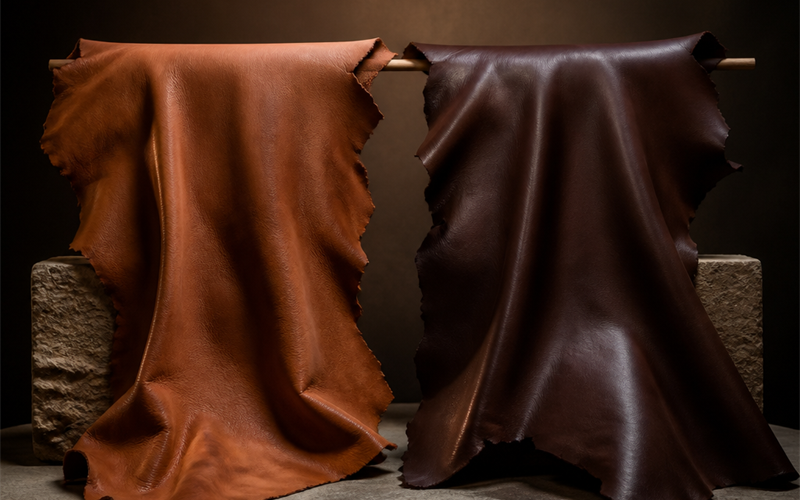
Ponte a Egola vs Santa Croce: Two Tuscan Towns, Two Tanning Philosophies
TL;DR:
- Santa Croce sull'Arno specializes in chrome and combination tannage — modern, faster, softer leathers.
- Ponte a Egola specializes in traditional vegetable tannage — slow, structured, dramatic-patina leathers.
- The two towns sit on opposite banks of the Arno River, about 5 km apart.
- Together they handle most of Italy's premium leather production — different methods, different products, complementary roles.
- For belt buyers: Santa Croce leather tends toward fashion and soft luxury; Ponte a Egola leather tends toward heritage dress belts.
If you cross the Arno River from Santa Croce sull'Arno and drive 5 kilometers north, you arrive in Ponte a Egola. Same valley. Same river. Same leather tradition. But the two towns have spent the last century quietly developing opposite tanning philosophies — and the leather they make ends up in very different products. Santa Croce makes the soft luxury handbag side of Italian leather; Ponte a Egola makes the heritage dress belt side.
This guide explains the differences between the two towns: their tanning methods, their typical output, and how to recognize which town's tradition your belt comes from. If you're trying to understand why some "Italian leather" feels buttery soft while other "Italian leather" feels firm and structured, the answer often comes down to which bank of the Arno the leather started on.
Which Bank of the Arno Suits Your Belt?
The two-town lesson as a buying decision:
| Your situation | Go with |
|---|---|
| Patina-first, structured leather | Ponte a Egola tradition — slow vegetable tannage that ages dramatically. |
| Soft, modern, consistent color | Santa Croce tradition — chrome and combination tannage, supple from day one. |
| Dress belt purchase | Either, well-finished — the tannage matters less than the grade and construction at the formal end. |
| Just want the Tuscan virtues, fair price | Veg-tanned full-grain at DTC pricing — from $58, the method without the geography markup. |
Veg-tan done properly: BELTLEY's full-grain collection.
Where are Ponte a Egola and Santa Croce, and how are they related?
Both Ponte a Egola and Santa Croce sull'Arno sit in the Tuscan leather district along the Arno River, about 40 km west of Florence. Santa Croce is the larger town (about 14,000 residents); Ponte a Egola is smaller. They're physically close — about a 10-minute drive apart — but operationally distinct. Together they form the two anchor points of Italy's leather industry.
The geography:
- Santa Croce sull'Arno: South bank of the Arno, larger, about 14,000 residents
- Ponte a Egola: Slightly north of the Arno, smaller, part of San Miniato commune
- Distance between them: ~5 km
- Connecting infrastructure: Bridges (literally — "Ponte a Egola" means "Bridge to Egola")
- Shared services: Aquarno wastewater treatment, regional logistics, labor pool
Wikipedia's entry on Santa Croce sull'Arno and the entry on San Miniato (the commune containing Ponte a Egola) both note the same leather tradition. We covered Santa Croce specifically in our Santa Croce sull'Arno post.
Why did the two towns develop different tannage methods?
The split happened mostly in the post-WWII industrial expansion. Santa Croce's tanneries leaned into chrome tannage because Italian fashion houses needed soft, supple, fast-produced leather for handbags and fashion accessories. Ponte a Egola kept the traditional vegetable methods because it served the heritage end of the market — saddlery, bridle leather, structured dress goods. Neither town consciously chose to specialize — markets pulled them in opposite directions.

The historical evolution:
- Pre-1900: Both towns used traditional vegetable tannage exclusively
- Early 1900s: Chrome tannage invented; some Italian tanneries adopt it
- Post-WWII: Italian fashion industry explodes; chrome tannage scales up
- 1950s–1970s: Santa Croce specializes in chrome/combination for fashion
- Same period: Ponte a Egola consolidates around traditional vegetable tannage
- 1990s–today: Both towns operate alongside each other, supplying different markets
The market specialization stuck. Today, most consortium members (the strict vegetable-only certified tanneries) are concentrated in or near Ponte a Egola, while the bigger chrome-and-combination operations cluster in Santa Croce.
How does chrome tannage actually differ from vegetable tannage?
Chrome tannage uses chromium salts to convert raw hide into leather in 24–48 hours. Vegetable tannage uses plant-derived tannins (oak, chestnut, mimosa) over 4–8 weeks. The results are very different: chrome produces softer, more supple, less structured leather; vegetable produces firmer, more structured, more patina-prone leather. Same starting hide, completely different finished material.

The technical comparison:
| Property | Chrome Tannage | Vegetable Tannage |
|---|---|---|
| Time | 24–48 hours | 4–8 weeks |
| Tanning agent | Chromium salts | Plant tannins (oak, chestnut, mimosa) |
| Feel | Soft, supple, buttery | Firm, structured |
| Patina | Limited | Dramatic |
| Best for | Handbags, soft belts, fashion | Dress belts, bridle, saddlery |
| Environmental complexity | Higher (chromium handling) | Lower (plant tannins) |
| Cost per sq ft | Lower | Higher |
We covered the full tannage tradeoff in our vegetable vs chrome-tanned calfskin post. Neither is universally better — they produce different products for different uses.
What kinds of belts come from each town's leather?
Belts using Santa Croce leather tend to be softer, more pliable, and more fashion-oriented — think of a buttery designer belt that wraps comfortably around your waist with minimal break-in. Belts using Ponte a Egola leather tend to be firmer, more structured, and more patina-prone — think of a serious dress belt that holds its shape for 20 years and gets richer-looking every year.

What typically comes from Santa Croce:
- Soft luxury fashion belts (designer brands)
- Combination-tanned dress belts (slightly softer dress feel)
- Aniline-finished casual belts
- Patent leather formal belts
- Suede and nubuck belts
What typically comes from Ponte a Egola:
- Heritage dress belts in vegetable-tanned cowhide
- Bridle leather belts with dramatic patina
- Traditional vachetta belts
- Saddlery-influenced structured belts
- Consortium-certified vegetable-tanned belts
Both can be premium. Both can be luxury. The difference is character: Santa Croce leather prioritizes immediate softness and fashion appeal; Ponte a Egola leather prioritizes structure and long-term aging.
Which town's leather is in luxury belts you've heard of?
Most major luxury fashion houses (LVMH brands, Kering brands, designer fashion) source heavily from Santa Croce tanneries because their leather goods lean toward fashion accessories that benefit from chrome and combination tannage. Heritage menswear brands, traditional bridle goods, and serious dress-belt makers tend to source more from Ponte a Egola tanneries for the structure and patina that vegetable tannage provides.

By brand category:
- High-end fashion: Mostly Santa Croce supply
- Heritage menswear (e.g., bridle belts): Mostly Ponte a Egola supply
- Premium DTC dress belts: Mix of both, depending on belt finish
- Italian heritage shoemakers: Both, depending on shoe construction
The brands rarely credit either town by name, of course. We covered the supplier-anonymity pattern in our Hermès vs designer calfskin post. The DTC movement is starting to change this, but the default in mainstream luxury is still opacity about which town (and which tannery) the leather came from.
How do environmental practices differ between the two towns?
Both towns have invested heavily in environmental modernization over the last 30 years. The Aquarno shared wastewater treatment facility serves tanneries in both Santa Croce and Ponte a Egola, handling effluent from hundreds of tanneries. Chrome recovery systems are standard in Santa Croce operations (because chrome tannage needs them); water-quality monitoring is continuous along both stretches of the Arno.

Modern environmental controls in both towns:
- Shared wastewater treatment (Aquarno) processes most district effluent
- Chrome-recovery systems at chrome tanneries
- LWG audits for environmental performance
- Closed-loop water systems for most modern tanneries
- Continuous river monitoring by regional environmental agencies
The Leather Working Group audits tanneries in both towns. Both have made dramatic improvements from the mid-20th-century environmental conditions. Vegetable tannage in Ponte a Egola has slightly lower environmental complexity (no chromium handling), but both towns now operate under similar regulatory frameworks.
The Bottom Line
Santa Croce sull'Arno and Ponte a Egola are two neighboring Tuscan leather towns with opposite tanning philosophies — and the difference shows up in the belts you buy. Santa Croce leather goes into soft luxury fashion belts; Ponte a Egola leather goes into structured heritage dress belts. Both are genuinely Italian, genuinely Tuscan, and genuinely premium. They just serve different purposes.
At BELTLEY, we source from both traditions depending on the specific belt we're producing. For polished dress belts that need structure and patina potential, we lean toward Ponte a Egola tradition. For softer fashion belts and combination-tanned products, we lean toward Santa Croce tradition. The 10-year warranty stands behind either — the choice is about which leather fits the belt's intended job, not about which town is "better."
Browse our Italian-leather belts in our calfskin collection.
Frequently Asked Questions
Q: Which town is bigger, Santa Croce or Ponte a Egola?
Santa Croce sull'Arno is much bigger — about 14,000 residents and 200+ tanneries. Ponte a Egola is smaller and part of the larger San Miniato commune. But Ponte a Egola punches above its weight in vegetable tannage specifically.
Q: Can the same tannery operate in both towns?
Some larger tannery groups have facilities in both towns or in nearby satellite locations. Most family-owned consortium tanneries operate from a single location, often passed down across generations.
Q: Does the Arno River still play a role in tanning today?
Symbolically yes, practically no. Modern tanneries use treated municipal water and discharge through Aquarno's shared treatment facility. The river is part of the district's identity but no longer the working water source.
Q: Is Ponte a Egola leather always vegetable-tanned?
Mostly, yes. Ponte a Egola is the heart of the consortium tannery cluster, and consortium members must use 100% vegetable tannage. A few non-consortium tanneries in or near Ponte a Egola may use combination tannage.
Q: Why doesn't Santa Croce just adopt vegetable tannage too?
Market specialization. Santa Croce serves a market (fashion handbags, soft luxury) that prefers chrome and combination tannage. Switching would mean abandoning a successful business position. Both towns are doing what their customers want.