The Billet, the Strap, and the Tongue: Belt Anatomy You Never Knew
Quick answer: A belt has roughly 10 named parts, most of which buyers never learn. The billet is the short, often shaped end of the belt where the buckle attaches (saddlery term, also used for finer leather goods). The strap is the long primary leather body that holds the holes and passes through the buckle. The tongue (or prong) is the metal pin that passes through the holes to lock the belt. The chape is the metal mount that connects the buckle to the strap. Plus keepers, billet snaps, tip, edge, lining, and stitching. Naming the parts changes how you evaluate construction quality.
Last updated: May 2026 • By BELTLEY Editorial
TL;DR:
- Billet = the short end attached to the buckle (often shaped or skived).
- Strap = the long primary body of the belt with adjustment holes.
- Tongue (or prong) = the metal pin on the buckle that goes through the holes.
- Chape = the metal mount or pivot connecting the buckle to the strap.
- Keeper loops, tip, edge, lining, stitching, and end finish round out the anatomy.
A belt is a deceptively simple object — most people think of it as "a strap with a buckle." In reality, it has roughly 10 named parts, each of which can be made well or made poorly, and each of which affects how the belt performs over years of wear. Knowing the vocabulary changes how you read a belt at the point of purchase. Saddlery and leatherwork have used this anatomy language for centuries; modern belt-making inherits the terms even when contemporary belts simplify the construction. Wikipedia's belt buckle reference covers the buckle terminology; Wikipedia's belt reference covers the broader category. Our dress belts and full-grain leather belts collections are built with every named part executed properly.
What are the main parts of a belt called?
A complete leather belt has the following named parts:

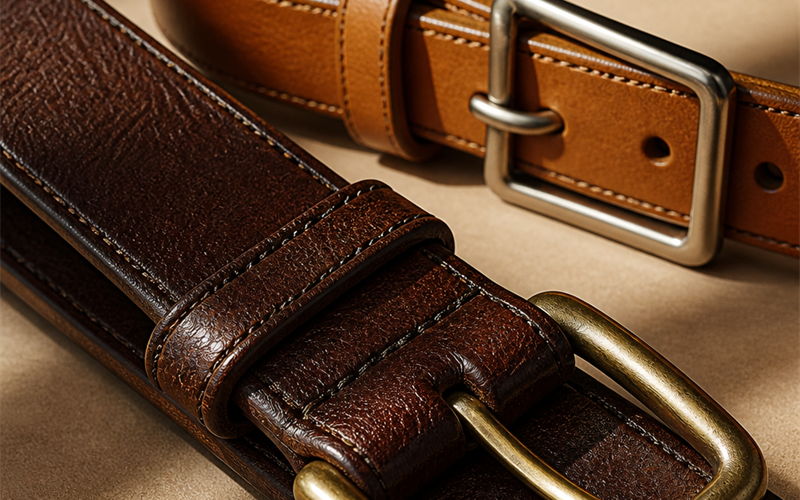
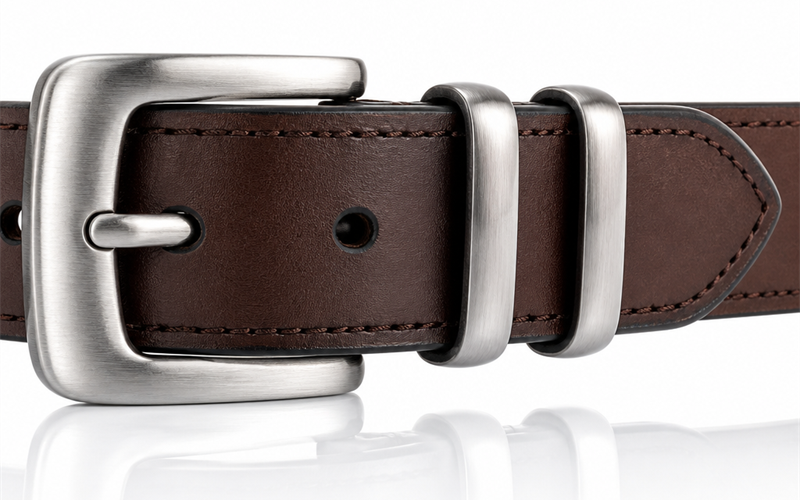
- Billet — the short end of the belt where the buckle attaches. In English saddlery, "billet" specifically refers to the leather strap that the buckle is sewn or fastened to. On modern belts, it's the section between the buckle and the start of the main strap.
- Strap — the long primary body of the belt, holding the adjustment holes and passing through the trouser belt loops. The bulk of the belt material.
- Tongue (or prong) — the metal pin on a frame-style buckle that passes through holes punched in the strap to lock the belt.
- Buckle frame — the outer shape of the buckle (rectangular, round, oval, plate) that the strap passes through.
- Chape — the metal mount or pivot that connects the buckle to the belt strap. On many modern belts, this is integrated into the buckle frame.
- Keepers — the small leather loops near the buckle that hold the belt tail flat. Usually one fixed, one floating (see our keeper loop guide).
- Tip — the finished end of the belt strap (the end opposite the buckle). Can be pointed, rounded, blunt, or square.
- Edge — the cut-and-finished long sides of the belt. Either burnished, painted, or raw-cut.
- Lining — the second layer of material on the back of the belt (see our lining guide).
- Stitching — visible or hidden thread securing layers and reinforcing structural points (see our stitching guide).
Some belts add additional parts: billet snaps (chicago screws or rivets that let the buckle be removed and swapped), heel bar (a fixed crossbar at the buckle frame's back), and decorative elements like conchos or studs.
What is the billet, specifically?
The billet, in modern belt-making, is the short section between the buckle and the main strap body — typically 1.5"–3" long, often slightly shaped or skived (tapered) at the buckle attachment point. The billet has to handle concentrated stress (the prong's load, the buckle's pull, the trouser belt loops occasionally catching at this point), so it's often reinforced with extra stitching or an additional layer of leather.

The billet is also the section that's most often used for branding on quality belts (maker's mark, model number, sometimes the leather grade), because it's a small visible-but-not-prominent area where the brand can sign the work. Anonymous billets (no maker's mark, no leather signature) often indicate budget construction; signed billets indicate quality makers proud of the work.
Historically, "billet" was used in English saddlery for the short straps that hold a horse's saddle in place via the girth. The terminology migrated to belt-making over the centuries through cross-pollination between saddlers and belt-makers — the construction techniques are largely the same.
Key stat: The billet's reinforcement zone (the area where the buckle attaches) handles roughly 80–90% of all stress the belt experiences during normal wear — the prong pulls back against the buckle frame, the buckle frame pulls against the strap, and the strap pulls against the billet. A failed billet is the most common belt failure point on poorly constructed belts.
What's the difference between tongue, prong, and pin?
These are three names for the same part on a frame-style buckle: the metal pin that extends from one side of the buckle frame and passes through holes in the belt strap to lock the belt closed. "Tongue" is the most traditional English saddlery term. "Prong" is the more common American term. "Pin" is a generic descriptor.
The naming is regional and contextual. English heritage saddlery uses "tongue." American Western and dress belt-making uses "prong." Some makers use both interchangeably. The functional definition is identical regardless of which name you encounter. We covered the alternative buckle mechanisms in our plate vs. frame buckle guide.
Belt anatomy — quick reference
| Part | Function | Quality signal |
|---|---|---|
| Billet | Connects buckle to strap | Reinforced stitching, maker's mark |
| Strap | Main body, holes | Uniform thickness, clean hole punching |
| Tongue / Prong | Locking pin | Solid metal, matched to buckle frame |
| Buckle frame | Outer mount | Solid brass, stainless, no plating |
| Chape | Buckle-to-strap pivot | Often integrated; should be sturdy |
| Keepers | Hold tail flat | Two (fixed + floating), matched leather |
| Tip | Finished strap end | Cleanly cut, edge-finished, often slightly tapered |
| Edge | Long sides | Burnished or painted; not raw-cut |
| Lining | Back layer | Pigskin, calfskin, or self-lined; not synthetic |
| Stitching | Structural seams | Saddle stitched or quality machine stitched |
Why does knowing belt anatomy matter for buying?
Knowing the anatomy lets you ask the right questions when buying — and lets you evaluate construction quality even when you can't see all the details. Instead of asking "is this a good belt?" (an unanswerable generic question), you can ask:

- "How is the billet attached and reinforced?"
- "What's the lining material?"
- "Are the edges burnished or painted?"
- "Is the stitching saddle-stitched or lockstitched?"
- "Is the buckle solid metal or plated?"
- "What's the tip finish?"
Quality makers can answer all of these specifically. Budget makers often deflect to generic terms ("premium leather," "metal buckle") because they're hiding the answer. We covered the broader quiet luxury construction signals framework — anatomy literacy is the practical application.
Do women's belts use the same anatomy?
Yes — the anatomy is consistent across men's and women's belts, just at different proportions. A women's 1" wide belt has the same named parts (billet, strap, tongue, chape, keepers, tip, edge, lining, stitching) as a men's 1.25" wide belt. Quality variation matters as much for women's belts as for men's. See our women's belts collection.

The one area where women's belts sometimes simplify is the keeper count (some narrow dress belts skip keepers entirely) and the billet length (often shorter on narrower belts). These are aesthetic choices, not quality compromises.
What about specialty belt anatomies?
Specialty belts add or modify named parts:

- Ratchet belts add an internal track mechanism inside the buckle, replacing the prong/tongue function with a spring-loaded pawl.
- Magnetic belts add a metal reinforced strap section and remove the holes and prong (the lock is magnetic).
- Plate buckle belts add hook-and-clasp attachment points instead of a tongue, and the chape often becomes a fixed mount.
- Two-piece belts add an interchangeable buckle attachment (typically chicago screws), allowing the buckle to be swapped without replacing the strap.
Each specialty adds vocabulary but the core anatomy (billet, strap, tip, edges, lining, stitching) remains. For more on the two-piece variation, see our mono-piece vs two-piece belt construction guide.
The Bottom Line
A belt has roughly 10 named parts, each of which can be made well or poorly, and each of which contributes to how the belt performs over its service life. The billet handles the highest stress; the strap is the main visible body; the tongue/prong is the locking element; the chape connects buckle to strap; keepers, tip, edge, lining, and stitching complete the structure. Knowing the vocabulary lets you ask specific construction questions when buying and evaluate quality independently of marketing claims. Quality makers can answer questions about each named part; budget makers can't. At BELTLEY, every named part is executed deliberately — reinforced billets, hand-finished edges, premium linings, saddle-stitched seams. Browse our dress belts, full-grain leather belts, and men's belts collections.
Frequently Asked Questions
Q: What's the difference between billet and strap on a one-piece belt?
On a one-piece belt where the leather is a single continuous piece from buckle to tip, the "billet" is the conceptual section near the buckle (typically 2–3 inches), and the "strap" is the rest of the body. The names refer to functional regions even when there's no physical seam separating them.
Q: Can the billet be replaced if it tears?
In limited cases, yes — a skilled leather worker can splice a new billet onto an existing strap, though the splice point is visible. For most belts, billet failure means belt replacement. Premium belts with billet snaps (chicago screws) allow the buckle and billet to be removed and replaced as a unit.
Q: Is the tip's shape (pointed vs. rounded vs. square) functional or aesthetic?
Mostly aesthetic. The pointed tip is the most traditional shape and helps the belt thread through buckle and keepers easily. Rounded tips are more contemporary. Square tips appear on some heritage workwear styles. All three are functional.
Q: What's a "heel bar" on a buckle?
The heel bar is the fixed crossbar at the back of a frame buckle, positioned opposite the prong's anchor point. It's what the prong rests against when the belt is buckled. Most frame buckles have one; some specialty designs use alternative anchor mechanisms.
Q: Does the edge finish affect the belt's anatomy or just its appearance?
Both. A burnished edge is the natural leather edge sealed by friction and water; a painted edge has a polymer or paint coating sealing the edge against moisture. Burnished edges are more traditional and visually softer; painted edges are more durable in wet conditions but can chip over time. See our edge paint guide.
Q: What's a chicago screw and where is it on a belt?
A chicago screw is a two-piece threaded fastener used as an alternative to rivets for attaching the buckle to the billet on two-piece belts. It allows the buckle to be removed and replaced without damaging the strap. Found on belts marketed as "interchangeable buckle" or "ranger style."