Why Some Belts Have a Keeper Loop and Some Don't
Quick answer: A keeper loop is the small leather loop next to the buckle that holds the belt tail in place after it passes through the buckle. Most quality belts have one fixed keeper (sewn or riveted next to the buckle) and one floating keeper (a loose leather loop that slides along the tail). Some have only one. Some dress belts have none. The keeper count and type is a quiet construction detail that signals the belt's intended formality and how the maker thinks about the tail's behavior in wear.
Last updated: May 2026 • By BELTLEY Editorial
TL;DR:
- Keeper loops hold the belt tail flat against the wearer's body after it exits the buckle.
- Most belts have one fixed keeper (anchored near the buckle) and one floating keeper (slides on the tail).
- Some dress belts skip keepers entirely for a cleaner aesthetic — the tail tucks under the next trouser loop instead.
- Western and heavy-duty belts often have larger keepers; dress belts have smaller and subtler ones.
The keeper loop is one of the smallest visible parts of a belt and the part that buyers most often don't notice until something about it goes wrong — the floating keeper slips off, the fixed keeper tears, or the dress belt has no keeper and the tail flaps awkwardly. Like most belt anatomy details, the keeper is a function-driven design choice that has been refined into several distinct construction conventions. Wikipedia's belt reference covers the broader category; the keeper is a sub-detail with its own logic. Our dress belts and full-grain leather belts collections vary in keeper configuration based on the belt's intended use.
What is a keeper loop on a belt?
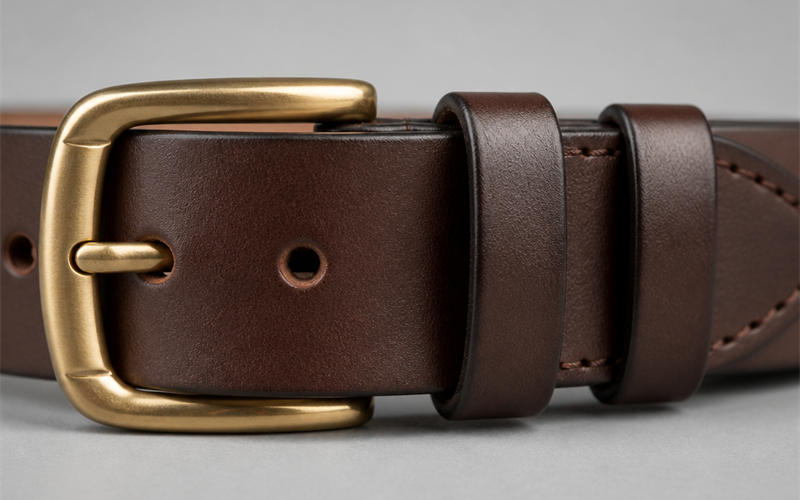
A keeper loop (also called a belt loop, keeper, or sometimes just "loop") is a small leather strip that's attached to the belt near the buckle and forms a closed loop around the belt strap. The keeper's job is to hold the belt tail (the strap end past the buckle) in place after the wearer fastens the belt. Without a keeper, the tail flaps free, can pull out from under the buttoned suit jacket, and may slip out of the trouser belt loops.

There are two types of keepers found on most quality belts:
- Fixed keeper — sewn, glued, or riveted permanently to the belt right next to the buckle. Doesn't move. Holds the tail at a consistent position.
- Floating keeper — a separate leather loop that slides freely along the tail. The wearer slides it down to the appropriate position based on how much tail is past the buckle.
Quality belts typically have both. Budget belts often have just one or none.
Why do some belts have one keeper and some have two?
Belts have one keeper, two keepers, or zero depending on the belt length geometry, the intended formality, and the maker's construction philosophy. The two-keeper configuration (one fixed, one floating) is the most versatile because it works regardless of where the tail ends up after the wearer threads it.

- Two keepers (one fixed, one floating) — most common on quality leather belts. Fixed keeper holds the tail close to the buckle; floating keeper holds the tail's far end. Works for any tail length.
- One keeper (fixed only) — common on shorter belts or specific dress styles where the tail is expected to land at a predictable length. Looks slightly cleaner.
- One keeper (floating only) — uncommon, but found on some heavy-duty and Western belts where the keeper is meant to handle gear (badge, tool) rather than just hold the tail flat.
- Zero keepers — found on some slim dress belts where the aesthetic is "no extra leather elements." The tail tucks under the wearer's first trouser belt loop instead.
The construction logic ties to the belt body language framework we covered earlier — tail behavior is part of the visual register the belt presents.
Key stat: Quality belts position the fixed keeper roughly 1.25"–1.5" from the buckle's prong contact, which places the keeper inside the first trouser belt loop on most standard suit trousers. This positioning isn't accidental — it puts the keeper in a hidden position so the visible belt face stays clean.
Are keeper loops attached or free-floating?
Both, on most quality belts. The fixed keeper is attached structurally — sewn through the belt body with saddle stitching, sometimes additionally reinforced with a small rivet or invisible clip. The floating keeper is unattached — it slides freely along the belt and can be repositioned by the wearer.
The fixed keeper has to be securely attached because it takes load from the tail's pull. A poorly attached fixed keeper will tear loose within a few months of normal wear — usually at the stitching that connects it to the belt body. Quality construction uses the same saddle-stitch technique on the keeper attachment as on the rest of the belt. We covered the saddle-stitch logic in our hidden vs. visible stitching guide.
Keeper loop configurations by belt type
| Belt type | Typical keeper count | Reason |
|---|---|---|
| Slim dress belt | 1–2 (sometimes 0) | Clean aesthetic, hidden under trouser loop |
| Standard dress belt | 2 (fixed + floating) | Universal versatility |
| Casual full-grain | 2 (fixed + floating) | Standard construction |
| Heavy-duty / work | 2 (often larger leather) | Tail control under load |
| Western (ranger) | 2 (often decorative) | Both function and styling |
| Tactical / CCW | 2 (often reinforced) | Critical for tail and gear control |
| Ratchet buckle | 0 (mechanism includes its own tail management) | No tail in traditional sense |
| Magnetic | 1 (sometimes 0) | Light load, less critical |
For more on the structural construction principles, see our plate vs. frame buckle guide.
What happens when the floating keeper slips off?
It's annoying but not catastrophic. The floating keeper can be slid back onto the tail and repositioned, or it can be replaced if lost. Some wearers prefer to wear belts with only the fixed keeper precisely because floating keepers can slip during active wear. The trade-off is tail control versus accessory simplicity.

If the fixed keeper tears loose, that's a more serious construction failure — typically requires a leather worker to restitch or replace it. A torn fixed keeper indicates either substandard stitching (single-thread lockstitch, cheap thread) or excessive pull stress (the tail being yanked outward repeatedly). Quality belt makers reinforce the fixed keeper specifically to prevent this failure mode.
Should the keeper loop match the belt color exactly?
Yes — the keepers are typically made from the same primary leather as the belt body, often with a slightly thinner cut to keep the loop's bulk manageable. Tonal matching reads as intentional construction. Some craft makers use slightly different leather (slightly darker, slightly different finish) on the keepers as an intentional design signature, but this is unusual and reads as styling rather than construction shortcut.

A keeper loop that doesn't match the belt color usually indicates that the maker ran out of matching material or used a generic keeper component. This signals budget construction even if the rest of the belt is reasonable quality. Premium belts have keepers that look like they belong to the same belt — because they do.
Do women's belts use the same keeper system?
The same keeper system but at narrower proportions. Women's belts (typically 1"–1.18" wide) use thinner keepers proportioned to the belt width. The number of keepers and their function is identical: fixed plus floating, or just fixed, depending on the design. For dress belts at the natural waist over dresses, some women's belts skip keepers entirely for cleaner aesthetics — the tail behaves differently against a dress than against trouser belt loops.

See our women's belts collection for sized examples and our statement belt for dresses guide for dress-context keeper considerations.
The Bottom Line
The keeper loop is a small but consequential part of belt construction — the difference between a belt tail that sits flat under a jacket and a tail that flaps around all day. Quality belts have two keepers (one fixed, one floating) made from the same leather as the belt body, sewn with the same quality stitching as the rest of the construction. Budget belts often have just one or use cheap matched components that fail within a year. Slim dress belts may skip keepers entirely for aesthetic reasons, relying on the trouser belt loops to manage the tail. The keeper count and configuration is one of the quiet quality signals on a belt — and noticing it on the belts you own gives you a quick read on the maker's construction philosophy. At BELTLEY, every belt has properly stitched keepers matched to the primary leather, with the fixed keeper saddle-stitched for permanent attachment. Browse our dress belts, full-grain leather belts, and men's belts collections.
Frequently Asked Questions
Q: Can I add a keeper loop to a belt that doesn't have one?
A leather worker can add a custom keeper to most belts, though the result is more visible than a factory-integrated keeper. The repair runs $25–$75 depending on the leather worker and the belt's complexity. For belts with intentionally no keepers (slim dress belts), adding one undermines the original design.
Q: Where should the floating keeper sit when the belt is buckled?
About 2 inches past the fixed keeper, so the tail's far end is held flat against the wearer's body. The wearer adjusts this on each wear based on how the tail lands. Quality belts have keepers that slide smoothly without dragging the leather.
Q: Are wider keepers a sign of quality?
Not necessarily — keeper width is mostly aesthetic and tied to the belt's overall styling (Western and heavy-duty belts use wider keepers; dress belts use narrower keepers). Quality is about construction technique (saddle stitching, attachment durability), not keeper width.
Q: Why do some belts have decorative keepers (studs, conchos)?
Western and heritage casual belt styles sometimes use decorated keepers — small metal studs, miniature conchos, or stamped leather details — as part of the overall design. These are functional but also stylistic. See our Native American concho belts guide for the cultural-respect framework around concho elements specifically.
Q: Does a fixed keeper ever cause sizing problems?
In some cases yes — if the fixed keeper is positioned too close to the buckle, it can interfere with where the trouser belt loop catches the belt. This is uncommon on quality construction but does occur on cheaper belts where keeper placement is standardized rather than considered. If a belt's keeper interferes with the trouser loop, the belt is poorly designed.
Q: How do I clean a keeper that's developed a worn spot?
The keeper sees less wear than the main belt body, but skin oils and friction can darken it slightly. A microfiber cloth with a tiny amount of leather conditioner restores the original finish on most leathers. Avoid soaking; the keeper's bond to the belt body can weaken under prolonged moisture.