Why Some Buckles Patina Beautifully and Others Just Look Dirty
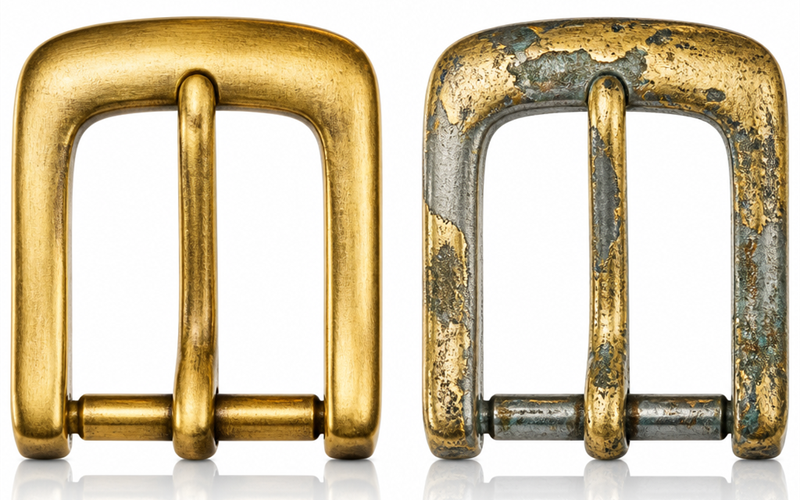
Quick answer: A buckle patinas beautifully when the metal is solid (brass, copper, bronze, solid nickel), the surface is intact (no chipped plating exposing base metal), and the environment is consistent. A buckle looks dirty when the plating has chipped and exposed cast-zinc underneath, or when grime and skin oils have accumulated on a finish that doesn't chemically interact with them. Patina is chemistry on intact metal; "dirty" is corrosion on damaged metal or residue on a non-reactive surface.
Last updated: May 2026 • By BELTLEY Editorial
TL;DR:
- Patina = controlled oxidation of solid metal (brass, copper, bronze, solid nickel). It's protective and aesthetic.
- "Dirty" buckles = either plating failure exposing corroding cast zinc, or grime buildup on a non-reactive surface (steel, chrome).
- Solid brass and solid copper develop the best patina. Stainless steel doesn't patina at all.
- The difference between beautiful and ugly aging is 90% the metal choice, 10% care.
A well-aged belt buckle is one of the satisfying details of a quality belt — warm honey-brown brass that has shifted color over years of wear, or deep copper-bronze that catches light differently than the original finish. A poorly aged buckle, by contrast, just looks worn out. The difference isn't usually about how the wearer treated it. It's almost entirely about the metal underneath. Real patina is a chemical process that requires intact solid metal as a substrate; cheap buckles can't patina because the underlying material isn't capable of the chemistry. Wikipedia's patina entry documents the science — and the difference between aged copper and tarnished plating is dramatic. Our dress belts and full-grain leather belts collections use solid brass and 316L stainless exclusively for exactly this reason.
What is patina, actually?
Patina is a chemical surface layer that forms on certain solid metals — copper, brass, bronze, solid nickel, sterling silver — through gradual oxidation, sulfide formation, and reaction with atmospheric humidity and skin oils. The layer is stable, protective, and visually continuous across the surface. As Wikipedia's patina reference explains, the chemistry varies by environment: rural air produces basic copper carbonate; urban air produces copper sulfides and sulfates; coastal air introduces chlorides.

The key word is continuous. Real patina forms evenly across the whole surface because the underlying metal is uniform. A chipped or plated buckle can't patina continuously because parts of the surface are intact plating (non-reactive) and other parts are exposed base metal (reactive) — the result is mottled, blotchy, and reads as damage rather than aging. We covered the broader solid versus plated logic in our buckle-metal wear test.
BELTLEY 3-Material Rule
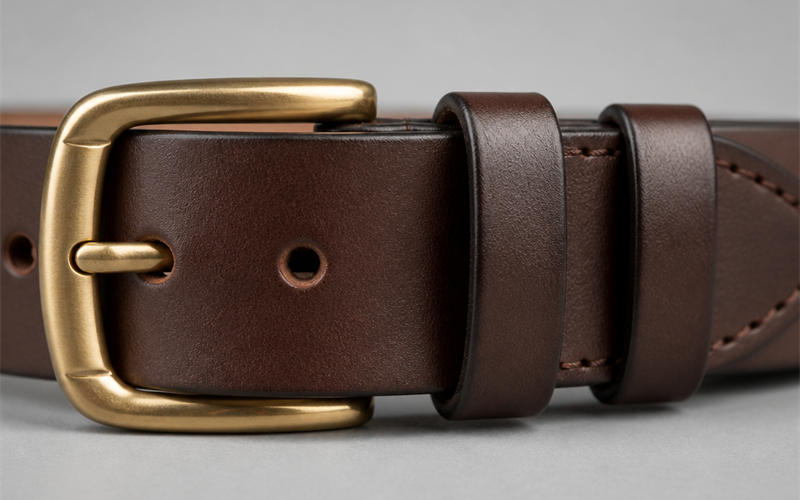
The 3-Material Rule = full-grain leather + 316L stainless or solid brass buckle + sealed (painted or burnished) edges. For patina specifically, the buckle metal is the only part that matters. Solid brass develops the rich honey-bronze patina that aged correctly. 316L stainless doesn't patina — but it doesn't tarnish either, which is what you want if you prefer the buckle to stay bright. Both are valid choices; both age cleanly because neither has plating to fail. The rule fails only when buckles use plated cast-zinc cores.
What makes brass patina beautifully versus look dirty?
Solid brass patinas beautifully when three conditions are met: the brass is solid (not plated over cast zinc), the surface starts uniform (consistent finish across the buckle face), and the wear is regular (daily use that allows skin oils and humidity to react with the surface consistently). Under those conditions, patina develops evenly within 6 to 18 months and stabilizes into a warm honey-bronze color that observers read as "this has been worn well."

The brass starts looking dirty when one or more conditions fail. Plated brass (a thin layer of brass over cast zinc) develops "patina" only on the visible plating — until the plating chips at the prong contact and the underlying zinc corrodes through. Uneven starting finish (mixed polished and brushed sections, or factory polish residue) produces blotchy patina that reads inconsistent. Inconsistent wear (long storage periods interrupted by short wear stretches) produces patches of patina that don't blend. The Wikipedia brass entry covers the chemistry in detail.
Key stat: A solid brass buckle in daily wear develops visible warm patina within roughly 6 months in temperate climates and stabilizes into a uniform color over 18–24 months. A plated buckle that's "supposed to look like brass" typically shows its first chip-and-corrosion damage in 8–12 months at the prong contact, depending on wear intensity.
Does stainless steel patina at all?
No — stainless steel doesn't patina because the alloy is specifically designed to resist surface oxidation. The chromium content (typically 10–11% in 304 stainless, similar in 316L) forms a passive chromium-oxide layer on the surface that prevents the underlying iron from oxidizing. That's what "stainless" means. The buckle stays essentially the same color over years of wear — minor scratches accumulate, but the surface chemistry doesn't change.
For wearers who want their hardware to evolve visually, brass or copper is the right choice. For wearers who want hardware that looks the same on year 10 as day 1, stainless is the right choice. Neither is wrong — they're different design choices with different aging logic. We covered the climate-specific recommendation in our buckle metal wear test.
What different buckle metals look like over time
| Metal | Day 1 | Year 1 | Year 5 | Year 10 |
|---|---|---|---|---|
| Solid brass | Bright yellow-gold | Warm honey | Honey-bronze | Deep bronze patina |
| Solid copper | Bright orange-pink | Rich copper-brown | Dark bronze | Near-black with green highlights |
| 316L stainless | Bright silver | Same with light scratches | Same | Same |
| Solid nickel | Cool silver | Slight darkening | Subtle smoky gray | Mild darkening |
| Plated brass / nickel | Bright (matches solid) | First chips at prong | Visible base-metal corrosion | Mostly damaged |
| Plated chrome / cast zinc | Mirror finish | First chips show | Significant flaking | Largely failed |
Can you accelerate patina artificially?
Yes — and the result usually looks wrong. Forced patina techniques (ammonia fuming, salt-and-vinegar baths, liver of sulfur) can age brass or copper in days rather than months, but the resulting patina lacks the depth, variation, and burnish-from-handling that natural patina has. Trained eyes can distinguish forced from natural patina in person, particularly the absence of "burnished spots" where natural skin contact has polished the patina back at the high-touch points.

The cleaner approach: wear the belt. Natural patina takes 6–18 months to develop visibly but produces a result that reads authentic. If you want patinated hardware faster than that, buy a vintage buckle from a quality maker — pre-aged through genuine wear is the only patina shortcut that doesn't look forced. We covered the related logic in our old money vs new money belts guide; intentionally aged accessories signal differently than naturally aged ones.
How do you maintain a beautifully patinated buckle?
Maintain a patinated buckle by mostly leaving it alone. Wipe off heavy moisture and salt deposits with a soft cloth after exposure (rain, sweat, beach). Avoid abrasive cleaners, brass polish, and household chemicals — all of these remove patina and force the buckle to restart the aging process. The patina is the protection layer; cleaning it off exposes fresh metal that oxidizes inconsistently.

The only case to actively clean a patinated buckle is if it's developed verdigris (green oxidation) from prolonged moisture exposure — that's corrosive rather than protective. A gentle wipe with a vinegar-dampened cloth removes verdigris without stripping the underlying patina. For broader leather and belt care, see our leather care guide.
What if my buckle is already looking dirty?
If the buckle is solid brass or copper and is just discolored, that's almost certainly natural patina — let it develop and it will look intentional within another 6–12 months. If the buckle shows chipped finish with corrosion patches, the buckle was plated and has failed; no amount of cleaning will restore it because the underlying base metal is compromised. Replace the belt or the buckle (if the belt is high-quality enough to warrant rehardware).

The diagnostic test: rub a small area of the buckle face with a soft polishing cloth. If the cloth picks up dark residue and the area brightens to a uniform color underneath, you have patina. If the cloth removes finish and reveals a different-colored base metal underneath, you have plating failure. Patina is removable but recoverable; plating failure is permanent.
The Bottom Line
The difference between a beautifully patinated buckle and a dirty-looking one is overwhelmingly about the metal underneath. Solid brass, copper, bronze, and solid nickel can develop genuine, protective, beautiful patina. Plated buckles can't — they can only fail. Stainless steel doesn't patina at all, which is the right choice for wearers who want their hardware to stay bright. At BELTLEY, we use solid brass and 316L stainless exclusively across our buckle range — patina-friendly or patina-resistant, but never plated, never the kind of hardware that turns dirty rather than aging well. The 3-Material Rule (full-grain leather + solid metal buckle + sealed edges) makes a belt where every component ages correctly. Browse our dress belts, full-grain leather belts, and plaque buckle belts collections.
Frequently Asked Questions
Q: Can I polish a brass buckle back to bright if I don't like the patina?
Yes — brass polish (Brasso, Wright's) restores the original yellow-gold color. Many brass-buckle wearers polish to bright every few months and let new patina develop. Others let it develop fully. Both approaches are valid.
Q: Does sweat ruin a buckle?
For solid brass and 316L stainless, no — both handle sweat (which contains chlorides) without permanent damage. For plated buckles, yes, eventually — sweat accelerates the chipping-and-corrosion process. For solid copper, sweat speeds up patina development but doesn't damage the metal.
Q: Should I oil or wax my buckle?
Generally no. Solid brass and stainless don't need protection beyond what the natural finish provides. Oiling can leave streaks; waxing can attract dust. Just wipe with a soft cloth occasionally and let the buckle do its own work.
Q: How can I tell if a buckle is solid brass before buying?
Check the weight (solid brass is heavier than plated cast zinc for the same size), look for explicit "solid brass" labeling in the product description, and inspect the prong-hole area for any color difference (plated buckles often show base-metal color at the cut). The reliable rule: if the maker doesn't specify "solid," assume plated.
Q: Does patina protect against scratches?
Slightly — patinated surfaces are slightly harder than the bright underlying brass, so they resist minor scratches better. Deep scratches still go through to bright metal, but light scratches that would show on polished brass often blend into patinated brass.
Q: Can a vintage belt buckle be re-patinated if it's been over-polished?
Yes — wear it regularly for 6–12 months and the patina rebuilds naturally. Don't try to chemically force the re-aging; the result usually looks inconsistent. Wear and time do the work better than chemistry.
,%20the%20surface%20is%20intact%20(no%20chipped%20plating%20exposing%20base%20metal),%20and%20the%20environment%20is%20con...)