Why Your Leather Belt Sweats in Summer (and How to Stop It)
Quick answer: A sweaty leather belt usually means poor leather quality, no rotation, or the wrong width for hot weather. Fix it with two full-grain belts in daily rotation, a thinner summer width (1.18-1.25"), and a stainless or solid brass buckle.
Last updated: May 2026 • By BELTLEY Editorial
TL;DR:
- A sweaty leather belt usually means three things: poor leather, no rotation, or wrong width.
- Sweat doesn't ruin good leather, but it accelerates damage on cheap belts and corrodes plated buckles.
- Fix: rotate two belts daily, choose lighter widths in summer (1.18-1.25"), condition lightly every 8 weeks.
- Apply the BELTLEY 3-Material Rule: full-grain leather + stainless or solid brass + sealed edges. Bonded leather rarely survives one summer.
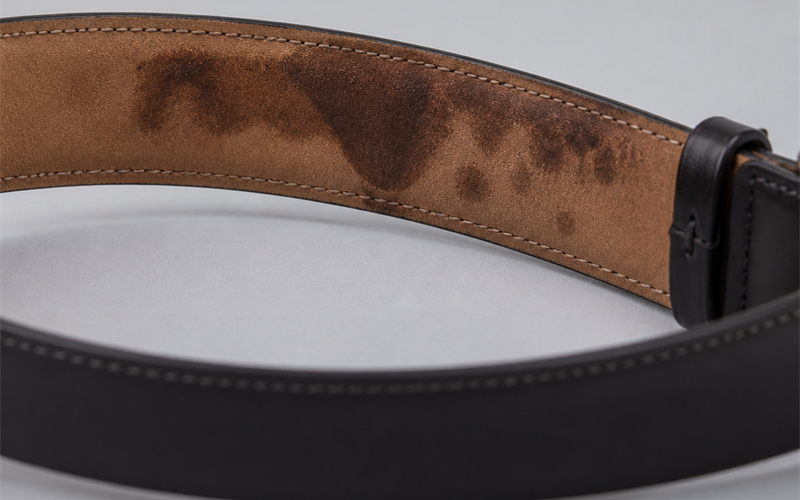
You sit down at lunch. You stand up. Your waistband feels damp. The leather has darkened in patches. There might be a faint smell when you take the belt off at night.
This is one of the most common summer complaints from belt owners, and it's almost always fixable. The belt isn't broken. The system around the belt usually is.
Why does my leather belt feel sweaty in summer?
Your leather belt feels sweaty because leather absorbs perspiration from skin and waistband faster than it can evaporate. In hot weather, you can sweat 0.5-1 liter per hour, and a small percentage goes directly into your belt. Cheap leathers absorb sweat aggressively; high-quality full-grain absorbs less and dries faster.

The CDC NIOSH heat stress reference confirms typical sweat rates. Your belt sees the wettest part of your torso for hours at a time. Some moisture transfer is inevitable.
What you can control is how quickly the belt dries afterward — and what materials it's made of.
Key stat: During heavy heat or activity, the human body can produce 1+ liter of sweat per hour. A small percentage saturates the waistband and belt directly — wear-and-dry rotation is the only way to keep up.
Does sweat actually damage leather belts?
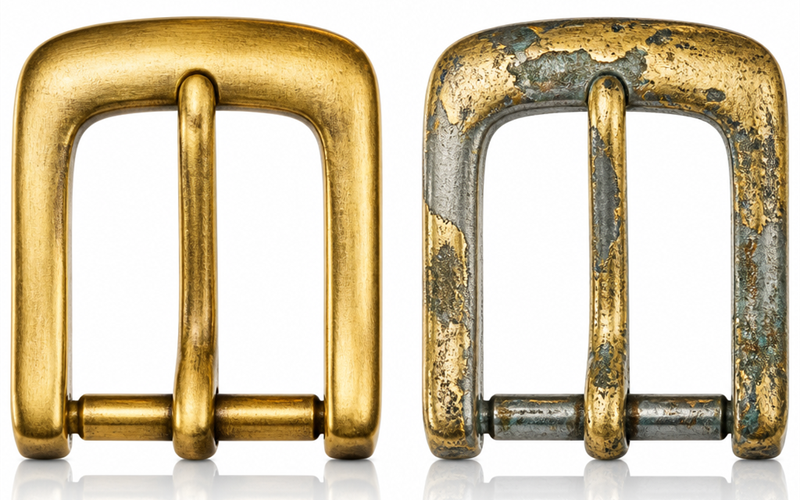
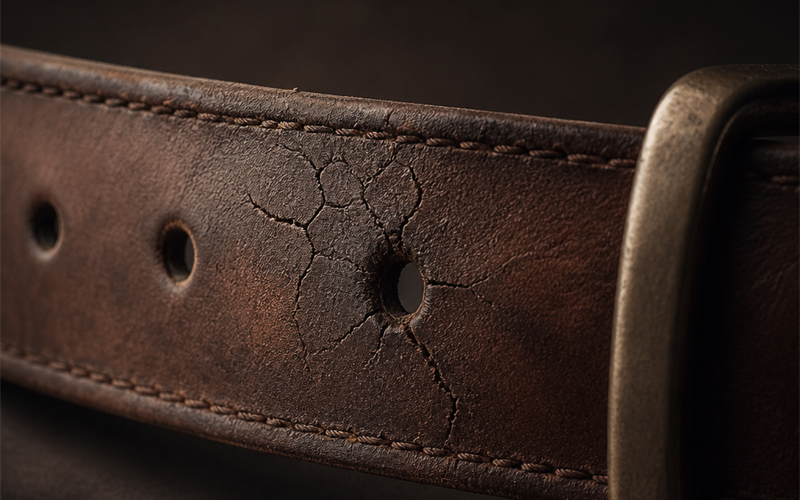
Sweat damages leather through three mechanisms: salt and acid weaken fibers over time, sustained moisture creates mold-friendly conditions, and plated buckle hardware corrodes from chloride exposure. Quality full-grain leather and stainless or brass hardware handle all three with minimal damage. Cheap leather and plated zinc fail fast.
It's not a question of whether sweat damages leather — it's how quickly. A $200 full-grain belt absorbs hundreds of summers worth of sweat with basic care. A $25 bonded belt often gives up after one humid season.
For belt-quality basics, see our 4 quality markers guide.
Why does belt rotation matter so much in summer?
Belt rotation matters in summer because leather needs at least 24 hours between wears to dry fully. Wearing the same belt every day during a heatwave means it never recovers, leading to compounding moisture damage, odor, and accelerated wear. Two belts in rotation is the single best fix for any sweat-related belt problem.
Most owners resist this because two belts feel like a luxury. Run the math: one belt worn daily lasts 3-4 years in heavy use. Two belts rotated each last 8-10 years. Twice the upfront cost, 4-5x the total life.
Summer belt-survival math
| Setup | Daily wear comfort | Sweat smell risk | Lifespan per belt |
|---|---|---|---|
| 2× full-grain 1.25" + stainless, rotated | Excellent | Very low | 10-15 yr each |
| 1× full-grain 1.25" + stainless, no rotation | Good | Low | 3-5 yr |
| 2× crocodile 1.25" + stainless, rotated | Outstanding | Negligible | 20-25 yr each |
| 1× bonded leather + plated zinc | Poor | High by August | <1 summer |
Should you choose thinner belts in summer?
Yes — thinner belts perform better in summer because less leather means less moisture absorption and faster drying. A 1.18" (30mm) or 1.25" (32mm) belt is a more breathable daily choice than a 1.5" (38mm) belt in 90°F+ weather. The thinner belt holds less sweat, dries faster overnight, and feels lighter against the waistband.

Browse our 1.25" belt collection and 1.18" skinny belts. For full width math, see the ultimate guide to standard belt width in mm.
Why do some leather belts develop odor in summer?
Leather belts develop odor when sweat saturates fibers without enough drying time between wears. Bacteria break down sweat proteins inside the leather, producing the distinctive musty or sour smell. Once embedded, odor is hard to fully remove. Prevention through rotation and ventilation is far easier than cure.
If a belt already smells, hang it in a dry, ventilated area for 48-72 hours. A light wipe with a cloth dampened in 1:1 water and white vinegar can help. Severe odor usually means the belt is bonded leather or has cracked finish, both of which trap bacteria deep in the structure.
What's the right summer belt care routine?
Four steps. Rotate two belts daily — never wear the same belt two days in a row. Hang belts overnight at room temperature, not on a chair or bedroom floor. Wipe with a slightly damp cloth weekly during the hottest weeks. Apply a light coat of leather conditioner every 8 weeks during summer.

That's it. Five minutes a week. Pays back in decades of belt life.
For specific conditioner picks, see right and wrong conditioners.
Are some belt colors better in summer?
Darker colors hide sweat marks better than pale tan or natural veg-tan. Espresso, dark brown, and black show minimal change from sweat exposure. Pale colors develop visible dark patches behind the buckle and along the waistband that take months to even out.
Our espresso leather belts are the classic summer pick. Black is more formal — see black or brown belt with jeans for men for context.
Does perforated leather help with summer sweat?
Perforated leather belts allow slightly better airflow through the strap, reducing sweat retention modestly. They're popular for warm-climate dress wear — particularly with linen and lightweight suits. The trade-off: they're harder to find in full-grain construction and the perforations collect debris.
For warm-climate formal wear, a thinner full-grain belt usually outperforms a perforated belt at the same price point.
Why do cheap belts smell faster than expensive ones?
Cheap belts smell faster because bonded and split leathers have porous internal structures that trap bacteria deep in the material. Real full-grain leather has a dense, tight fiber structure that bacteria struggle to colonize. Cheap belts also use synthetic glues that themselves smell when exposed to sustained moisture.

If a belt is smelling within its first summer, it's almost always a quality issue, not a usage issue. See our is genuine leather real leather post.
Are exotic leathers more sweat-resistant?
Crocodile and alligator leathers handle sweat exceptionally well because their natural oils and dense scale structure resist moisture penetration. Owners frequently report exotic belts staying odor-free and stain-free through years of warm-climate daily wear, often with less maintenance than premium cowhide.
The trade-off is upfront cost. Browse our crocodile and alligator belt collection and see why is alligator leather so expensive for the value math.
What about buckle materials in summer?
Stainless steel and solid brass buckles handle summer sweat without corrosion. Plated buckles develop dull spots and pitting from sweat-induced chloride exposure. The alloy science behind this is on Wikipedia's stainless steel page.
Our stainless steel buckle and brass buckle collections are the safe long-term picks.
What about canvas or fabric belts?
Canvas belts breathe better than leather and don't show sweat in the same way, but they absorb moisture directly and develop their own odors faster. They're a reasonable casual option for beach or vacation wear, but they look out of place with most office attire.

See are canvas belts good for men for full pros and cons.
The Bottom Line
A sweaty leather belt is almost always solvable. Apply the BELTLEY 3-Material Rule — full-grain leather + stainless or solid brass + sealed edges — and run two belts in summer rotation. Lighter widths (1.18-1.25"), darker colors, and an 8-week conditioning schedule handle the rest. 95% of summer belt complaints disappear with this setup.
BELTLEY's summer-friendly belts ship daily to customers in Phoenix, Houston, Mumbai, Bangkok, and Sydney. Start with the full-grain leather belt collection or browse the 1.25" summer-friendly widths. For maximum sweat resistance, the crocodile and alligator collection is the long-game pick. Free worldwide shipping, 30-day returns, 10-year warranty.
Frequently Asked Questions
Q: Can sweat ruin a leather belt?
Sweat doesn't ruin quality full-grain leather, but it accelerates damage on cheap belts and corrodes plated buckles. Rotation between two belts solves most sweat-related wear.
Q: How do I get sweat smell out of a leather belt?
Hang the belt in a dry, ventilated area for 48-72 hours. Wipe with a soft cloth dampened in 1:1 water and white vinegar. Apply light conditioner once fully dry. Severe odor in cheap belts is usually permanent — the bacteria embed in the bonded core.
Q: What's the most breathable leather belt material?
Thin full-grain leather and exotic leathers like crocodile and alligator have the best breathability-to-durability ratio. For warm-climate daily wear, a 1.25" or 1.18" full-grain belt is the sweet spot.
Q: Do I need to condition a belt in summer?
Yes — a light conditioning every 8 weeks during summer helps the leather recover from sweat exposure. Don't over-condition — too much oil traps moisture. See right and wrong conditioners.
Q: Will my belt stretch from summer sweat?
Quality full-grain leather has very minor stretch under regular sweat exposure — usually under 1/4 inch over years of daily wear. Cheap belts can stretch significantly because the bonded core breaks down.
Q: Are leather belts okay to wear during exercise?
Leather belts aren't ideal for exercise. Heavy sweat saturation, repeated bending, and friction wear out even good belts faster than normal use. For workouts, a dedicated athletic belt or webbed nylon belt is the better choice.