Why Italian Belts Use Solid Brass Buckles More Than American Belts Do
TL;DR:
- Italian belt makers default to solid brass buckles for tradition, durability, and patina.
- American belts lean toward stamped steel, zinc alloy, or plated finishes for cost and uniformity.
- Solid brass is heavier, ages more beautifully, and outlasts cheaper alternatives by decades.
- The difference shows up at the price tag, the weight, and ten years later in your belt drawer.
Pick up a vintage Italian belt and a mass-market American belt. Same length. Same width. Same color.
The Italian one will weigh more. By a lot.
That's because the Italian buckle is almost always solid brass, while the American belt is probably hiding a zinc-alloy or stamped-steel buckle under a thin layer of plating. The visual difference is small. The actual difference is enormous.
This isn't a "European things are better" essay. There are great American belt makers and shaky Italian ones. But on the buckle question specifically, there's a clear historical and cultural divergence. Let's unpack it. For wider context, our why Italian leather belts cost more post covers the broader economics.
Why Do Italian Belt Makers Prefer Solid Brass?
Italian belt makers prefer solid brass because the material aligns with the broader Italian leather tradition of building objects that age beautifully and last for decades. Brass develops a warm patina, holds its shape under repeated buckle stress, and pairs naturally with vegetable-tanned leather — the dominant leather style in Italian craft. Cheaper buckle materials don't match that timeline.

Three forces keep the tradition alive:
- Material chemistry. Brass is a copper-zinc alloy that resists corrosion, develops character, and stays structurally sound for generations. Britannica's brass entry covers the metallurgy if you want the deep version.
- Workshop culture. Italian belt workshops tend to be small, multi-generational, and integrated with local foundries. Sourcing solid brass castings locally is just easier in Italy than it is in most American belt-making regions.
- Customer expectation. Italian buyers — and their export customers — expect heft. A light, hollow-feeling buckle reads as "fake" in that market.
You'll see this approach across pieces in our brass buckle belts collection, where the buckle is the centerpiece, not an afterthought.
What Do American Belt Brands Use Instead?
Most mass-market American belt brands use zinc alloy (often called zamak), stamped steel, or thin brass-plated steel for their buckles. These materials are cheaper, easier to cast in volume, and lighter — which keeps shipping costs down. They also let factories crank out thousands of identical buckles per shift, which suits American retail margins.
Common American belt buckle materials:
| Material | Weight | Lifespan | Notes |
|---|---|---|---|
| Zinc alloy (zamak) | Light | 2–8 years | Cracks at stress points |
| Stamped steel | Medium | 5–15 years | Rusts if uncoated |
| Brass-plated steel | Medium | 3–10 years | Plating wears off |
| Solid brass | Heavy | 30+ years | Patinas, doesn't fail |
| Solid stainless steel | Heavy | 30+ years | Modern alternative |
Wikipedia's zamak article explains why the alloy is so popular for mass-produced hardware — castability and cost — and also where it breaks down over time.
There are exceptions. American heritage brands like vintage Levi's belts, custom Western belt makers, and small-batch leather goods houses have always used solid brass. But the average belt at a department store? Zinc alloy with a brass-toned plating. Looks like brass. Isn't.
Is a Solid Brass Buckle Really More Durable?
Yes — a solid brass buckle is dramatically more durable than zinc alloy or plated steel because it doesn't have plating to wear off, fatigue lines to crack along, or corrosion-prone metals underneath. A solid brass buckle that's been used daily for 30 years usually still works. A zinc-alloy buckle from the same era is probably in a landfill.

Three failure modes brass simply doesn't have:
- Plating loss. There's no plating to lose. The whole buckle is the same material all the way through.
- Casting cracks. Zinc-alloy castings often crack at the pin or post under repeated stress. Brass castings are far more forgiving.
- Rust. Steel buckles oxidize when the plating wears. Brass develops a patina instead — that's oxidation too, but it's stable and decorative, not destructive.
Wikipedia's brass article covers why the alloy resists corrosion in everyday environments — it's the same reason brass is used in marine fittings and door hardware.
For more on what separates great belt hardware from filler, our 4 quality markers in calfskin belts guide covers stitching, edge, buckle, and suppleness together.
Why Did America Move Away From Solid Brass?
America moved away from solid brass primarily because of post-WWII manufacturing economics — zinc-alloy die-casting became cheap and fast, retail price competition got fierce, and consumers were trained to expect $20–$50 belts. Solid brass simply couldn't compete on cost at the entry level, so factories switched.
A quick timeline:
- Pre-1950s: American work belts and dress belts mostly used solid brass or steel buckles. Western and military belts especially.
- 1950s–1970s: Zinc die-casting industry scales massively. Buckle costs drop 60–80%. Brass becomes a "premium" feature instead of the default.
- 1980s–2000s: Mall retail dominates belt sales. Margin pressure pushes most brands to alloy. "Brass-tone" plating replaces actual brass.
- 2010s–today: Quiet luxury and heritage revival push some brands back to solid brass — but mostly at higher price points.
Italy never made that switch at the workshop level. Italian factories making cheap belts use alloys too, but the small-batch workshops kept brass as their default. That continuity is why "Italian belt" still implies "solid brass buckle" in most buyers' minds.
Does Solid Brass Look Different Over Time?
Solid brass develops a warm, golden-brown patina over years of wear — a thin oxidation layer that protects the metal beneath while adding visual depth. Plated buckles do the opposite: the thin coating wears through at high-contact spots, exposing the silver or gray metal underneath. One gets better. The other looks broken.

What patina looks like in real life:
- Year 1: Almost no change. Brass stays bright gold.
- Year 3: Slight warming. Edges where you grip the buckle most start to deepen.
- Year 5: Distinct two-tone effect — high-contact areas dark, low-contact areas still gold.
- Year 10+: Full patina. Looks like an heirloom.
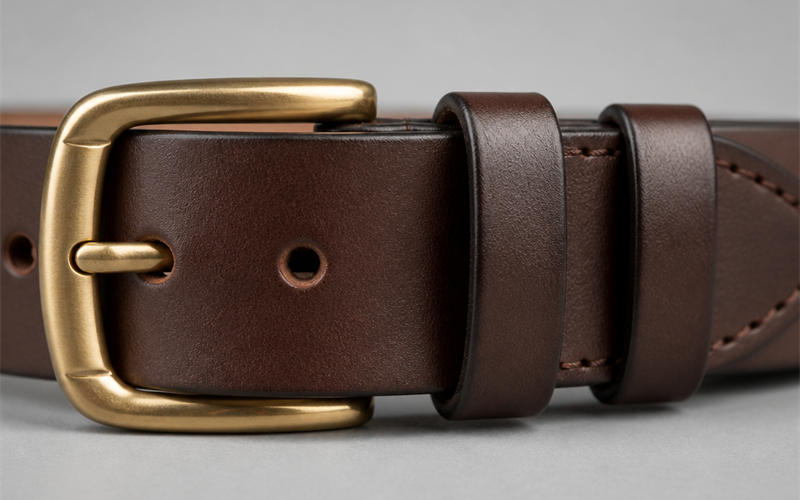
This is the look people pay vintage prices for. Belts like our brown vintage brass buckle belt ship with a brand-new brass buckle that will go through this exact transition with the right wearer.
If you ever want to reset the brass to bright gold, a soft cloth and a tiny dab of brass cleaner does it in 30 seconds. Most people don't bother — the patina is the point.
When Should You Choose Solid Brass vs Stainless Steel?
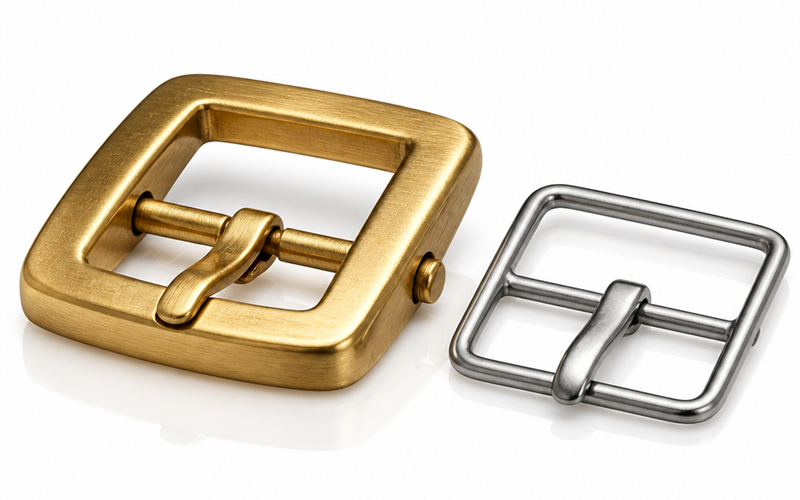
Choose solid brass when you want a warm, traditional, patina-developing look — think vintage, casual, heritage, or country styles. Choose stainless steel when you want a cool, modern, low-maintenance look that stays uniform forever — think dress belts, plaque buckles, business-formal pairings.

Quick decision guide:
| Want this look | Pick this material |
|---|---|
| Warm gold, vintage feel | Solid brass |
| Cool silver, formal feel | stainless steel |
| Aged, characterful, ages with you | Solid brass |
| Sharp, uniform, identical for 20 years | Stainless steel |
| Pairs with brown/tan/casual leather | Solid brass |
| Pairs with black formal leather | Stainless steel |
Both are quality choices. Both are what BELTLEY uses across the range. Our stainless steel buckle belts collection covers the modern-dress side, while the brass buckle belts collection covers the warm, vintage, heritage side.
Wikipedia's stainless steel grades article explains why stainless steel specifically is the marine-grade alloy used in jewelry and watch cases — it's corrosion-resistant, hypoallergenic, and holds polish for decades.
How Heavy Should a Quality Italian Brass Buckle Be?
A quality solid brass belt buckle for a 1.5" leather belt typically weighs between 60 and 110 grams, depending on design. Anything under 40 grams is almost certainly hollow, plated, or alloy. Anything over 130 grams is usually a heavy ornamental Western-style piece.
Weight ranges by belt type:
- Slim dress brass buckles (1"): 25–50g
- Standard dress (1.25"–1.38"): 45–80g
- Casual / heritage (1.5"): 60–110g
- Heavy-duty vintage (1.5"): 90–140g
- Western / ornamental: 130g+
Pick up our classic casual brass buckle belt or the reddish-brown full-grain belt with brass buckle and you'll feel the weight immediately. That heft isn't accidental — it's the brass.
Are Italian Belt Brands Always Made With Real Solid Brass?
No — Italian-branded does not automatically mean solid brass. Mass-market belts labeled "Made in Italy" often use the same zinc alloys as cheap American belts because the production has been outsourced or simplified. The solid-brass tradition lives mainly in small-batch artisan workshops, not in volume factories regardless of country.

Three ways to verify a belt actually has solid brass:
- Magnet test. Brass is non-magnetic. If a magnet sticks, it's plated steel.
- File test on the back. A discreet scratch on the buckle back reveals the same color underneath. Plated buckles show a different metal.
- Weight test. Lift the belt by the buckle. Solid brass is noticeably heavy in the hand.
The lesson: country of origin matters less than workshop standards. We work with Italian workshops that still cast in solid brass because it's the right material for the belts we make — see the Italian Brutti pull-up brown belt for an example where the brass buckle does as much storytelling as the leather.
The Bottom Line
The Italian preference for solid brass isn't snobbery — it's continuity. Workshops kept doing what worked because their customers kept rewarding the choice. American factories scaled into alloys because the math said scale.
Both approaches produce belts. Only one produces belts your grandkids might still wear. At BELTLEY we lean into the brass tradition on our vintage and casual pieces — start with our brass buckle belts collection if heft and patina are what you're after, or jump to full-grain leather belts for the broader range.
Frequently Asked Questions
Q: How can I clean a tarnished brass buckle?
Use a soft cloth with a tiny amount of brass polish (Brasso or similar). Rub in small circles for 20–30 seconds, then buff with a clean cloth. Don't use abrasives or harsh chemicals — they remove the patina layer that protects the underlying metal.
Q: Does solid brass cause skin reactions?
Pure brass rarely causes reactions, but some people are sensitive to the nickel content in cheaper brass alloys or to the copper itself. If you have known metal sensitivities, stainless steel is usually the safer hypoallergenic option.
Q: Why are some brass buckles called "antique brass"?
Antique brass refers to a chemically aged finish that mimics decades of natural patina. It's applied at the foundry with a controlled oxidation process. Pieces like our khaki heritage belt with antique brass use this finish for an instant-vintage look.
Q: Can a solid brass buckle break?
Extremely rarely. The most common failure on a brass buckle is the pin bending under unusual stress (like a heavy tool belt), and even that is usually bendable back. Catastrophic cracks are nearly unheard of with proper-thickness castings.
Q: Are stainless steel buckles a better choice than brass for everyday wear?
Both work. Stainless steel stays bright and uniform with zero maintenance. Brass develops character over years. The choice is aesthetic, not durability — both last decades when made properly.