Why Did My Belt Buckle Snap? (And What Construction Prevents It)
Quick answer: Belt buckles snap for three reasons: 1) the buckle is zinc alloy with thin chrome plating (the most common failure mode), 2) the prong is welded rather than forged from solid metal, or 3) micro-fatigue from years of bending finally exceeded the metal's tolerance. Solid brass and stainless-steel buckles almost never snap — they outlast the leather strap they're mounted on, often by decades. The whole problem is alloy selection.
Last updated: May 2026 • By BELTLEY Editorial
Why trust this guide: BELTLEY uses stainless steel and solid brass for every buckle, with cast-and-machined construction rather than welded prongs. We've handled customer returns of competitor buckles for over two decades — and the broken pieces tell the same story every time. This guide reflects metallurgy reality, not marketing language.
TL;DR:
- The "buckle" you bought might actually be zinc alloy with a chrome coating — and zinc fatigues fast.
- Solid brass and stainless steel buckles last 30-50+ years; plated zinc buckles often fail at 18-36 months.
- The prong is the most common failure point — welded prongs snap 5-10x more often than forged or single-piece prongs.
- The BELTLEY 3-Material Rule (full-grain leather + stainless or solid brass buckle + sealed edges) was built specifically to prevent buckle failure.
At a glance:
- Average solid brass buckle lifespan: 30-50+ years
- Average plated zinc buckle lifespan: 18-36 months
- Magnet test: solid brass = non-magnetic; cheap zinc = often strongly magnetic
- Weight test: solid metal feels heavier than its size suggests; plated zinc feels light
- Updated — May 2026 · By BELTLEY Editorial
A snapped belt buckle ranks among the most demoralizing wardrobe failures — the belt was fine, the leather was fine, and then on one ordinary morning the prong sheared off in your hand. The good news: buckle failure is almost entirely a construction-quality problem with a documented, predictable cause. Below: why buckles actually fail, the magnet test that separates good metal from bad, and the construction profile that makes a buckle outlast the belt it's mounted on.
Why do most belt buckles snap?
Most belt buckles snap because they're made of zinc alloy (sometimes called "pot metal" or "zamak") with a thin chrome or nickel plating. Zinc has poor fatigue resistance — every time you bend the prong slightly, microscopic stress cracks form in the alloy. After 500-2,000 cycles, the cracks meet and the prong snaps. Solid brass and stainless steel have 5-10x better fatigue resistance and almost never reach failure during normal use.

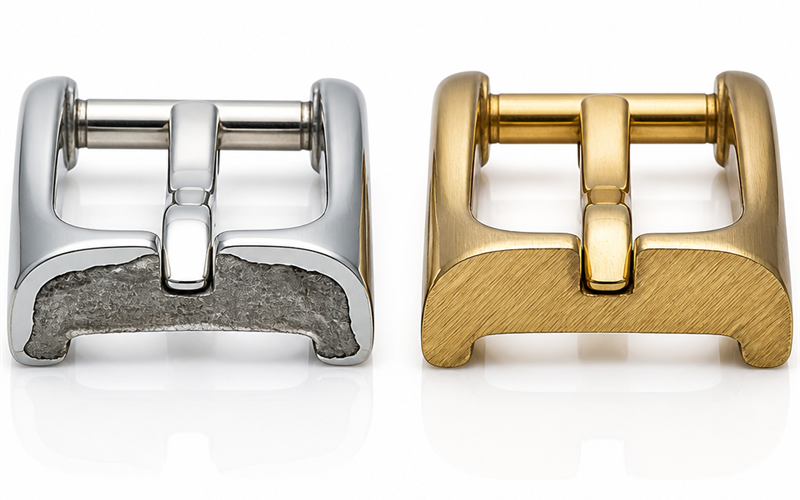
The plating hides the alloy underneath. A chrome-plated zinc buckle looks identical to a polished stainless steel buckle from arm's length — sometimes brighter, because chrome plating is reflective. The difference only shows up months or years later when the alloy fails. Most "fashion" belts under $40 use plated zinc; almost all heritage and craft belts use solid metal.
How do you tell a solid brass buckle from a plated one?
Three quick tests. Magnet test: solid brass and most quality stainless are non-magnetic or very weakly magnetic; cheap plated zinc is often strongly magnetic (the steel substrate). Weight test: lift the buckle in your palm — solid brass feels significantly heavier than its size suggests; plated zinc feels disproportionately light. Edge inspection: look at the inside edge of the buckle frame for any chip, scratch, or brassing — solid brass shows brass color all the way through; plated metal shows a different color underneath.
The magnet test isn't perfectly definitive — some stainless grades are weakly magnetic — but it's a strong indicator. A buckle that pulls hard to a fridge magnet is almost certainly plated steel or zinc, never solid brass.
Key stat: A solid brass belt buckle survives roughly 20,000-50,000 buckle cycles before showing measurable wear. A plated zinc buckle typically fails between 500-2,000 cycles — a 10-100x lifespan gap purely from alloy choice.
What is stainless steel and why does it matter for belt buckles?
stainless steel is a high-grade austenitic stainless steel containing chromium, nickel, and molybdenum — designed for marine, medical, and food-grade applications where corrosion resistance and structural integrity are critical. For belt buckles, stainless steel delivers three things plated zinc cannot: 1) it doesn't corrode against skin perspiration, 2) it doesn't fatigue under bending stress at normal belt-wear pressures, and 3) it holds its finish for decades without brassing or pitting.

According to the Wikipedia stainless steel entry, 316 (and its low-carbon variant stainless steel) is specifically distinguished by chloride and acid resistance — the same exposure pattern human skin presents. This is why we specify stainless steel for all stainless hardware across the men's belt collection. Lower-grade stainless (430, 201) often shows surface staining within 1-2 years of skin contact; stainless steel doesn't.
Belt buckle materials compared
| Buckle Material | Typical Lifespan | Failure Mode | Magnet Reaction | Cost Range |
|---|---|---|---|---|
| Chrome-plated zinc alloy | 18-36 months | Prong snaps, plating flakes | Strongly magnetic | $0.50-$3.00 per buckle |
| Nickel-plated brass | 5-10 years | Plating wears off; brass underneath usable | Non-magnetic | $3-$12 per buckle |
| Solid brass | 30-50+ years | Essentially indestructible | Non-magnetic | $5-$25 per buckle |
| stainless steel | 30-50+ years | Indestructible; may scratch | Weakly magnetic or non-magnetic | $8-$30 per buckle |
| Sterling silver (Western/trophy) | 50+ years | Essentially indestructible | Non-magnetic | $40-$400+ per buckle |
| Gold-plated solid brass | 20-40 years | Gold wears, brass underneath | Non-magnetic | $20-$80 per buckle |
Why do welded prongs snap so much more than solid prongs?
Welded prongs snap more often because the weld joint creates a stress concentration point — the metal there has a different crystal structure than the surrounding alloy, and bending fatigue concentrates at that boundary. Forged or single-piece prongs (machined or cast as part of the buckle body) distribute stress uniformly and rarely fail at the prong-buckle interface.

You can spot a welded prong by inspecting the joint where the prong meets the buckle frame — under a magnifying glass, a weld shows a visible seam, often slightly discolored. A forged or single-piece prong shows continuous metal grain with no seam. Heritage buckle makers (Bridle leather workshops, Western silversmiths, BELTLEY hardware partners) refuse welded prongs as a default quality standard.
What does the BELTLEY 3-Material Rule contribute to buckle survival?
The 3-Material Rule — full-grain leather + stainless or solid brass buckle + sealed edges — pairs the right buckle metal with the leather and edge finish that surround it. Even a perfect buckle can fail prematurely if it's mounted in low-quality leather (the buckle bar twists, stressing the prong); even perfect leather fails fast if the buckle bar bends. The three elements have to be matched.

This is why our customers report buckles outlasting straps under heavy daily use — not because the strap fails early, but because the buckle simply doesn't fail. Browse the full-grain leather collection to see the construction profile in person.
Can a snapped belt buckle be repaired?
Solid brass and stainless steel buckles can sometimes be repaired by a jeweler or metalsmith — brazing or welding the prong back is straightforward on these alloys. Plated zinc buckles cannot be effectively repaired; the cracked alloy will simply fail again at the same weak point within weeks. Repair cost: $30-$80 from a jeweler. Replacement of the entire buckle on a quality belt (if the buckle is removable) costs $20-$60 in hardware.
For unrepairable plated-zinc failures, the belt strap can sometimes be saved by replacing the buckle with a quality solid-brass or stainless replacement. See our guide on replacing a belt buckle for which belt designs support buckle swaps.
How can you prevent buckle failure on your next belt purchase?
Before buying, do three checks: 1) lift it — heavier than expected = solid metal; light for its size = plated zinc, 2) magnet check — strong magnetic pull = avoid, 3) read the spec — quality makers advertise "solid brass" or "stainless"; vague descriptions like "alloy hardware" or "metal buckle" usually mean plated zinc. If the seller can't or won't specify the alloy, assume it's the cheap option.

The good news: solid-brass and stainless hardware is increasingly common at the DTC craft tier. Even mid-priced quality belts now spec real metal. Our full-grain leather belt collection and crocodile belt collection both use only solid brass and stainless throughout.
Related BELTLEY guides
- Why Some Belts Fail Within 18 Months: Staples vs Rivets vs Stitched Loops — broader construction failure
- Replacing a Belt Buckle: Which Belts Can and Cannot — buckle replacement guide
- Brass vs Stainless Steel vs Nickel Buckles: Wear Test — head-to-head durability data
- Why Are My Belt Holes Wearing Out So Fast? — companion failure-mode analysis
- Why Does My Belt Tongue Slip Out of the Buckle? — buckle-fit troubleshooting
The Bottom Line
Belt buckles snap because they're made of the wrong metal — almost always plated zinc instead of solid brass or stainless. The fix isn't being gentler with your belt; it's choosing buckles that aren't engineered to fail. Apply the magnet and weight tests at point of purchase, demand alloy specification from the seller, and you'll never face a snapped buckle again. At BELTLEY, every buckle is solid brass or stainless — and every prong is single-piece, not welded. Browse the men's belt collection for hardware built to outlast everything around it.
Frequently Asked Questions
Q: How long should a belt buckle last?
A solid brass or stainless steel buckle should last 30-50+ years with normal daily wear. Plated zinc buckles typically fail in 18-36 months. The difference is entirely the underlying metal, not the belt brand or price tier above a certain quality threshold.
Q: Is a heavier buckle always better?
Heavier almost always means solid metal rather than plated zinc — which is the durability win. The exception is oversized Western trophy buckles, where extra weight is decorative rather than functional. For everyday belts, heavier within reason = more durable.
Q: Can I replace a broken buckle with a better one?
Often yes — most quality belts have removable buckles attached with chicago screws or rivets. Standard 1.25"-1.5" replacement buckles in solid brass or stainless are widely available for $20-$60. Mono-piece belts (sewn buckles) cannot be swapped.
Q: Are stainless and surgical stainless the same?
Yes — stainless steel is the standard "surgical stainless" used in medical implants and quality watch cases. The "L" indicates low carbon content for better corrosion resistance. It's the highest-tier stainless commonly used in belt hardware.
Q: Why are luxury brand buckles still sometimes plated?
Some luxury brands use plated brass (not plated zinc) — which is still very durable. The bad combination is plated zinc, which both luxury and fast-fashion brands sometimes use to keep weight down or for specific design effects. Always ask: "is it plated, and if so, what's the base metal?"
Q: Do exotic leather belts use different buckle metals?
Quality exotic-leather belts (crocodile, alligator, ostrich) almost always use solid brass, stainless, or sterling silver. Plated hardware on a $300+ exotic belt is a strong signal of compromised construction elsewhere.

%20the%20buckle%20is%20zinc%20alloy%20with%20thin%20chrome%20plating%20(the%20most%20common%20failure%20mode),%202)%20the%20prong%20is%20welded%20rather%20than%20forged%20from%20solid%20metal,%20...)