Why Are My Belt Holes Wearing Out So Fast?
Quick answer: Belt holes wear out fast for one of four reasons: 1) the leather is bonded or split (not full-grain), so the hole stretches with every wear, 2) the holes were punched without back-finishing — leaving raw fibers exposed, 3) you're using the same hole every single day instead of rotating between two or three, or 4) the prong is too large for the hole size. Full-grain leather with finished holes, used in rotation, can survive 10+ years without a single hole stretching.
Last updated: May 2026 • By BELTLEY Editorial
Why trust this guide: BELTLEY has hand-punched and finished belt holes since 1999, with master artisans setting hole spacing, diameter, and back-burnishing on every piece. We see exactly which construction shortcuts cause early hole failure — and which ones quietly add decades of life. Every claim here is based on our production data and customer service records.
TL;DR:
- Bonded and split leather stretch around the prong on every wear — full-grain doesn't.
- Holes punched without back-burnishing fail 3-5x faster than properly finished holes.
- Using the same hole daily concentrates wear; rotating between two adjacent holes nearly doubles lifespan.
- The BELTLEY 3-Material Rule (full-grain leather + stainless or solid brass buckle + sealed edges) is the construction profile that keeps holes from stretching at all.
At a glance:
- Average lifespan of full-grain belt hole: 10+ years (with rotation)
- Average lifespan of bonded leather belt hole: 8-18 months
- Best practice: rotate between 2-3 adjacent holes
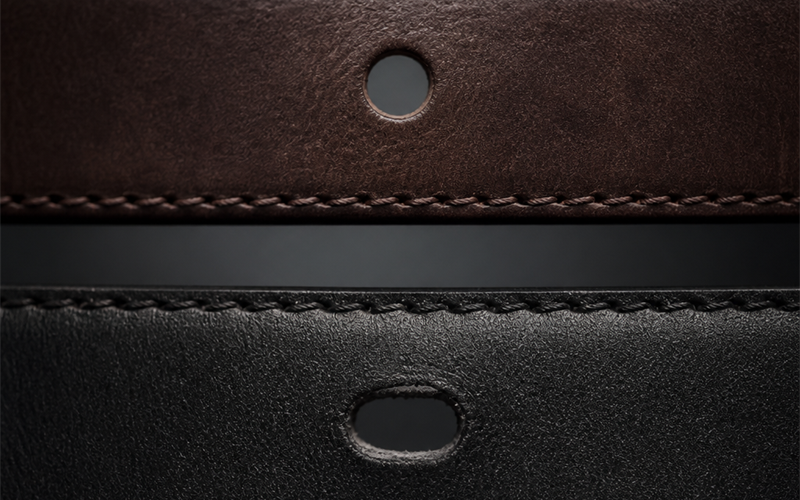
- Diagnostic tip: oval-shaped holes = stretched; round holes = healthy
- Updated — May 2026 · By BELTLEY Editorial
You bought the belt eight months ago. The first hole is now an oval. The second hole is starting to fray. The leather around the prong feels soft, almost squishy. None of this should be happening to a belt that's supposed to last — and yet it's happening on millions of belts every year. Below: what's actually going wrong inside those holes, why some belts never stretch a hole even after a decade, and the four simple checks that tell you if your belt is built for survival.
Why do belt holes stretch into ovals so quickly?
Belt holes stretch into ovals because bonded leather and split leather don't have the fiber structure needed to resist the prong's daily pressure. Every time you buckle and unbuckle, the prong stretches the hole microscopically. Full-grain leather springs back; bonded leather doesn't. After 200-500 wears, the difference becomes visible — bonded leather develops an oval hole; full-grain keeps the original circle.

The fiber structure is the whole story. According to the Wikipedia leather entry, full-grain leather "lasts for decades" because its intact grain layer holds together under stress. Bonded leather — which is leather scraps glued together with polyurethane — has no continuous fiber network to push back against the prong. It's the difference between stretching a rubber band and stretching wet paper.
How do you tell if your belt is full-grain or bonded?
Flex the belt into a tight U-shape. Full-grain leather flexes silently with no surface cracking and shows visible grain pattern on both sides. Bonded leather often makes a soft crackling sound, shows micro-cracks under flex, and reveals a uniform "paper-like" backing rather than natural grain texture. A drop of water absorbs into full-grain within 15-30 seconds; bonded leather typically beads water for several minutes due to the polyurethane coating.
The honest test: look at the price. A genuine full-grain belt almost never costs less than $50-$60 to produce, and rarely retails under $90. If you bought a "leather belt" for $25, it's almost certainly bonded or split. Our guide on how to tell full-grain from bonded leather walks through every diagnostic test.
Key stat: A full-grain belt hole survives roughly 2,000-3,000 buckle cycles before showing measurable stretch. A bonded-leather hole typically fails between 200-500 cycles — a 4-15x lifespan gap purely from leather grade.
What does "back-burnishing" mean and why does it matter?
Back-burnishing is the artisan technique of finishing the inside of a punched hole — sealing the raw leather fibers with heat, beeswax, or edge paint to prevent fraying and stretching. Holes that aren't back-burnished expose raw cut fibers to friction from the prong; they fray, then stretch, then tear. Holes that are back-burnished resist all three failure modes.

Most factory-produced belts skip this step because it adds 30-60 seconds of skilled labor per belt. Heritage and small-batch makers don't skip it — including every belt in our full-grain leather collection. You can spot a back-burnished hole instantly: the interior is smooth, slightly darker than the leather surface, and feels firm rather than fibrous to the touch.
Belt hole lifespan by construction quality
| Construction Profile | Hole Lifespan | Visible Failure Mode |
|---|---|---|
| Bonded leather, unfinished holes | 6-18 months | Oval stretch, fraying, tearing |
| Genuine leather (low grade), unfinished holes | 1-2 years | Gradual oval stretch |
| Top-grain leather, unfinished holes | 3-5 years | Slow oval stretch |
| Full-grain leather, unfinished holes | 5-8 years | Minor stretch at primary hole only |
| Full-grain leather, back-burnished holes | 10-20+ years | Often no measurable failure |
Why does using the same hole every day damage the belt?
Using the same hole every day concentrates the prong's pressure on one specific point — the equivalent of always bending a metal wire at the exact same spot. Even quality leather develops local fatigue at that point over time. Rotating between two or three adjacent holes spreads the stress across a larger area, nearly doubling the belt's effective lifespan.

The fix is easy: pick two adjacent holes that both feel comfortable and alternate between them daily. After a meal or two, your waist size shifts by 0.5-0.75" naturally — using the slightly looser hole post-dinner and the slightly tighter hole pre-meal is both more comfortable and structurally better for the belt.
Why does prong size matter for hole longevity?
Prong size matters because oversized prongs stretch holes from day one. A 3.5mm-diameter prong forced through a 3mm hole creates permanent micro-stretch on every insertion. Quality belt makers match prong diameter to hole diameter precisely (typically 2.5-3mm prong for a 3mm hole) so the prong slides through cleanly. Mismatched dimensions guarantee early hole failure regardless of leather quality.

This is a hidden quality marker most buyers miss. Cheap belt makers often use a generic "one-size-fits-all" prong that doesn't match the actual hole spec — and the resulting damage is blamed on the leather rather than the hardware. Our men's belt collection uses dimension-matched hardware throughout for exactly this reason.
Can you save a belt with stretched holes?
Sometimes — depending on how bad the stretch is. If the hole is oval but still functional, a leather repair specialist can re-punch a new hole half an inch away for $10-$25 and discard the damaged one. If the leather around the hole is torn or the bonded backing is delaminating, the belt is past saving. A bonded-leather belt with multiple stretched holes is almost always retired rather than repaired.
For a thorough fix on a belt worth saving, see our guides on how to add an extra hole to a leather belt and the belt hole that stretched — repair or replace.
How does the BELTLEY 3-Material Rule prevent hole failure?
The 3-Material Rule — full-grain leather + stainless or solid brass buckle + sealed (painted or burnished) edges — addresses every failure mode at the source. Full-grain leather has the fiber structure to resist stretch; properly sized stainless steel or brass prongs slide cleanly through matched holes; back-burnished hole interiors prevent fraying. A belt built to this spec rarely shows hole failure at 10 years, let alone 10 months.

This is also why our crocodile belt collection uses the same back-burnishing finish as the full-grain pieces — exotic leather is structurally more delicate than full-grain cowhide and needs the finish even more.
Related BELTLEY guides
- The Belt Hole That Stretched: Should You Replace or Repair? — fixing what you can save
- How to Add an Extra Hole to a Leather Belt (Without Ruining It) — DIY repair primer
- How to Tell Full-Grain from Bonded Leather — diagnosis at the leather level
- Why Some Belts Fail Within 18 Months: Staples vs Rivets vs Stitched Loops — broader construction failure analysis
- The Worst Care Mistakes That Quietly Kill Leather Belts — preventable damage
The Bottom Line
Belt holes wearing out fast almost always trace to one of four causes — bonded leather, unfinished holes, single-hole overuse, or mismatched prong sizing. Address all four (full-grain leather, back-burnished holes, rotation between two holes, correctly sized hardware) and the same belt that used to last 12 months will last 12+ years. At BELTLEY, every hole is hand-punched in full-grain leather and back-burnished by an artisan. Browse the men's belt collection or women's collection for belts built so the holes outlast the leather around them.
Frequently Asked Questions
Q: How long should belt holes last on a quality belt?
Full-grain belt holes, used in rotation and back-burnished, typically last 10-20+ years — often longer than the surrounding leather. Bonded or split-leather holes usually fail in 6-18 months. The construction quality predicts everything.
Q: Can I prevent hole stretching by being gentler with the prong?
Marginally. The biggest gains come from leather quality, hole finishing, and using more than one hole — not from technique. Even careful daily use of a single bonded-leather hole will wear it out in under two years.
Q: Is it normal for belt holes to stretch over time?
Some stretch is normal on the primary daily hole, even on quality belts — typically 5-10% over a decade. Severe oval stretching, fraying, or tearing inside 2-3 years is not normal and points to construction problems, not user error.
Q: What's the best way to extend belt hole life?
Three habits: rotate between two adjacent holes daily, condition the leather every 3-6 months, and avoid forcing the prong if it doesn't slide cleanly. Most belt-hole damage is preventable without any special tools or skills.
Q: Are exotic leather belt holes more or less durable than cowhide?
Properly back-burnished exotic-leather holes (crocodile, alligator) are roughly comparable in durability to full-grain cowhide — sometimes slightly more delicate due to the scale structure, but always finished more carefully because the leather itself is more valuable to protect.

%20the%20leather%20is%20bonded%20or%20split%20(not%20full-grain),%20so%20the%20hole%20stretches%20with%20every%20wear,%202)%20the%20holes%20were%20punched%20without%20back-fi...)