The Belt Hole That Stretched: Should You Replace or Repair?
Quick answer: Repair a stretched belt hole if the leather is full-grain, the surrounding strap is in good condition, and the stretch is only on one or two holes. Replace the belt if it's bonded leather, multiple holes are damaged, or the leather around the hole is torn or delaminating. Repair cost: $0 (DIY) to $25 (cobbler). New quality belt cost: $90-$300. The math usually favors repair on belts over $100 retail.
Last updated: May 2026 • By BELTLEY Editorial
Why trust this guide: BELTLEY's customer-service team handles belt repair questions weekly, including stretched-hole assessments under our 10-year construction warranty. We see firsthand which repairs hold up over years and which ones fail within months. This guide reflects actual repair outcomes — not theoretical advice.
TL;DR:
- Quick decision rule: full-grain + good strap = repair; bonded or multi-hole damage = replace.
- Three DIY repairs work; one (leather glue inside the hole) actively shortens lifespan.
- A cobbler can re-punch and back-burnish for $15-$25 in 10 minutes.
- Belts over $100 retail almost always repay repair; belts under $50 rarely do.
At a glance:
- DIY repair time: 15-30 minutes
- DIY repair cost: $0-$10 (leather punch + small leather glue patch)
- Cobbler repair cost: $15-$25
- Skill level: beginner
- Success rate: ~85% on full-grain; ~30% on bonded leather
- Updated — May 2026 · By BELTLEY Editorial
That oval-shaped hole on your favorite belt is annoying — but it's not always a death sentence. The repair-vs-replace decision comes down to four quick checks you can do in 60 seconds, and a $0-$25 repair that will buy you another 5-10 years if the belt deserves it. Below: how to make the call, the three DIY fixes that actually work, and the one "fix" you'll see on YouTube that quietly ruins the belt.
Your Belt's Verdict in Four Rows
Repair-or-replace, decided fast:
| Your situation | Go with |
|---|---|
| Full-grain belt, one stretched hole | Repair — re-punch or cobbler ($0–$25); the leather can take it. |
| Bonded leather, any damage | Replace — repairs tear out of bonded leather within weeks. |
| Multiple holes gone, edges cracking | Replace — the strap is telling you its story is over. |
| Replacing either way | Buy the grade that repairs well next time: full-grain from $58 with a 10-year warranty. |
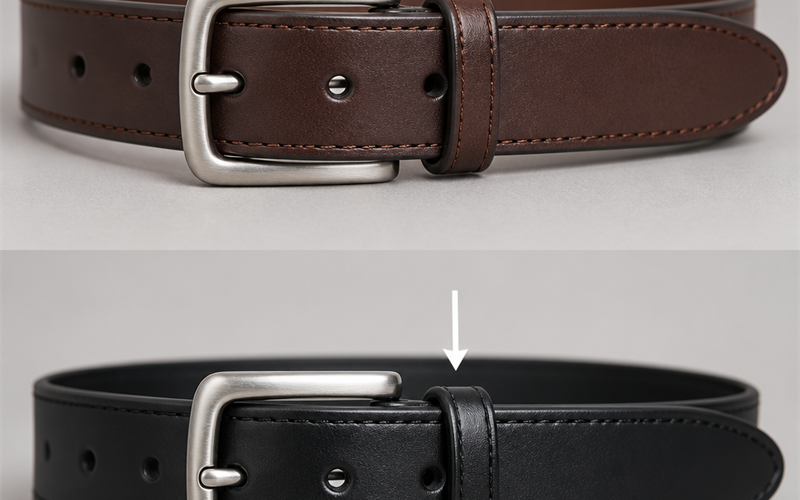
The repairable kind: BELTLEY's full-grain collection.
How do you decide whether to repair or replace?
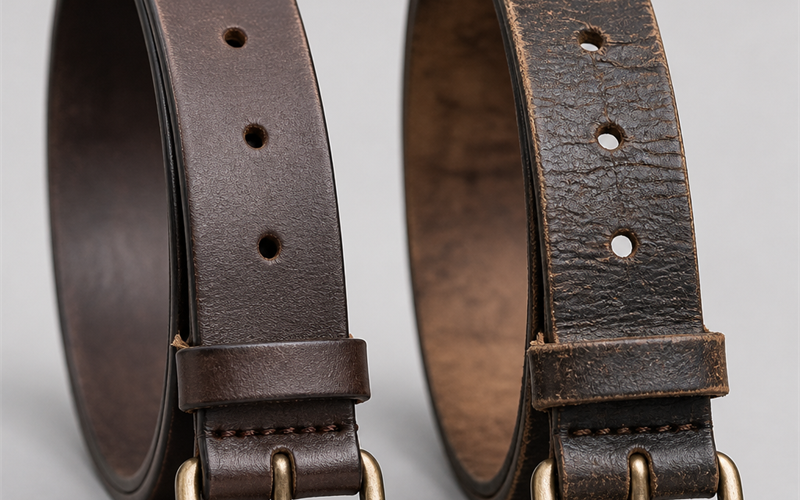
Run four quick checks: 1) Is it full-grain leather? Yes → repairable. Bonded or split → usually not worth it. 2) Is the leather around the hole torn? Yes → not repairable. No tears → repairable. 3) Are multiple holes stretched? One or two → repairable. Four or five → replace. 4) Is the strap still flexible and intact elsewhere? Yes → repair. Cracking or peeling → replace.

If three of four checks favor repair, repair. If two or fewer, the belt has reached the end of its life and should be replaced. The most reliable single signal is the leather grade — bonded leather repairs almost never hold because the fiber structure that would anchor a new hole isn't there.
Repair option 1 — re-punch a new hole
A new hole 0.5" away from the stretched one is the cleanest repair. Mark the new location precisely (use a ruler — alignment matters), punch with a rotary leather punch ($8-$15 on Amazon), and back-burnish the interior with a drop of edge paint or beeswax. The stretched original hole stays in place but becomes the "loose" rotation hole; the new hole becomes the primary.
This works because full-grain leather holds its structure indefinitely around a clean punch. The repair is invisible at arm's length and adds 5-10 years of life to the belt. Detailed walkthrough in our guide on how to add an extra hole to a leather belt.
Repair option 2 — let a cobbler do it
A cobbler will re-punch the hole, back-burnish the interior, and inspect the surrounding leather for hidden damage. Cost: $15-$25, completed while you wait. Most cobblers in any mid-sized city handle this regularly. Bring the belt with a ruler measurement of where you want the new hole, or let the cobbler size it on your waist directly.

The cobbler advantage is back-burnishing — they have proper edge paint and a burnishing wheel, producing a hole that looks factory-original. DIY repairs are functional but sometimes visibly amateur. If the belt is sentimental, expensive, or both, $20 at the cobbler is the better path.
Repair option 3 — small leather patch behind the stretched hole
For belts where the hole is functional but oval-stretched, you can adhere a thin leather patch (0.5" square, same color) to the back of the strap behind the damaged hole using contact cement. The patch re-creates the missing fiber density, and the prong then catches against the patched layer rather than the worn original. This works for moderate stretch; severe stretching requires re-punching.
This is the only repair where adhesive belongs anywhere near the belt. The patch goes on the back, never inside the hole itself.
Key stat: A re-punched and back-burnished hole on a full-grain belt typically lasts another 8-15 years — often outlasting the rest of the strap.
The "fix" you should never do
Never fill a stretched belt hole with leather glue, hot glue, or any adhesive. This is the most common YouTube advice and it actively destroys the belt. Adhesive inside the hole creates a rigid plug that doesn't flex with the leather; the surrounding fibers then tear during use, expanding the damage zone. Belts "repaired" this way usually fail completely within 60-90 days.

The temptation is obvious — the hole looks too big, fill the gap. But hole stretching isn't about the gap; it's about fiber failure in the surrounding leather. Adding adhesive doesn't restore fibers; it just creates a stress point. Always re-punch or patch from behind. Never fill.
Repair vs replace: cost-benefit comparison
| Belt Original Retail | DIY Repair | Cobbler Repair | Replace (Similar Quality) | Recommendation |
|---|---|---|---|---|
| $20-$50 (likely bonded) | Often fails | Not cost-effective | $50-$100 | Replace with quality piece |
| $50-$100 (genuine leather) | Possible, mixed results | $15-$25 | $100-$150 | Repair if leather is decent |
| $100-$200 (full-grain) | Reliable | $15-$25 | $150-$300 | Repair confidently |
| $200-$500 (exotic, heritage) | Possible but risky | $20-$40 | $400-$800+ | Cobbler repair |
| $500+ (Hermès, BELTLEY exotic) | Don't risk it | Brand-authorized repair | $1,000-$5,000+ | Authorized repair only |
When should you absolutely not repair?
Don't repair a belt when: 1) the leather is delaminating (top layer separating from backing — characteristic of bonded leather end-of-life), 2) cracks have appeared in the strap independent of the holes, 3) the buckle is failing in addition to the holes, or 4) the belt is showing dye loss or color fading severe enough that a repaired patch will look mismatched. Any one of these is a strong "replace" signal.

For exotic-leather pieces like those in our crocodile belt collection, always send the belt back to the original maker for authorized repair rather than attempting DIY. Exotic scales can crack during punch operations performed by anyone without species-specific experience.
What does back-burnishing add to the repair?
Back-burnishing seals the interior of the punched hole — preventing the fiber fraying that causes early stretch. Without back-burnishing, even a freshly-punched hole on full-grain leather will stretch faster than it should because the raw cut fibers wear under the prong. Burnishing extends the hole's life roughly 3-5x.

You can DIY back-burnish with a drop of edge paint (Fiebing's edge paint, $8 a bottle) applied with a toothpick and allowed to dry, or with a small amount of beeswax rubbed in with friction. Cobblers use a heated burnishing wheel that produces a glossier finish, but the chemistry is identical. This is also the same principle behind why our full-grain leather belts come from the factory with every hole back-burnished — we don't ship holes that aren't finished, even though it adds labor cost.
Related BELTLEY guides
- Why Are My Belt Holes Wearing Out So Fast? — root causes of hole failure
- How to Add an Extra Hole to a Leather Belt (Without Ruining It) — DIY punch walkthrough
- The Worst Care Mistakes That Quietly Kill Leather Belts — preventable damage
- Why Some Belts Fail Within 18 Months: Staples vs Rivets vs Stitched Loops — broader construction failure
- How to Tell Full-Grain from Bonded Leather — repair candidacy diagnosis
The Bottom Line
A stretched belt hole is a repair decision in 60 seconds: full-grain leather with one or two stretched holes and an intact strap is almost always worth repairing — DIY or cobbler. Bonded leather with multiple stretched holes or delaminating strap is almost always worth replacing. Skip the leather-glue "fix" entirely; it accelerates damage rather than reversing it. At BELTLEY, every belt ships with a 10-year construction warranty that covers stretched holes from defects in materials — and our men's belt collection is built so repairs are rarely needed in the first place.
Frequently Asked Questions
Q: How much does it cost to fix a stretched belt hole at a cobbler?
Most cobblers charge $15-$25 for a re-punch and back-burnish, completed while you wait. Belt-specific specialists (luxury leather repair shops in major cities) charge $30-$50 with original-quality finish work.
Q: Can I fix a stretched belt hole permanently?
Yes — re-punching the hole 0.5" away and back-burnishing the interior typically adds 8-15 years to the belt's life. The original stretched hole stays in place but becomes a secondary rotation position rather than the daily primary.
Q: Will conditioning leather fix a stretched belt hole?
No. Conditioning improves leather suppleness and prevents future damage but cannot restore stretched fibers. Once a hole has gone oval, the fiber damage is permanent — the only fix is mechanical (re-punch or patch).
Q: Should I repair an old belt or buy a new quality belt?
Math favors repair for belts originally retailing over $100 with intact straps. For sub-$50 belts (likely bonded leather), the repair often fails within months — buying a new full-grain belt is usually the better long-term value.
Q: Can a belt with a torn hole still be saved?
If the tear is small (under 3mm) and the leather around it is full-grain and intact, a cobbler can patch the back, re-punch a new hole nearby, and reinforce the strap. Larger tears or tears on bonded leather usually mean the belt is past saving.