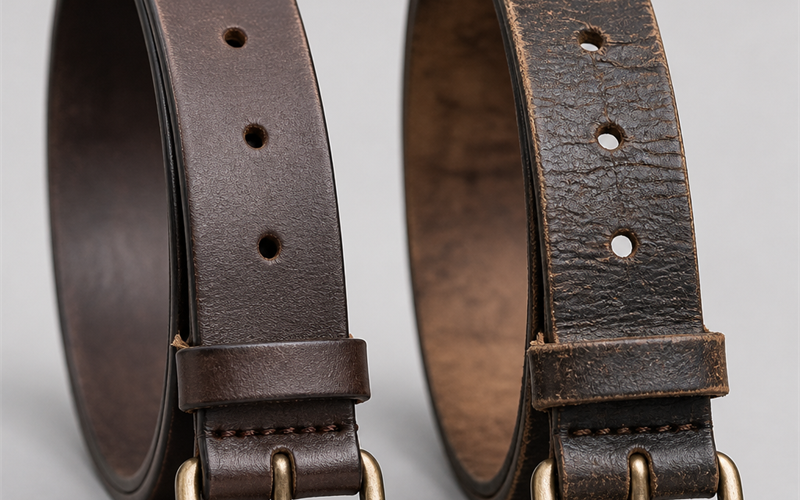
Belt for University Professors (Tenure-Track Style)
Quick answer: Tenure-track professors should wear a 1.18"–1.25" smooth full-grain leather or calfskin belt in espresso or matte black, with a slim, unbranded prong buckle. The look is intentional understatement — academia rewards credibility over fashion, and a quiet, well-made belt signals exactly that. Save designer pieces for the conference dinner, not the lecture hall.
Last updated: May 2026 • By BELTLEY Editorial
TL;DR:
- Academia rewards "intentional understatement" — credible, not flashy. The belt is a major part of how senior faculty read junior faculty.
- Default: 1.18"–1.25" smooth full-grain leather, espresso or matte black, slim brass or silver prong buckle.
- Skip Western buckles, distressed belts, and logo belts — all read out of place in a humanities department.
- For job talks and conference keynotes, upgrade to smooth calfskin with a slim polished plaque or dress prong buckle.
The tenure-track professor's wardrobe sits in a narrow band — readable as professional, not stuffy; intellectual, not performative; current, but not chasing trends. Senior faculty read junior faculty constantly during the tenure clock, and accessories factor into the broader read on whether the candidate "fits the department." Wikipedia's tenure entry describes the typical six-year probationary period during which research, teaching, and service all get evaluated; visible self-presentation is read alongside the rest. A quiet, quality belt removes one variable from the assessment. Our dress belts and full-grain leather belts collections are the right starting point.
What belt does a tenure-track professor actually wear?
A tenure-track professor most commonly wears a 1.18"–1.25" smooth full-grain leather belt in espresso brown or matte black, with a simple, unbranded silver or brass prong buckle. The look reads "professional but not corporate" — which is the precise register academia targets. Field-specific variations exist (humanities lean toward warmer tones and softer leather, sciences and economics lean toward black and slightly more formal), but the underlying width and buckle logic is consistent.

For the job-talk visit and tenure-review presentation, the upgrade is a smooth black calfskin dress belt with a slim polished plaque buckle — paired with a sport coat or full suit. Outside those events, the daily belt is the brown full-grain. We unpack the dress-versus-casual distinction in dress belt vs. casual belt and the color logic in brown belt vs. black belt.
Why does academia notice belts at all?
Academia notices belts because accessories are read as proxies for self-awareness, and self-awareness is read as a proxy for intellectual judgment. A faculty candidate who shows up to a campus visit in a Western tooled belt with a turquoise inlay buckle isn't going to lose the job over the belt, but the belt becomes a footnote in the candidate's file — "interesting style choice" — and footnotes accumulate.

The standard academic dress reference, Wikipedia's academic dress entry, covers the formal regalia worn at convocations and degree ceremonies — but day-to-day faculty dress is unwritten, learned by department immersion, and surprisingly consistent across R1 universities. The belt sits inside that unwritten code.
Key stat: A typical tenure-track faculty member teaches 3–4 days per week for 6–7 years before the tenure decision — roughly 900+ teaching days during which the same belt may be worn. A bonded-leather belt fails inside year three; a quality full-grain belt outlasts the entire tenure clock.
What color belt for which academic context?
Academic context dictates color more than personal preference. Espresso or warm brown for lecture-hall teaching and office hours (the default); matte black for job talks, tenure presentations, department chair meetings, and external grant interviews; oxblood or cognac for conference keynotes and named-lecture invitations (slightly distinguished without being loud).
Professor belt by context
| Context | Belt | Width | Buckle |
|---|---|---|---|
| Daily teaching / office hours | Espresso or warm brown full-grain | 1.18"–1.25" | Brushed brass or solid copper |
| Department meetings | Espresso or matte black | 1.18"–1.25" | Polished or brushed |
| Job talk / campus visit | Matte black smooth calfskin | 1.18"–1.25" | Slim polished plaque |
| Tenure review presentation | Black smooth calfskin | 1.18"–1.25" | Slim dress prong |
| Conference keynote | Oxblood, cognac, or black | 1.18"–1.25" | Slim polished |
| Named lecture / honorary | Black calfskin or subtle crocodile | 1.18"–1.25" | Slim polished plaque |
| Field work (sciences, anthropology) | Saddle full-grain | 1.25"–1.5" | Solid brass prong |
For full color logic, see our breakdown of what color belt goes with everything.
Are designer or logo belts a mistake in academia?
Yes — in most academic contexts, visible-logo belts (Gucci G, Hermès H, Ferragamo Gancini) read as out of place. The signal mismatch is real: academia explicitly does not reward luxury signaling, and a logo belt at a department mixer announces a class identity that doesn't match the institutional culture. The exception is professional schools (law, business, medicine) where finance-adjacent signaling is more acceptable.

For tenure-track candidates specifically, the safest move is unbranded leather. A senior partner at a hedge fund wearing a logo belt signals one thing; a tenure-track assistant professor wearing the same belt signals another. We covered the broader quiet luxury logic for adjacent professions; it applies even more strictly in academia.
Should the belt match the elbow-patch jacket cliche or modernize?
For most modern tenure-track professors, the elbow-patch tweed jacket has been replaced by a wool blazer, a softer cotton sport coat, or even a high-quality cardigan over a button-down. The belt logic is the same regardless: full-grain leather, conservative buckle, color matched to shoes. The 1970s humanities-professor uniform is largely retired in 2026, but the underlying register (intellectual, intentional, unflashy) is unchanged.

What this means practically: pair the belt with the actual outfit you wear, not the imagined one. A wool blazer over chinos calls for an espresso full-grain belt with a brushed brass prong buckle. A cardigan over a button-down and dark denim calls for the same belt. The full-grain leather belt is the single accessory that bridges every variation. See our men's dress belts for the right options.
What belt for a job talk or campus visit?
For a job talk or campus visit — typically the most consequential dress event in a tenure-track career — the right belt is a smooth black calfskin belt with a slim polished silver or brushed nickel plaque or dress prong buckle, paired with a sport coat and dress trousers or a full suit (field-dependent). The belt should disappear under a buttoned jacket and read clean when seated. Avoid casual textures, contrast stitching, or any width over 1.25".

The visit is judged on every variable, but the goal is to remove "what is this candidate signaling with their belt" from the list. The cleanest path is the quietest belt. For more on the precise belt-to-suit logic, see what is a formal belt for men.
The Bottom Line
The tenure-track professor's belt is an exercise in intentional understatement: 1.18"–1.25" smooth full-grain leather or calfskin, espresso or matte black, slim unbranded buckle in brass or silver. The look reads professional and credible — the two qualities that matter most during the tenure clock. Skip logos, statement buckles, and anything that pulls attention. At BELTLEY, we handcraft dress belts without visible branding, in full-grain leather with sealed edges and solid metal hardware, with a 10-year warranty. One quality belt covers an entire tenure-track career. Browse our dress belts, brown leather belts, and black leather belts collections.
Frequently Asked Questions
Q: Does the belt rule differ between R1 universities and liberal arts colleges?
Slightly — liberal arts colleges tend toward warmer tones and softer leather (cognac, oxblood), while R1 universities lean toward matte black and espresso. Both register as intentional understatement; the palette differs at the margin.
Q: What belt should an adjunct or postdoc wear?
The same quiet-luxury rules apply: 1.18"–1.25" smooth full-grain leather, espresso or matte black, unbranded buckle. Adjuncts and postdocs are often more closely scrutinized than tenure-track candidates because they're being evaluated for the next role.
Q: Is a crocodile belt acceptable for a senior professor?
Yes — a smooth black or espresso crocodile belt with an unbranded slim buckle reads as quality, not flash, particularly for endowed-chair holders, deans, and named-lecture speakers. Our crocodile leather belts collection has dress-cut options.
Q: Should the belt match shoes exactly?
Color family yes, exact finish no. Espresso belt with espresso or chestnut shoes. Black belt with black shoes. Patent versus matte mismatches are acceptable at the academic register; perfect tonal matching reads corporate.
Q: Do female faculty follow the same rules?
The principles transfer — quiet, quality, unbranded — at a narrower width (1"–1.18") and often with dress shoes that drive the color. See our women's belts collection.
Q: How often should I replace an academic belt?
A quality full-grain leather belt lasts 8–10+ years of normal academic wear. Inspect annually for cracking at prong holes or wear at the buckle attachment; condition once a year with a small amount of leather balm. Replace when the leather visibly cracks, not before.