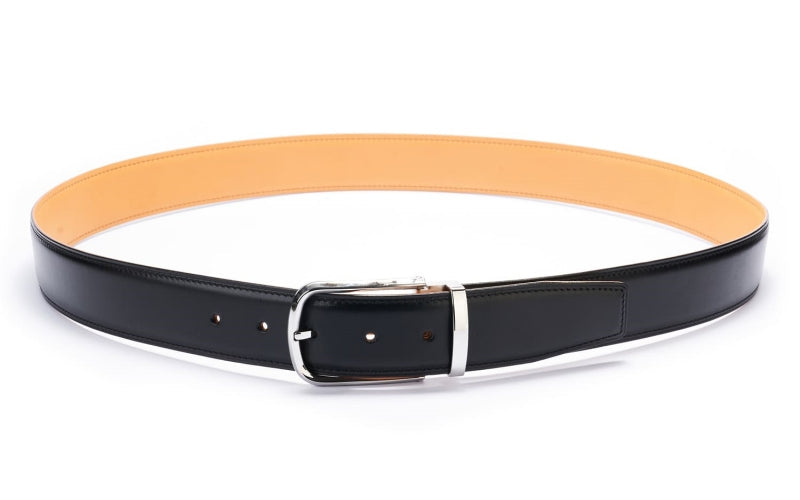
What Is a Formal Belt for Men? The Complete Dress Belt Guide
TL;DR:Quick answer
- A formal belt for men is a slim (1"–1.25"), smooth leather belt with a small, polished metal buckle in black or dark brown — designed to complement suits and tailored trousers without drawing attention to itself.
- The belt must match your shoes in color and shine level, and the buckle metal must match your watch and cufflinks.
- Never wear a belt with a tuxedo (traditional rule), and never wear a belt and suspenders at the same time.

A formal belt isn't just a thinner version of a casual belt. It's a different category entirely — built from different leather, finished differently, buckled differently, and governed by matching rules that don't apply to weekend wear. Get it right and nobody notices, which is the point. Get it wrong and the belt becomes the only thing people see.
This guide defines exactly what makes a men's belt "formal," covers the rules for wearing one with suits and formalwear, and explains where exotic leathers and 2026 trends fit in. If you're choosing between a dress belt and a casual belt, start here.

What Does Your Event Require?
Formality has levels — find yours:
| Your situation | Go with |
|---|---|
| Tuxedo / black-tie | No belt at all — suspenders or side-adjusters. The trousers shouldn't even have loops. |
| Dark suit, business formal | 1"–1.25" smooth black calfskin, small polished silver buckle. |
| Navy or gray suit, less rigid office | Dark brown or espresso works — match shoes exactly in color and shine. |
| Formal but want quiet distinction | Glazed crocodile in black ($118–$289) — formal-legal and unmistakably finer up close. |
Dress widths and glazed exotics: BELTLEY's men's belts ship in 2–3 days.
What Defines a Formal Belt for Men?
A formal belt is defined by five characteristics: narrow width (1"–1.25"), smooth polished leather, a small understated buckle, a classic color (black or dark brown), and clean finished edges. Every attribute is designed to be functional and invisible — the belt serves the outfit without competing with it.
The Art of Manliness' belt guide and Real Men Real Style's belt infographic both define formal belts using this same framework. The standard hasn't changed in decades — and for good reason. Suits are designed with clean, unbroken lines from shoulder to shoe. A slim, matching belt maintains those lines. A thick, textured, or flashy belt breaks them.

What Width Should a Formal Belt Be?
A formal belt should be 1"–1.25" (25–32mm) wide. This is the standard dress belt width — it fits the narrow belt loops sewn into suit trousers and dress pants, and it sits proportionally against tailored fabrics without creating bulk.
Here's how width maps to formality:
| Width | Formality | Best With |
|---|---|---|
| 1" (25mm) | Most formal | Slim-cut suits, evening wear |
| 1.25" (32mm) | Business formal | Standard suits, dress trousers |
| 1.38" (35mm) | Business casual | Blazer combos, chinos, unstructured suits |
| 1.5"+ (38mm+) | Casual | Jeans, weekend wear — not for suits |
Permanent Style's belt capsule guide recommends keeping suit belts at 1.25" maximum, noting that anything wider "interrupts the clean lines of tailored trousers." For the complete measurement breakdown, see our belt width guide in MM.

What Leather Is Best for a Formal Belt?
Smooth, polished full-grain calfskin is the gold standard for formal belts. The surface should have a consistent color, minimal visible grain, and a subtle sheen that matches the polish level of your dress shoes.
Formal-appropriate leathers:
- Smooth calfskin — the classic. Polished, clean, pairs with everything from charcoal worsted to navy flannel.
- Box calf — similar to calfskin but with a tighter grain and higher natural sheen. Hermès uses this on their formal H Buckle straps.
- Shell cordovan — a deep, mirror-like finish that ages beautifully. The connoisseur's choice.
- Glazed crocodile or alligator — the most elevated formal belt leather. A high-gloss finish from agate stone polishing creates a surface that complements suits and evening wear. The natural scale pattern adds texture without the "roughness" of casual leathers. Browse BELTLEY's crocodile belt collection for handcrafted options in this category.
Not formal: Suede, nubuck, distressed leather, braided leather, canvas, and any belt with visible embossing or heavy texture. These belong in casual territory.

What Buckle Style Is Correct for a Dress Belt?
A small, flat frame buckle with a single prong in polished silver or gold is the standard formal buckle. The buckle should lie flat against the waist, sit flush with the trouser's front closure, and never protrude or catch attention.
| Buckle Type | Formal? | Notes |
|---|---|---|
| Single-prong frame | Yes — the standard | Classic, universally accepted |
| Flat plaque (no logo) | Yes | Clean, minimal, modern formal |
| Ratchet/micro-adjustable | Emerging | Accepted in business settings if buckle is slim and mechanism is concealed |
| Box buckle | Business casual | Slightly less formal than frame |
| Western/oversized | No | Casual only |
| D-ring | No | Canvas/casual only |
The buckle metal must match your other visible hardware. Silver buckle → silver watch, silver cufflinks. Gold buckle → gold watch, gold accessories. The Gentleman's Gazette calls this "the single most overlooked matching rule in men's dressing."
At BELTLEY, every buckle is crafted from stainless steel — the same alloy used in surgical instruments and Swiss watch cases. A polished stainless steel buckle maintains its finish indefinitely, which matters when you're matching it to fine accessories daily.

How Do You Match a Formal Belt to Your Suit?
Match the belt to your shoes in both color and shine level — then match the buckle metal to your watch and cufflinks. This is the foundational rule of formal belt styling, and virtually every menswear authority from Permanent Style to FashionBeans agrees on it.
Here's the color matching cheat sheet:
| Suit Color | Belt Color | Shoe Color |
|---|---|---|
| Charcoal / black | Black | Black oxfords or derbies |
| Navy | Dark brown or black | Brown brogues or black cap-toes |
| Medium grey | Dark brown or cognac | Brown derbies or monks |
| Tan / light grey | Cognac or tan | Light brown loafers |
A polished black belt with polished black shoes and a charcoal suit is the safest combination in menswear — appropriate for interviews, funerals, courtrooms, and any situation where getting it wrong carries consequences. For more matching guidance, see our guide on how to match belts and shoes.
Can You Wear a Belt with a Tuxedo?
No — not under traditional black-tie rules. A tuxedo should be worn with suspenders (braces) or a cummerbund, not a belt. The clean, unbroken front line of a tuxedo shirt is designed to be uninterrupted by a buckle. The Gentleman's Gazette's black-tie guide is explicit: a belt has no place in formal evening wear.
The modern exception: if your tuxedo trousers have belt loops (some contemporary cuts do) and you skip the suspenders, a very slim black leather belt with a matte black or polished black buckle is tolerated at "creative black tie" events. But it's a compromise, not a best practice.
One absolute rule: Never wear a belt and suspenders at the same time. They serve the same function, and wearing both signals that you don't understand either one.
Should You Wear a Belt to a Job Interview?
Yes — a formal belt is essential for job interviews. It signals attention to detail, which interviewers notice even if they can't articulate why. Holdform's 2026 formal belt guide lists interviews alongside client meetings as situations where a dress belt is non-negotiable.
The interview belt formula:
- Width: 1.25" (32mm)
- Leather: Smooth black calfskin or full-grain leather
- Buckle: Silver or nickel frame buckle, polished
- Match: Black shoes, silver watch
This combination is invisible — which is exactly the point. You want the interviewer focused on your answers, not your accessories.
How Should a Formal Belt Fit?
A formal belt should fasten at the middle hole (the third of five). Buy a belt that's 1–2 inches longer than your trouser waist size. The tail should extend 2–3 inches past the buckle and tuck cleanly into the first keeper loop — no dangling, no excess bunching.
If you're between sizes, size up rather than down. A belt straining at the last hole looks worse than one with slightly more tail. BELTLEY's size guide maps exact measurements to help you order the right length the first time.
The Bottom Line
A formal belt for men is simple in concept — slim, smooth, polished, understated — but the details matter. The width fits suit trouser loops. The leather matches your shoes in color and sheen. The buckle matches your watch and cufflinks. The edges are clean.
The fit is precise. None of it is accidental. A well-chosen dress belt is the difference between a suit that looks assembled and one that looks worn — with intention, by someone who understands the details.
Browse BELTLEY's dress belts collection for handcrafted options in full-grain and exotic leathers, built with stainless steel buckles designed to hold their polish for years.
Frequently Asked Questions
Q: What is the difference between a formal belt and a casual belt?
A formal belt is narrow (1"–1.25"), smooth leather, with a small polished buckle. A casual belt is wider (1.5"+), often textured or distressed, with larger or decorative hardware. Read our full comparison in the formal vs. informal belts guide.
Q: What color dress belt should every man own?
Black and dark brown. A black dress belt covers charcoal and navy suits with black shoes. A dark brown belt covers navy, grey, and earth-toned suits with brown shoes. These two belts handle 95% of professional wardrobe needs.
Q: Is a ratchet belt appropriate for formal wear?
Increasingly, yes — in business and business-casual settings. The key is a slim buckle with a concealed ratchet mechanism. Ratchet belts are not yet standard for black-tie events or ultra-conservative offices, where a traditional prong buckle remains the convention.
Q: Can you wear a crocodile belt with a suit?
Yes — glazed crocodile and alligator leather are among the most formal belt materials available. The high-gloss finish complements worsted wool and evening fabrics. Matte-finished exotic leather is better suited for smart-casual and blazer looks.
Q: Should your belt match your shoes exactly?
For formal settings, match as closely as possible — same color family and similar shine level. An exact shade match isn't always achievable, but black with black and brown with brown is the minimum standard. Casual settings are more forgiving.
Q: Do you wear a belt or suspenders with a suit?
Either — but never both. Suspenders are more traditional for formal wear and eliminate the visual interruption of a buckle. Belts are more common in modern business settings. Choose based on your trouser construction: side tabs suggest suspenders, belt loops suggest a belt.
,%20smooth%20leather%20belt%20with%20a%20small,%20polished%20metal%20buckle%20in%20black%20or%20dark%20brown%20%E2%80%94%20designed%20to%20complement%20suits%20and%20tailored%20trouse...)