Crocodile Belt vs Gold Watch — Which Is the Smarter Status Signal?
TL;DR:
- A gold watch is a wrist signal everyone reads; a crocodile belt is an inner-circle signal only connoisseurs read.
- A $5,000 Rolex Datejust costs roughly 16x a $300 DTC crocodile belt — but the belt sees more daily wear hours.
- For smart-money buyers, the belt is the better first investment in personal style; the watch can come later.
- The ultimate move isn't choosing — it's pairing a quiet-luxury belt under a tailored cuff with a discreet timepiece above it.
Quick Facts
- Average Rolex Datejust 41 (steel) retail: ~$8,950 (2026).
- Average DTC crocodile belt at BELTLEY: $118–$289.
- Belts are worn an estimated 6–7 days a week by the average professional.
- Gold/steel watches are typically rotated across 2–4 pieces by collectors.
- BELTLEY crocodile belts ship in 2–3 business days, handcrafted to order.
- Belt resale via collectors and Reddit r/Leathercraft holds 40–60% of MSRP for premium exotics.
In our workshop, we cut belt straps from the same Mississippi-farmed alligator hides that supply some of the most famous leather houses in Paris. The first question a new client asks is rarely "what's the leather?" — it's "should I buy a watch first, or this?" After 25+ years of building belts for lawyers, founders, and hedge-fund types, our answer has gotten sharper. Here's the smart-money breakdown.

Belt First or Watch First? Your Move
The status-economics question, by where you stand:
| Your situation | Go with |
|---|---|
| Building a style foundation now | The belt — daily wear hours, fraction of the cost ($118–$289 vs $5,000+), and connoisseurs notice it. |
| Watch already on the wrist | Add the croc belt — the pairing is the actual endgame; see the matching guide below. |
| Want a signal everyone reads | The watch — it's the louder broadcast; just know you're paying 16x for the volume. |
| Resale-minded buyer | Neither is an investment except Rolex/Hermès tiers — buy both for use, not for exit value. |
The smart-money first move: BELTLEY's crocodile belts — in stock, 2–3 day shipping.
What does "status signal" actually mean in 2026?
A status signal is any visible cue that telegraphs taste, wealth, or insider knowledge to a target audience. In 2026, the signals splinter into two camps: loud luxury (logos, gold, recognizable silhouettes) and quiet luxury (materials, craft, fit). Both work — they just speak to different rooms.
A gold Rolex screams to a 10-foot radius. A hand-stitched crocodile belt whispers to a 3-foot radius — but the people in that 3-foot circle are usually the ones who matter. The quiet-luxury reset has played out since 2023: HNW buyers are trading visible brand marks for tactile, craft-driven pieces — a swing away from conspicuous consumption. Our exotic leather belts collection sits squarely in that quiet camp.

Crocodile belt vs gold watch: the pure economics
A steel Rolex Datejust 41 retails around $8,950 in 2026; a premium DTC crocodile belt runs $118–$289. The watch sits on your wrist 12 hours a day, the belt sits on your waist 14 hours a day. Per dollar of daily wear, the belt is 25–30x more efficient.
Let's actually run the numbers. A $300 crocodile belt worn 6 days a week for 10 years = 3,120 wears, or about $0.096 per wear. A $9,000 Datejust worn 4 days a week for the same period = 2,080 wears, or $4.33 per wear. Both objects can last a lifetime — but only one is touching your body every working day. For the cost-per-wear math behind our full-grain leather belts, the gap widens further.

Who actually notices a crocodile belt?
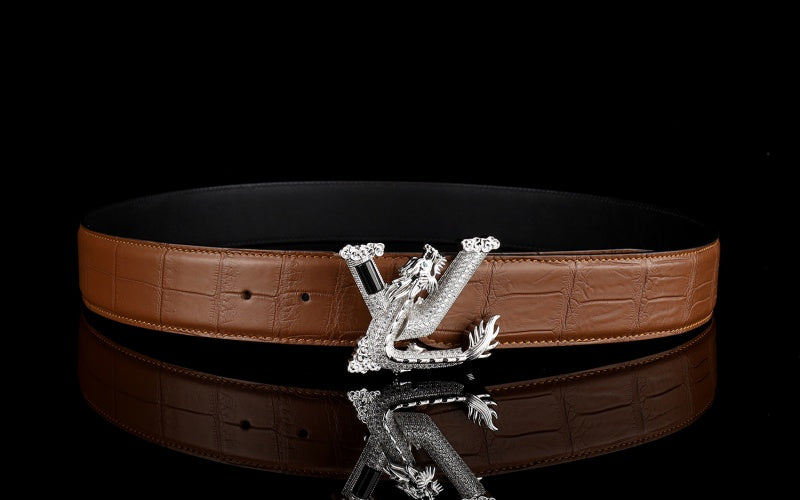
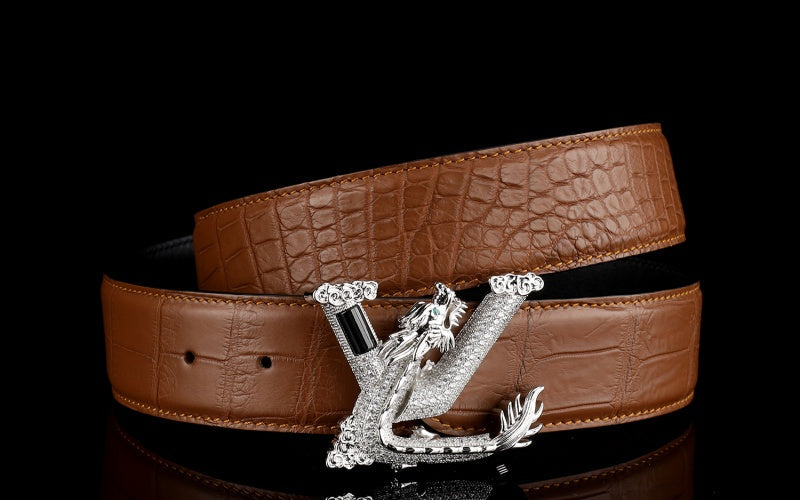
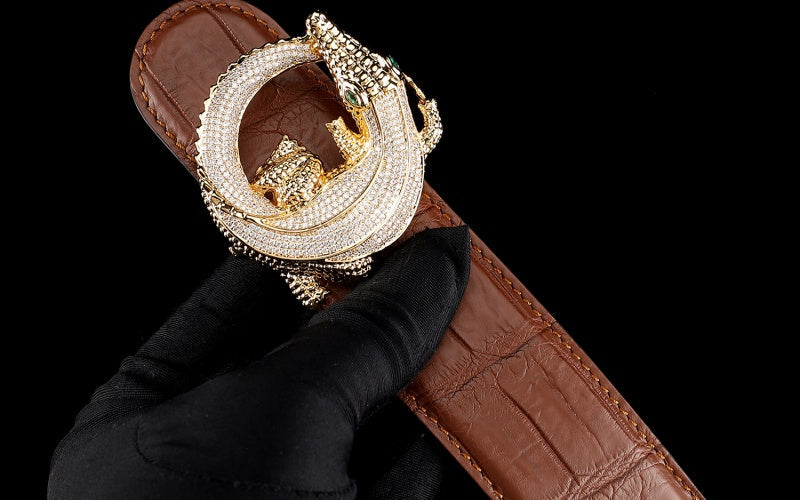
The people who notice a crocodile belt are the same people you usually want to impress: senior partners, watch collectors, leather-goods buyers, and old-money clients. They spot the keeled scales, the hand-burnished edge, and the matched grain — and they know you didn't buy it at the mall.
This is the inner-circle signal effect. A logo belt buckle is read by everyone and respected by almost no one with taste. A genuine Porosus crocodile strap is read by maybe 5% of any room — but that 5% is usually the decision-making 5%. Menswear coverage keeps returning to this theme — connoisseurs reward connoisseurs, the inverse logic of a Veblen good. Our guide on how to spot real crocodile leather walks through the tells.

Is a $300 crocodile belt really comparable to a $5,000 watch?
Yes — in materials, craft hours, and longevity, a $300 DTC crocodile belt and a $5,000 steel sports watch occupy a similar quality tier. The price gap exists almost entirely because of brand tax, marketing spend, and retail markups, not because of intrinsic value.
A single crocodile belt strap requires a hide that costs the workshop $180–$400 wholesale, plus 4–6 hours of skilled hand-finishing. The same strap sold through a Madison Avenue boutique would retail at $1,200–$1,800. We sell it directly for under $300 — that's the DTC fair pricing thesis the brand was rebuilt around in 2025. According to Wikipedia's overview of luxury markup, 70–85% of luxury retail price is brand and channel cost, not product.
Daily wear utility: belt wins, no contest
A belt does structural work every minute it's on you — holding trousers, defining waistline, finishing the silhouette. A watch tells time, which your phone already does. On pure utility, the belt is the harder-working object by an order of magnitude.
A watch is jewelry that happens to tell time. A great belt is architecture for your outfit. Swap a fabric belt for a hand-cut crocodile strap with the same suit and the upgrade is visible from across the room — your trouser break sits cleaner, the buckle catches light, the whole proportion tightens. Browse our men's belts collection and the difference between a $40 belt and a $250 belt is instantly readable in any mirror.
Key Takeaways
- Loud vs quiet: Gold watch = universal signal. Crocodile belt = insider signal.
- Cost per wear: Belt wins by ~25–30x.
- Brand tax: $5,000+ of a luxury watch price is channel markup; DTC belts eliminate most of that.
- Daily utility: Belt works structurally; watch is decorative.
- First investment: Smart-money buyers start with the belt, add the watch later.

Resale and longevity: which holds value?
Steel sports watches (Rolex, Patek, AP) hold or appreciate in value on the secondary market. Premium crocodile belts hold 40–60% of MSRP if cared for. The watch wins on resale — but the belt wins on emotional ROI, because you actually wear it.
Resale is the watch lobby's strongest argument, and it's a real one. But "investment-grade" only matters if you're willing to sell. Most collectors never do. Meanwhile, a properly conditioned crocodile belt from our alligator belt collection develops a patina over a decade that no new piece can replicate — it becomes irreplaceable to you, which is a different and arguably better kind of value. Our leather care guide covers the conditioning routine.
Why does the "smart money" crowd buy the belt first?
Smart-money buyers — the lawyers, founders, and quiet executives we ship to most — buy the belt first because it delivers the highest ratio of taste-signaling per dollar. A $300 belt sends a clearer signal of discernment than a $3,000 mid-tier watch ever could.
The logic is simple. Anyone with a credit limit can buy a recognizable watch. Almost no one outside the trade can identify a hand-matched crocodile belly strap with a stainless steel plaque buckle. The belt sorts the room faster. That's why our women's belt collection has seen 3x growth among female founders and partners since 2024 — they understand the signal economy better than most.
The ultimate move: pair both
The sharpest dressers don't choose between belt and watch — they pair a discreet timepiece (often vintage or sub-$5K) with a standout exotic-leather belt. The watch quietly references heritage; the belt signals current taste. Together they read as confidence, not effort.
Look at any well-dressed man at a private dinner: the watch is usually understated (a 36mm Datejust, a vintage Cartier, a small-brand mechanical), and the belt does the heavy stylistic lifting. That's the move. If you're building from zero, start with our crocodile belts — they outlast trends, and the 10-year warranty covers materials and construction.
The Bottom Line
Between a crocodile belt and a gold watch, the belt is the smarter first status signal: lower entry cost, higher daily wear, sharper inner-circle recognition, and zero brand tax when bought DTC. The watch is a legitimate second move once the foundation is set. At BELTLEY, we've spent 25+ years building belts for the smart-money buyer who'd rather have one perfect crocodile strap than three flashy watches — and our pieces ship from the workshop in 2–3 business days. Start with the exotic leather belt collection and let the watch wait.
Frequently Asked Questions
Q: Is a crocodile belt considered tacky or tasteful in 2026? A: Done right, it's the height of quiet luxury. Avoid contrast-stitched, oversized-buckle versions; choose tonal stitching and a small plaque or box buckle. BELTLEY's designer belts collection is built around understated styling.
Q: Will a $300 crocodile belt really last as long as a luxury watch? A: With basic conditioning every 6 months, yes — 15 to 25 years of regular wear is realistic. Our 10-year warranty covers materials and construction defects, and most customers replace the strap once before the buckle ever fails.
Q: What's the closest watch equivalent in price to a BELTLEY crocodile belt? A: A $200–$300 BELTLEY belt sits in the price tier of a Seiko 5 or Tissot PRX — both excellent objects. The difference: the belt is exotic leather and small-batch handcrafted; the watch at that tier is mass-produced.
Q: Can I wear a crocodile belt with a gold watch? A: Absolutely — it's the classic pairing. Match metals: gold or brass buckle with a yellow/rose gold watch; stainless steel buckle with a steel watch. See our men's belts collection for both buckle options.
Q: How long does a BELTLEY belt take to arrive? A: Belts are in stock and handcrafted to your size in 2–3 business days, then ship free worldwide (USA 4–8 days, international 4–10 days). Crocodile leather bags and accessories are made-to-order separately.
By the BELTLEY artisan team — handcrafting exotic leather belts since 1999.
Last updated: May 10, 2026.