Upgrading from a Cowhide Belt to Crocodile — What Changes
TL;DR:
- Crocodile belts feel firmer, sit cleaner, and develop scale-driven character instead of cowhide's uniform patina.
- Expect a quieter, softer creak, a heavier hand, and a belt that holds its shape for decades with light care.
- Cost-per-wear typically beats premium cowhide because crocodile lasts roughly 3x longer when conditioned annually.
- Your buckle, sizing, and rotation habits stay the same — only your tailoring tightens up around it.
Quick Facts
- Material shift: full-grain cowhide → genuine crocodile (belly or hornback)
- Hand feel: uniform flex → segmented scales with subtle rigidity
- Lifespan with care: cowhide 5–8 years → crocodile 15–25 years
- Break-in time: cowhide ~2 weeks → crocodile ~3–5 wears
- BELTLEY production: in stock, handcrafted and shipped in 2–3 business days
- Warranty: 10-year coverage on materials and construction
I still remember the first crocodile strap I cut on my bench, right next to a fresh full-grain cowhide belt I'd made the day before. Same width, same buckle, same stitch count. Picked them up back to back and the difference was obvious before I'd even buckled one on. That's the moment most of our customers describe when they upgrade — the hand knows before the mirror does. Here's what actually changes when you make the jump.

What does a crocodile belt feel like compared to cowhide?
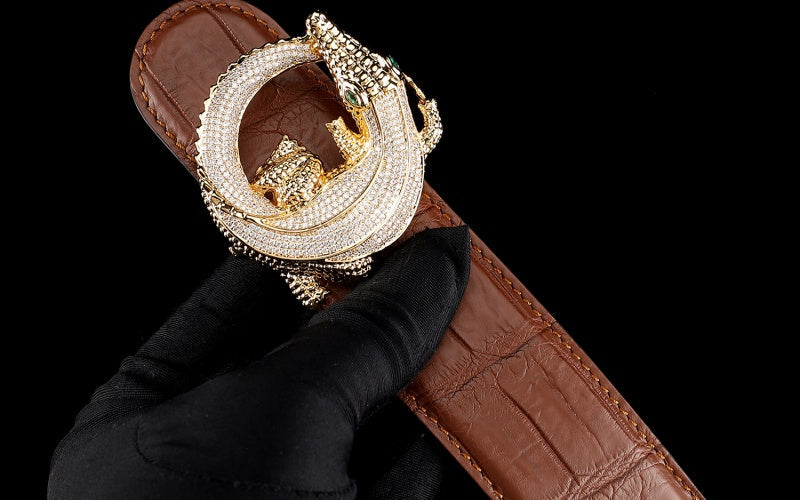
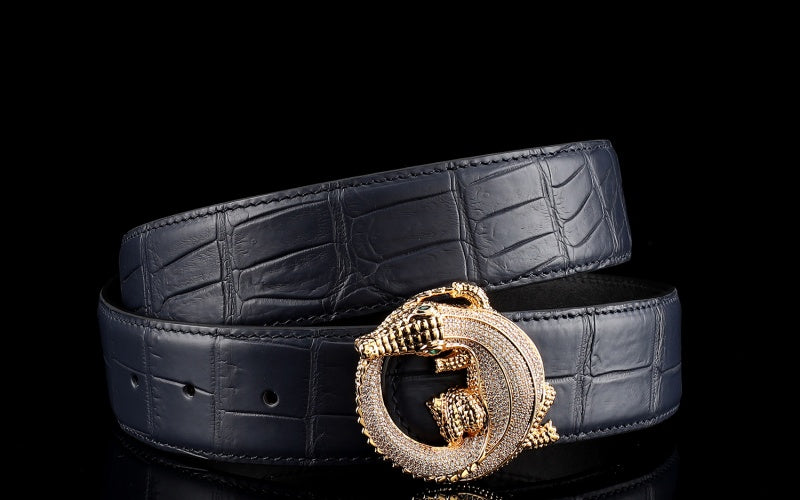
A crocodile belt feels denser, firmer, and texturally alive. Cowhide flexes uniformly across its length, while crocodile bends in segments along its scale pattern, giving a subtle "articulated" feel in the hand. The surface is cooler to the touch and has measurable grip against fabric — it doesn't slide through loops the way slick cowhide does.
The structural reason is simple. Cowhide is a continuous fiber network, so it bends as one sheet. Crocodile skin is organized around osteoderms — small bony plates beneath each scale — which is why menswear editors describe crocodile leather as having a "tactile sculpture" quality you don't get from cattle hides. On a 1.5" dress strap, that translates to a belt that wraps your waist with quiet authority instead of just lying flat.
If you want to compare hand feel against other exotics before deciding, our crocodile vs alligator leather guide breaks down the subtle scale differences.

How does the weight and sound change?
Crocodile belts weigh roughly 20–30% more than equivalent cowhide straps of the same width and thickness, and they sound softer. Cowhide creaks audibly when new; crocodile produces a low, muted shift — closer to a whisper than a creak — because the scale structure dampens vibration through the leather.
That weight isn't a burden — it's why crocodile sits anchored at your waist and doesn't ride up over a long day. The acoustic difference matters more than people expect. In a quiet office or restaurant, a fresh cowhide belt announces every shift in your seat. A crocodile strap stays discreet, which is part of why it reads as more formal even in identical styling.

Break-in: what's different?
Crocodile breaks in faster than cowhide but changes less. A quality cowhide strap takes about two weeks of regular wear to soften and start patinating. Crocodile is mostly comfortable inside 3–5 wears and then holds its shape for decades — it doesn't slouch, sag, or stretch the way cowhide eventually will.
Cowhide develops character through change: darkening at the buckle fold, lightening at the wear points, softening across the strap. Crocodile develops character through deepening: the scales gain depth and a quiet sheen, but the geometry stays intact. If you love the lived-in look, keep a cowhide in rotation. If you want a belt that looks the same in year ten as year one (only better), that's the crocodile advantage.
Annual conditioning is the only required maintenance — our leather care page covers the routine, and Wikipedia's entry on crocodile leather is a solid background read on why the skin behaves this way.

Is crocodile actually worth it? The cost-per-wear math.
Yes, for daily-driver belts crocodile usually beats premium cowhide on cost-per-wear. A $250 full-grain cowhide belt worn 4x/week for 6 years costs about $0.20 per wear. A $600 crocodile belt at the same cadence over 20 years costs roughly $0.14 per wear — and the crocodile still has resale value at the end.
The math gets stronger when you factor in replacements. Most men cycle through 3–4 cowhide belts in the lifespan of one well-cared-for crocodile. Secondhand exotic-skin pieces consistently hold 40–60% of retail value on the resale market, which no cowhide belt does. You're not buying a luxury — you're buying duration.
Our exotic leather belts collection is priced for that math: DTC fair pricing without the Brand Tax that pushes designer crocodile into $1,500+ territory.

Key Takeaways (mid-post)
- Crocodile is heavier, quieter, firmer, and more textural than cowhide.
- It breaks in fast and then stops changing — cowhide keeps evolving for years.
- Cost-per-wear favors crocodile when you wear it regularly and condition annually.
- Your existing buckles, sizing, and outfit fundamentals carry over directly.
How do your outfits need to change?
Crocodile demands cleaner tailoring around it. Cowhide forgives — it pairs with workwear, washed denim, casual chinos, and rumpled blazers. Crocodile pulls the eye, so anything baggy, distressed, or unfinished nearby will read as a mismatch. Sharper trousers, pressed shirts, and considered shoes make a crocodile strap look intentional instead of loud.
Practical adjustments most customers make in the first month:
- Trousers: shift from relaxed-fit to a cleaner taper. The belt becomes a focal point, so the line above and below it matters.
- Shoes: match leather tone families. A cognac croc with black shoes is a hard sell; with brown calf-leather oxfords or loafers it sings.
- Shirts: tuck more often. The buckle and first 3–4 inches of strap are the visible asset.
- Layers: an open jacket frames the belt; a closed sweater hides it. Plan around that.
For specific pairings, our how to style a crocodile belt guide gets into casual, business-casual, and formal applications.

What stays the same?
Almost all the practical fundamentals carry over. Your belt size doesn't change — measure where you normally wear it, add two inches, that's your size in crocodile too. Standard 1.5", 1.38", and 1.25" widths use the same buckle systems, so a quality plaque, ratchet, or box-and-prong buckle from your cowhide rotation will fit a same-width crocodile strap.
What also stays the same: rotation logic (rest each belt 24 hours between wears), storage (hung or loosely rolled, never folded tight), and the basic conditioning calendar. The BELTLEY size guide works identically for both materials, and our men's belts collection is built around interchangeable hardware so upgrades don't strand your old buckles.
When should you keep a cowhide belt in rotation?
Keep a cowhide belt for high-abuse contexts: travel days, outdoor weekends, garden-to-grill rotations, anywhere a scratch would bother you on a crocodile. Cowhide patinas beautifully through wear — crocodile prefers to be respected. A two-belt rotation (one daily croc, one weekend cowhide) is the setup most of our long-term customers settle into.
Specifically, a full-grain cowhide belt earns its place when you're:
- Wearing raw or selvedge denim that bleeds indigo
- Traveling through airports with rough conveyor belts
- Doing anything where a sharp edge might catch the strap
- Building patina intentionally as part of the look
The crocodile lives in the dress rotation; the cowhide lives in the everyday. Both age well — just on different timelines.
The Bottom Line
Upgrading from cowhide to crocodile isn't a side-grade — it's a category change. You're trading a strap that evolves with you for one that anchors an outfit decade after decade. The hand feel sharpens, the sound softens, the weight grounds you, and the math quietly works in your favor over time. The fundamentals — sizing, buckle compatibility, rotation discipline — all carry over, so the only real adjustment is letting your tailoring catch up to the belt. At BELTLEY, every crocodile strap is handcrafted in small batches, in stock, and ships in 2–3 business days, backed by a 10-year warranty. Browse the full crocodile belts collection when you're ready to make the jump.
Frequently Asked Questions
Q: Will my old buckle fit a crocodile belt of the same width? A: Yes — as long as the strap widths match (1.5", 1.38", or 1.25"), standard plaque, ratchet, and box-and-prong buckles fit interchangeably. BELTLEY's hardware is designed around this so you can rotate buckles between straps.
Q: How often do I need to condition a crocodile belt? A: Once a year for normal wear is plenty. Twice a year if you live in a very dry or very humid climate. Use a small amount of exotic-leather-safe conditioner — never household oils.
Q: Does a crocodile belt actually last three times longer than cowhide? A: Yes, with basic care. A well-made crocodile belt commonly lasts 15–25 years; a premium cowhide belt typically reaches 5–8 years before retiring. The osteoderm-backed scale structure resists the fiber breakdown that ages cowhide.
Q: Is the break-in uncomfortable? A: No — most customers describe crocodile as comfortable from the first wear, with full break-in inside 3–5 wears. It's a much shorter window than cowhide, which can take two weeks to soften.
Q: Can I wear a crocodile belt casually? A: Yes, with a cleaner casual look — tapered chinos, a tucked oxford, leather loafers. Avoid pairing it with distressed denim or workwear; the texture clash undercuts both pieces.
By the BELTLEY artisan team — handcrafting exotic leather belts since 1999.