First Luxury Belt — Should You Start with Crocodile?
TL;DR:
- For most first-time buyers under $150, start with a 1.25"–1.5" black or brown full-grain calf belt. It teaches your eye what real leather feels like.
- Choose crocodile first if your budget is $250+, you want a single statement belt that lasts 15+ years, or you're buying a gift that should feel like an heirloom.
- A $1,500 crocodile belt from a big fashion house is mostly Brand Tax. A directly-sourced, handcrafted equivalent runs $250–$400.
- Black, 1.25" wide, plaque or classic prong buckle — that's the safest first-crocodile spec. Save the cognac, navy, and exotic colors for belt #2.

Most "best first luxury belt" articles online were written by affiliate sites that have never cut a strap or set a buckle. We have — every day, in our workshop, since 1999. So this guide answers the question the way we'd answer it for a friend walking into the studio with a thousand dollars and one decision to make.
We'll cover when calf is the right first move, when crocodile makes more sense than people think, the specific spec that almost never goes wrong, and the Brand Tax math that decides whether you're buying leather or a logo.
Quick Facts
- First-belt budget sweet spot: $120–$400
- Safest first crocodile spec: black, 1.25" (32 mm), classic prong or plaque
- Full-grain calf lifespan with care: 10–20 years
- Crocodile belt lifespan with care: 20–40 years
- DTC vs. big-house crocodile markup: 3–5x
- BELTLEY belts: in stock, handcrafted and shipped in 2–3 days

Your First Luxury Belt, Decided in Four Rows
The honest starting-point question, answered by budget and intent:
| Your situation | Start with |
|---|---|
| Budget under $120 | A 1.25"–1.5" black or brown full-grain calf belt — it trains your eye for what real leather feels like |
| Budget $120+, want one statement belt | Crocodile — 15+ years of wear, and the safest spec is black, 1.25"–1.38", classic prong or plaque buckle. Genuine croc starts at $118 at DTC pricing |
| It's a gift that should feel like an heirloom | Crocodile — the unboxing alone justifies it |
| You were about to buy a $1,500 fashion-house croc | Read the Brand Tax section first — a directly-sourced, handcrafted equivalent runs $118–$400 |
Both starting points live here: full-grain belts and crocodile belts. Why this order works:
Should your first luxury belt be crocodile or full-grain calf?
For most people under a $150 budget, start with full-grain calf. Crocodile becomes the smarter first choice once you're spending $250+ on a single belt, want a 20-year statement piece, or are buying a gift that should feel like an heirloom from day one. Calf trains your eye; crocodile rewards a trained one.
Here's the logic. A first luxury belt is partly a purchase and partly an education. You learn what real edge-paint looks like, how a properly set buckle sits, how full-grain leather develops patina. A well-made full-grain calf belt at $120–$180 teaches you all of that for the price of a dinner.
If you skip that step and start with crocodile, nothing is wrong — but you may not yet have the reference frame to judge what you bought. Menswear reviewers routinely make this point: build the foundation — a quality full-grain leather belt — then build the statement.

When is crocodile actually the right first move?
Crocodile makes sense as a first luxury belt when you only plan to own one or two dress belts for the next decade, when you want a piece that reads as "intentional" in formal settings, or when you're gifting. The cost-per-wear over 20+ years often beats buying three mid-range belts in the same period.
Three buyer profiles where we'd skip the calf step:
- The one-belt minimalist. You wear a suit twice a week, hate clutter, and want a single belt that handles every dress occasion. A black 1.25" crocodile is that belt.
- The 40-something upgrade. You've owned department-store belts for twenty years. You don't need to "graduate" — you need the real thing now.
- The gift buyer. A crocodile belt in a wooden box reads as a milestone gift. A $140 calf belt, however well-made, does not.
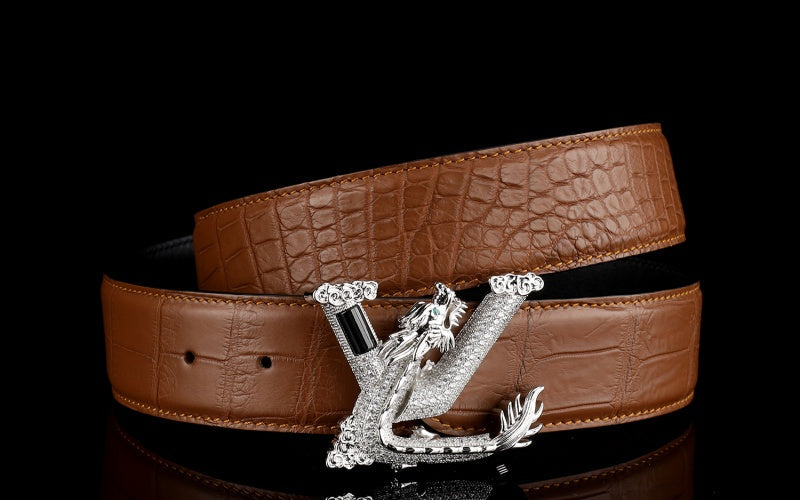
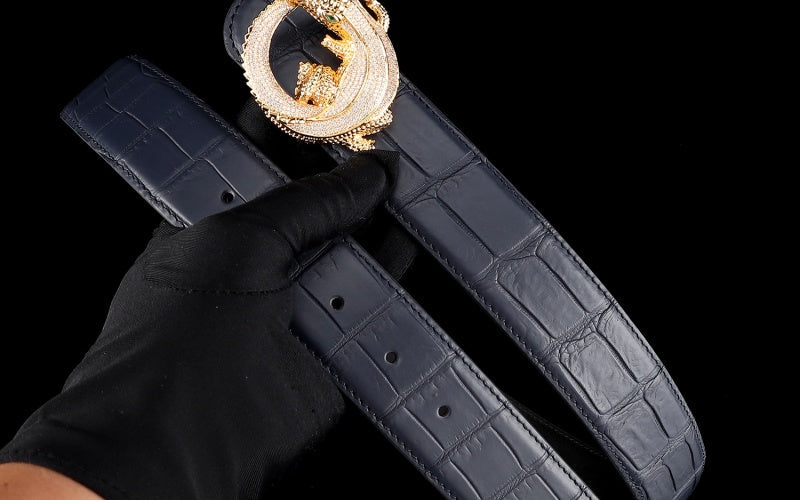
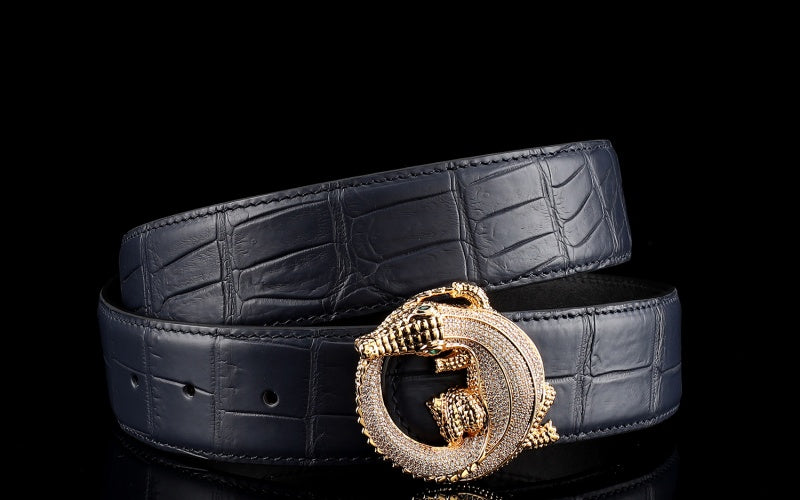
If you fit one of these, our crocodile and alligator belt collection is the right starting point, not the second step.

What's the Brand Tax — and why does it matter on your first belt?
Brand Tax is the portion of a luxury belt's price that pays for the logo, the boutique rent, the advertising, and the wholesale margin — not the leather, the hardware, or the artisan's hands. On crocodile belts from major fashion houses, Brand Tax can account for 60–75% of retail. A directly-sourced, identically-built belt runs $250–$400 instead of $1,200–$2,000.
The fashion industry doesn't hide this. Trade analysts regularly break down the wholesale-to-retail multiples — the luxury goods markup model — that push a belt from a $180 cost to a $1,400 sticker. The leather is the same Louisiana or Singapore-farmed Alligator mississippiensis or Crocodylus porosus hide that smaller workshops buy from the same tanneries.
What you're paying extra for, in a big-house belt: the boutique on Madison Avenue, the campaign starring an actor, and the resale story (which, for belts specifically, barely exists — belts almost never appreciate). What you're not getting extra of: leather grade, stitch density, or buckle quality.
This matters most on your first belt because it sets your internal price anchor. Pay $1,500 once and every reasonably-priced belt afterward feels "cheap." Pay $300 for the same quality and every $1,500 belt afterward feels honest about what it is.

What spec should a first crocodile belt actually have?
Black, 1.25" (32 mm) wide, belly-cut crocodile, single-prong classic buckle or low-profile plaque in brushed stainless or aged brass. No contrast stitching, no unusual colors, no oversized hardware. This spec works with a suit, with chinos, and with denim — which is the entire point of a first luxury belt.
The reasoning, piece by piece:
| Element | First belt choice | Why |
|---|---|---|
| Color | Black | Works with black shoes and most brown shoes; the dress default |
| Width | 1.25" (32 mm) | Fits standard suit and trouser loops; reads dressy |
| Cut | Belly | Tighter, more uniform tile pattern than back-cut |
| Buckle | Prong or low plaque | Quiet hardware ages better than logos |
| Stitching | Tonal | Contrast stitch dates fast |
Save the cognac, the navy, the bold buckles, and the 1.5" widths for belt #2 or #3. They're wonderful — but they're outfit-specific, and a first luxury belt should be outfit-universal.
For sizing, measure over the trousers you'll actually wear it with. Our size guide walks through it in two minutes; the most common first-belt mistake is ordering by jean size rather than by belt-loop measurement.
Key Takeaways (mid-post)
- Under $150 budget? Start with full-grain calf, learn the craft, upgrade later.
- $250+ and only want one belt? Skip ahead to crocodile.
- Brand Tax is real — a $1,500 crocodile from a fashion house is usually $250–$400 of belt plus $1,000+ of marketing.
- Safest first crocodile spec: black, 1.25", belly-cut, prong or low plaque.
- Cost-per-wear over 20 years favors one well-made crocodile over three mid-tier belts.

What mistakes do first-time luxury belt buyers make most often?
The five most common first-belt mistakes: buying too wide for dress wear, choosing a logo buckle that dates fast, picking an unusual color before owning a black or brown, confusing "genuine leather" labeling with full-grain, and paying Brand Tax for a hide they could have sourced directly at one-third the price.
A quick field guide:
- Width creep. 1.5" looks great with jeans, awkward with a suit. If you can only own one luxury belt, 1.25" is more versatile.
- Loud hardware. Big logo buckles are the first thing that dates a belt. Quiet hardware ages with you.
- Color before staple. Cognac crocodile is gorgeous — and useless if you don't already own a black belt.
- Label confusion. "Genuine leather" is the lowest legitimate grade; you want full-grain on calf and belly-cut on exotics.
- Paying for a logo. Once you understand the crocodile belt price structure, most $1,500 belts stop making sense.

How long should your first luxury belt last?
A well-made full-grain calf belt should last 10–20 years with basic care. A properly built crocodile belt should last 20–40 years — often outlasting the wearer's interest in it. Both timelines assume rotation (don't wear daily), occasional conditioning, and a leather-friendly storage hook rather than a folded drawer.
Belt failure modes are predictable: the strap stretches at the buckle holes (calf), the edges crack from dry storage (both), or the hardware loosens (cheap stitching). A 10-year warranty like ours — covering materials and construction — exists because we know which failures are craft-related and which are wear-related. Care guidance lives on our leather care page if you want the routine.
The Bottom Line
If you're under $150, your first luxury belt should be a black or brown full-grain calf belt with quiet hardware. You'll learn more about leather from wearing it for a year than from any article. If your budget reaches $250 or you want one belt to handle the next two decades, skip the intermediate step and start with a black 1.25" crocodile — the spec that works with everything.
What you should never do is pay Brand Tax on your first piece. At BELTLEY, our belts are in stock, handcrafted and shipped from our workshop in 2–3 days, with a 10-year warranty and pricing that reflects the leather, the hardware, and the hands — not a Madison Avenue lease. Browse the men's belt collection or the crocodile collection when you're ready, and read more about who we are on the about page.
Frequently Asked Questions
Q: Is a crocodile belt too formal for everyday wear?
A black 1.25" crocodile belt is dressier than calf but still works with chinos, dark denim, and tailored casual outfits. The cognac and exotic colors are more occasion-specific. If you want one belt that crosses contexts, black crocodile is more versatile than people assume.
Q: How much should I spend on my first luxury belt?
For full-grain calf, $120–$180 buys genuinely excellent quality from a DTC brand. For crocodile, $250–$400 from a direct-sourced workshop gets you the same hide quality as $1,200–$1,500 from a fashion house. Anything below those ranges usually means cut corners on leather grade or hardware.
Q: Is crocodile or alligator better for a first exotic belt?
For a first exotic, the visible difference is minimal — both are CITES-regulated, both develop similar patina. Alligator (Louisiana-farmed) tends to have a more uniform tile pattern; Nile or saltwater crocodile shows slightly more variation. Either is a fine first exotic; choose by the specific belt you like, not the species.
Q: Will my first luxury belt fit forever?
No belt fits forever — bodies change. Buy a belt with at least 5 holes (we punch 7 on most styles) and measure over the trousers you'll wear it with. If your waist shifts more than 2", you can have most quality belts re-cut at a leather workshop rather than replaced.