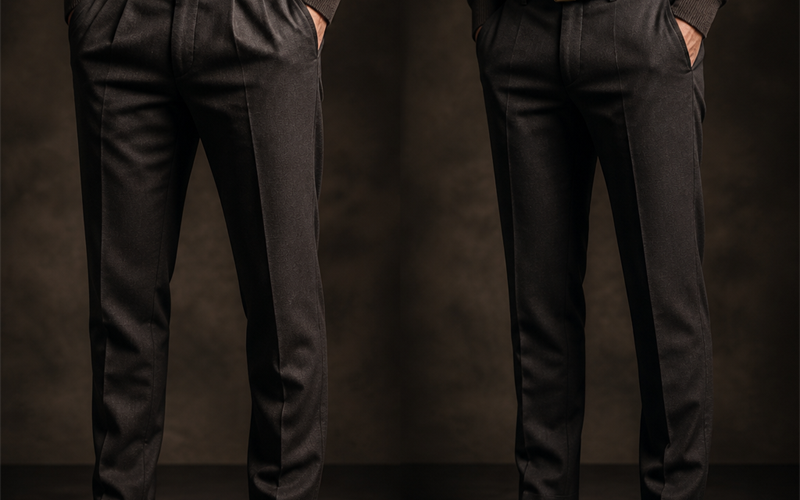
Why Your Belt Is Bunching at the Waistband
Quick answer: A belt bunches at the waistband for one of three reasons: 1) the pants are too large at the waist and the belt is pulling excess fabric into folds, 2) the belt is too narrow for the waistband construction, creating uneven pressure points, or 3) the pants have a stiff or reinforced waistband that resists smooth distribution. The fix is almost always pant tailoring, not a different belt — though a wider belt sometimes helps for borderline cases.
Last updated: May 2026 • By BELTLEY Editorial
Why trust this guide: BELTLEY has seen the bunching problem on every belt width and leather grade in our customer service photos — and it's overwhelmingly a pant-fit issue, not a belt issue. Our team knows the diagnostic and the fix because customers ask weekly. This guide reflects the real pattern, not the obvious assumption that the belt is wrong.
TL;DR:
- Bunching is usually a pant problem — the waistband is too large.
- A wider belt distributes pressure more evenly, sometimes hiding mild bunching.
- Stiff or interfaced waistbands (suit trousers, dress pants) bunch more easily than soft waistbands (jeans, chinos).
- Tailoring fixes bunching permanently for $15-$30.
At a glance:
- Diagnostic time: under 1 minute
- Tailor fix cost: $15-$30 (taking in waistband)
- Belt-side fix: switch to 1.5" wide belt for borderline cases
- Skill level: none (decision-making only)
- Updated — May 2026 · By BELTLEY Editorial
The shirt is tucked in, the belt is buckled, and the waistband looks like an accordion — gathered into folds, bunched at the sides or front. It's a small visual problem with an outsized impact on how a polished outfit reads. Below: why bunching happens (almost never the belt's fault), the diagnostic that confirms the cause, and the two-step fix that ends the problem.
Why does my belt bunch the waistband?
Belt bunching happens because the waistband is too large for the body, and tightening the belt forces the excess fabric to gather somewhere — usually at the sides or front. The belt isn't creating the extra fabric; it's compressing already-too-large pants into the available space. The visible bunching is the geometric proof that the pant's waistband circumference exceeds the wearer's actual waist by more than about 1".

Stiff or interfaced waistbands (trouser-style construction with internal stiffening) bunch more visibly than soft waistbands because the rigid material doesn't smooth out under the belt — it folds rather than distributes. This is why suit trousers and dress pants bunch more than jeans even when the size mismatch is identical.
How do you tell if it's the pants or the belt?
Quick test: take off the belt entirely and pinch the open waistband closed at the front to match your actual waist. If you can pinch more than 1.5" of excess fabric, the pants are too big — the belt is correctly compressing the slack, and bunching is unavoidable until the pants are tailored. If the waistband closes naturally with under 1" of give, the belt may be the issue — likely too narrow or made of bonded leather that doesn't spread pressure evenly.
In 80%+ of cases, the test reveals oversized pants. Most men buy the next size up rather than the size down, and the slack shows up as bunching the moment a belt is added.
What's the fix for bunching pants?
Two fixes work permanently: 1) Take the pants to a tailor to reduce the waistband by the amount of excess (typically 1-2"). Cost: $15-$30. Result: bunching disappears completely. 2) Replace the pants with a correctly sized pair (this only works if you're between sizes — many men actually need a different size than they assume). For borderline cases (under 0.5" of excess), a wider belt (1.5") distributes the slack more smoothly than a narrow belt and can hide the bunching visually.

The belt-side approach is a Band-Aid, not a cure. The tailoring approach is the real solution and lasts the life of the pants.
Key stat: A waistband 1" larger than the wearer's actual waist typically produces minor bunching that's hidden under a tucked-in shirt. 2" of excess produces visible bunching even with the belt at its tightest functional hole. 3"+ of excess produces severe bunching that no belt can hide.
Bunching diagnosis and solution matrix
| Symptom | Cause | Fix |
|---|---|---|
| Mild bunching, only at sides | Pants 0.5-1" too large | Wider belt may help; tailor for permanent fix |
| Visible bunching at front | Pants 1.5-2" too large | Tailor waistband down |
| Severe accordion folds | Pants 2.5"+ too large | Replace pants or major alteration |
| Bunching only on dress pants | Stiff waistband + slight size mismatch | Tailor specifically the waist + ease |
| Bunching only with one specific belt | Belt too narrow for waistband | Switch to 1.5" belt |
| Bunching on jeans only | Jeans stretched from wear | Replace or accept; jeans relax permanently |
| Even bunching all around | Waistband uniformly oversized | Standard tailoring fix |
Does a wider belt prevent bunching?
A wider belt (1.5" instead of 1") distributes compression over a larger area of the waistband, which can reduce visible bunching for borderline cases (0.5-1" of pant excess). The belt grips a wider band of fabric and pulls less aggressively at any single point — producing smoother gathers. For severely oversized pants (2"+ excess), even the widest belt can't hide the bunching.

Wider belts also have a structural advantage in pant-loop fit. Most jean and casual pant loops are sized for 1.5" belts; using a 1.25" belt in 1.5" loops leaves rotational play that contributes to uneven bunching. Match belt to loop size for the cleanest visual result. Our wide belt collection is sized at 1.5" specifically for this match.
Why do dress pants bunch more than jeans?
Dress pants bunch more than jeans because their waistbands contain internal interfacing (a stiffening fabric layer that maintains shape) — when this stiff waistband is compressed by a belt, it folds at specific points rather than gathering smoothly. Jean and chino waistbands are soft, single-layer construction that distributes belt pressure more evenly.

Suit trousers compound this with even stiffer waistband construction, which is part of why French tailoring tradition uses side adjusters instead of belt loops on tailored suits — see our piece on why French men don't wear belts with suits. The bunching problem is structurally built into stiff-waistband trousers worn with belts.
Can over-tightening cause bunching that wouldn't be there otherwise?
Yes — pulling the belt one or two holes tighter than necessary forces fabric to gather even on a correctly fitted pant. If you're using the last hole on a new belt and the pants are still bunching, the belt may have stretched (common on bonded leather) or the pants have grown (jeans relax over time). Loosening one hole sometimes resolves apparent bunching without any other change.
The tell: if the pants now feel like they might slip without the over-tight belt, you're back to the broader "belt won't hold pants" problem — see our companion guide on belt won't hold up my pants — is it the belt or the pants?.
Does belt material affect bunching?
Marginally. Stiff full-grain leather belts distribute pressure more evenly than soft bonded leather belts because the rigid strap doesn't flex inward at pressure points. A soft belt sometimes amplifies bunching by digging into the waistband at the buckle area and pulling fabric inward. A stiff belt spreads the compression along its full length.

But material is a minor factor compared to pant fit. Even the stiffest belt can't smooth out a 2" oversized waistband. Fix the pants first; the belt becomes irrelevant.
Related BELTLEY guides
- Belt Won't Hold Up My Pants — Is It the Belt or the Pants? — companion fit diagnostic
- Why Is My Belt Twisting Inside the Loops? — related belt-loop issue
- Belt for Pants That Fit Loose at the Waist but Tight at the Hip — specific fit scenario
- What Belt Width Should I Wear? — width selection
- Why French Men Almost Never Wear a Belt with a Suit — the bunching workaround in French tailoring
The Bottom Line
A belt that bunches the waistband is almost always solving a pant-fit problem — the waistband is too large, and the belt is compressing the excess fabric into folds. Tailor the waistband down ($15-$30) and the bunching disappears permanently. For borderline cases, a 1.5" wider belt can smooth mild bunching as a temporary hold. At BELTLEY, our men's belt collection is built at thickness and width that distributes pressure correctly — when paired with properly fitted pants, the belt does its job invisibly.
Frequently Asked Questions
Q: How tight should my belt be to prevent bunching?
Tight enough that you can fit two fingers comfortably between the belt and your waist — no tighter. Bunching from over-tightening is common; tighten only as much as needed to keep the pants in place, not as a sizing compensation.
Q: Will a tailor fix bunching for less than $30?
Yes — most tailors charge $15-$30 to take in a trouser waistband, typically completed in 3-7 days. Some dry cleaners offer the service for $20-$25. Major alteration shops in larger cities may charge $30-$50 for more complex waistband work.
Q: Can I prevent bunching by wearing pants without a shirt tucked in?
You hide it, you don't prevent it. Untucked shirts cover bunching visually but the underlying fit problem remains. For dress occasions where the shirt must be tucked, tailoring is the only complete solution.
Q: Does belt stiffness matter for bunching?
Marginally. Stiffer belts distribute pressure slightly better than soft belts. Quality full-grain leather is naturally stiff; bonded leather is soft and can amplify bunching. But the dominant factor is pant fit, not belt material.
Q: Will bunching damage my pants long-term?
Repeated compression at the same points can wear the waistband fabric over time — especially on dress pants. Tailoring the pants down doesn't just look better; it extends the pant's useful life.
%20the%20pants%20are%20too%20large%20at%20the%20waist%20and%20the%20belt%20is%20pulling%20excess%20fabric%20into%20folds,%202)%20the%20belt%20is%20too%20narrow%20for%20the%20...)