What to Do With Old Leather Belts — Repurpose & Upcycle Ideas
Quick answer: Don't throw an old leather belt away — quality leather is too useful. Repurpose it into practical items (drawer pulls, key fobs, luggage tags, tool rolls, dog collars, camera straps), use the leather for craft and repair projects, or upcycle the buckle onto a new strap. If the belt is still structurally sound, restoring it is often better than retiring it. Worn-out belts can also be donated or recycled rather than binned.
Last updated: June 2026 • By BELTLEY Editorial
TL;DR:
- Quality leather is too useful to bin — repurpose or upcycle it.
- Practical ideas: drawer pulls, key fobs, luggage tags, dog collars, straps.
- The buckle can be reused on a new strap; the leather suits craft projects.
- If the belt is still sound, restoring it often beats retiring it.
A belt that's too worn, too small, or just out of rotation doesn't belong in the bin — full-grain leather is a genuinely valuable material, and a buckle can outlast several straps. With a little imagination, an old belt becomes something useful again. This guide covers practical repurpose ideas, how to reuse the parts, and when restoring beats repurposing. For the recycle-and-donate route, see our companion guide on how to donate or recycle a worn-out belt.

What can you do with an old leather belt?
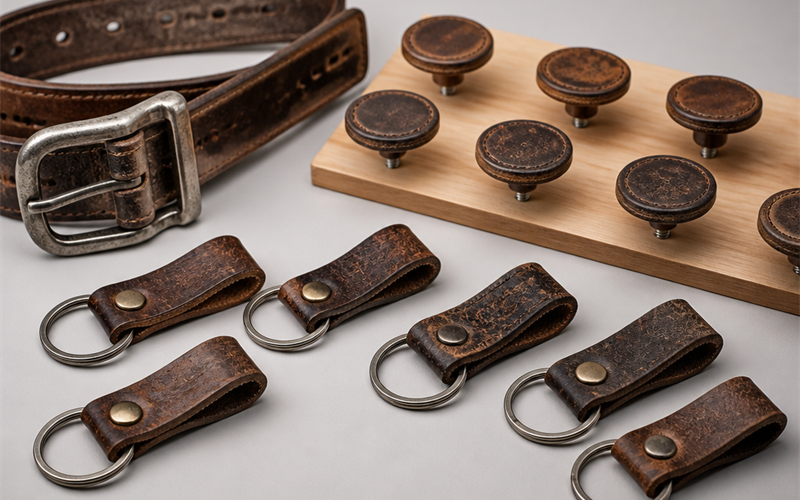
Repurpose it into practical leather items. An old belt's strap can become drawer or cabinet pulls, key fobs, luggage tags, a tool roll, a dog collar, a camera or bag strap, or even handles for baskets and crates. The leather is also useful for patching, strapping, and small craft projects. The buckle can be salvaged and reused too.

Quality leather rewards reuse. Upcycling — "transforming by-products, waste materials, useless, or unwanted products into new materials or products perceived to be of greater quality" — is exactly what an old belt invites. A single full-grain strap holds plenty of usable leather, and its existing thickness and finish make it ideal for projects that need a sturdy band. Here are some of the most practical second lives:
- Drawer & cabinet pulls — cut sections, screw the ends, instant rustic handles.
- Key fobs & luggage tags — small offcuts, a rivet or stitch, done.
- Dog collar or leash — a sturdy strap repurposed for a pet (size and finish edges).
- Camera, bag, or tool strap — the belt's length and strength suit carrying straps.
- Basket & crate handles — screw belt sections onto storage for a handsome handle.
Genuine leather ages into something with character, so a worn belt often looks better in these roles than new material would. Sustainability site One Green Planet makes the same case — "leather belts are extremely easy to repurpose, as there is ever the need for durable straps; they could be repurposed as carry bags or camera straps." The more imaginative you are, the more uses appear.
How do you reuse the buckle from an old belt?
Salvage the buckle and put it on a new or different strap. If the buckle is solid and attractive — especially a quality brass or stainless one — it can outlast the leather and be moved to a replacement strap. Snap or screw-back buckles come off easily; sewn-in ones need the stitching cut. A good buckle is worth keeping.

Key stat: A solid brass or stainless steel buckle can outlast several leather straps — which is exactly why interchangeable and swappable belt systems exist, and why salvaging a quality buckle from a worn belt is so worthwhile.
The buckle is often the most durable, valuable part of a belt. A solid-metal buckle doesn't wear out the way leather does, so reusing it is smart and sustainable. Whether you can remove it easily depends on the attachment: snap and screw-back buckles release quickly, while sewn-in or riveted ones require cutting. Our guides on whether you can swap buckles between two leather belts and sewn-in vs screw-back vs snap-button buckles explain the mechanics. A salvaged quality buckle on a fresh strap is essentially a new belt for the cost of the leather — a genuinely thrifty, sustainable move.
When should you restore an old belt instead of repurposing it?
Restore it when the belt is still structurally sound — the leather is intact and the stitching holds — and just looks tired, dry, or scuffed. Cleaning, conditioning, re-dyeing, or fixing a single hole or loop can bring a good belt back to full service. Repurpose only when the belt is genuinely past wearing as a belt.

Before you cut up a belt, ask whether it deserves a second wind as a belt. Many "old" belts are merely dry, faded, or lightly damaged — entirely fixable. Conditioning revives dried leather, re-dyeing refreshes faded color, and small repairs handle worn holes or loose loops. Our guides on restoring a cracked or dried-out belt and how to tell if a belt can be professionally restored or should be tossed help you judge. A quality full-grain belt is especially worth restoring — it's built for decades, not seasons. Reserve repurposing for belts that are truly finished as belts: cracked through, delaminating, or beyond comfortable wear.
What makes a belt worth repurposing in the first place?
Quality leather and solid hardware. A full-grain belt with a real metal buckle has durable material worth a second life, while a cheap bonded or plastic-coated belt has little usable leather and a flimsy buckle not worth salvaging. The better the original belt, the more rewarding its repurposing — another argument for buying quality once.

This is where the value of buying well comes full circle. A genuine full-grain belt with a solid brass or stainless buckle gives you durable leather and reusable hardware even at the end of its belt life — material good enough to become pulls, straps, or a new belt. A bonded or corrected-grain belt, by contrast, often disintegrates rather than ages, leaving little worth keeping. So the repurposing potential of a belt is decided the day you buy it. The BELTLEY standard of full-grain leather, a stainless or solid brass buckle, and sealed edges means a belt that serves for years and still has useful life in its parts afterward. Explore belts built to last — and to live again — in our full-grain leather belts collection.
The Bottom Line
An old leather belt is a resource, not rubbish. Quality straps repurpose into drawer pulls, key fobs, luggage tags, dog collars, and carrying straps, while a solid buckle can be salvaged onto a fresh strap for essentially a new belt. Before you cut it up, check whether the belt is merely tired and worth restoring — conditioning and small repairs revive many "old" belts to full service. And the better the original belt, the more rewarding its second life, which is one more reason to buy full-grain quality once. When a belt is truly finished, repurpose, donate, or recycle it rather than binning it. Start with belts worth keeping — and reusing — in our full-grain leather belts collection.
Frequently Asked Questions
Q: What can I make from an old leather belt?
Plenty: drawer and cabinet pulls, key fobs, luggage tags, a dog collar or leash, camera and bag straps, tool rolls, and basket handles. The strap's existing thickness and finish make it ideal for sturdy projects, and the buckle can be salvaged for a new belt. Quality leather upcycles especially well.
Q: Can you reuse a belt buckle?
Yes. A solid brass or stainless buckle often outlasts the leather, so it's well worth salvaging onto a new or different strap. Snap and screw-back buckles come off easily; sewn-in or riveted ones need the stitching or rivets cut. A good buckle on a fresh strap is essentially a new belt.
Q: Should I restore or repurpose an old belt?
Restore it if it's still structurally sound and just looks tired — cleaning, conditioning, re-dyeing, or fixing a hole or loop can bring it back to full service. Repurpose only when the belt is genuinely past wearing as a belt, such as cracked through or delaminating. Quality full-grain belts are usually worth restoring.
Q: Are cheap belts worth repurposing?
Usually not. Bonded or plastic-coated belts have little usable leather and flimsy buckles that aren't worth salvaging, and they tend to disintegrate rather than age. Full-grain belts with solid metal buckles are the ones worth repurposing, since they offer durable leather and reusable hardware even at the end of their belt life.
...)