The Reddit Belt-Flip Test, Explained — Only the Flesh Side, Deeply
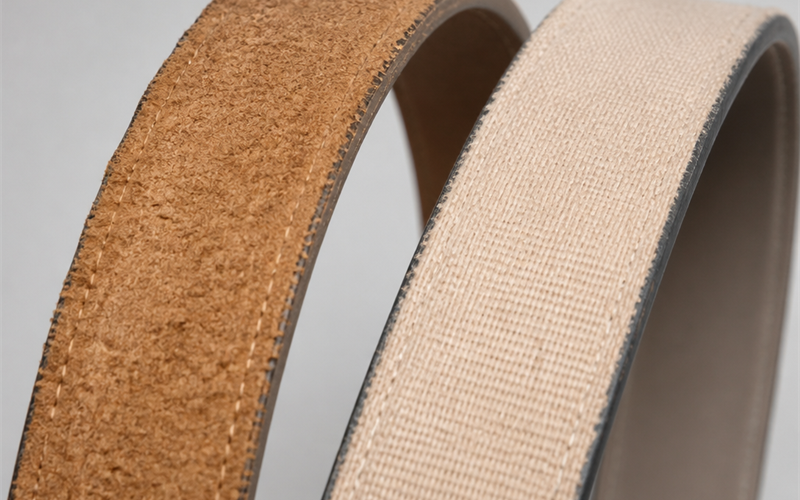
Quick answer: The Reddit belt-flip test is a 5-second check that flips a belt to examine the flesh side (inside surface). Real full-grain leather shows a fuzzy, fibrous, natural-colored surface with visible loose fibers when you brush it with a fingertip. Top-grain looks similar but more uniform. Corrected-grain looks smoother and more processed. Bonded leather shows fabric or paper backing. PU/vegan leather shows obvious woven fabric. The test isn't a complete authentication framework — that's the multi-test exotic-leather check covered in our 7 tests for real vs fake crocodile belts. The flip test is the single-question version: what tier is this leather, judged by its honest inside?
Last updated: May 2026 • By BELTLEY Editorial
TL;DR:
- The belt-flip test = examining the flesh side only.
- Reddit popularized it because it's instant, free, and revealing.
- This guide drills into ONLY the flesh side — not a full authentication framework.
- Five leather tiers, each with a distinctive flesh-side appearance.
- Adaptable to online product photos (when sellers show the inside).
The Reddit belt-flip test went viral on r/BuyItForLife and r/leather threads circa 2022-2023, picked up steam through r/frugalmalefashion and r/EDC, and is now the most-shared single leather identification check on the platform. It's the right tool for a narrow job: judging the leather tier in 5 seconds. It's the wrong tool for everything else (origin verification, species ID on exotic leather, construction quality). For the multi-test framework, see our 7-test crocodile authentication guide. This post stays on the flip test only, drilled deep.
Why did Reddit settle on the flip test specifically?
Because it works on every belt, takes 5 seconds, costs nothing, and the answer is hard to fake. Other authentication tests have prerequisites: the smell test requires you to know what real leather smells like (which presumes prior exposure), the cut-edge test requires sacrificing the strap, the bend test requires technique. The flip test requires nothing except eyes and a fingertip. Reddit communities valued it precisely because newcomers could apply it the moment they joined the conversation — no expertise required, no equipment, no risk of damaging the belt.

The cultural payoff: the flip test became a kind of shibboleth on Reddit. Sharing a belt's flesh-side photo with "is this real?" became the standard new-buyer post, and the community could answer reliably from the photo alone. The test's photographic visibility is part of what made it spread.
What does the flesh side reveal that the grain side hides?
The honest construction. Leather manufacturers finish, dye, emboss, and seal the grain side (outside) of a belt because that's the visible part — and the finishing can disguise lower-tier leather underneath. The flesh side (inside) is rarely finished because no one was supposed to see it. As a result, the inside reveals what the leather actually is, before any cosmetic work.

The grain side answers "what does the brand want this belt to look like?" The flesh side answers "what is this belt?" Reddit's instinct to flip the belt is the instinct to skip past the marketing surface and look at the substrate.
How does each leather tier look on the flesh side?
Five distinct appearances. Full-grain shows a fuzzy, fibrous flesh side with visible loose fibers, natural light tan or beige color, and subtle variation across the surface. Run a fingertip across it and you can feel individual fibers catch and release. Top-grain looks similar but more uniform — the slight sanding done to the grain side often comes with slight smoothing of the flesh side too. Corrected-grain shows a smoother, more processed-looking inside surface with less fiber visibility. Genuine leather (split) shows a more uniform, sometimes slightly waxy surface; the fibers are present but compressed. Bonded leather shows a visible fabric or paper backing where the leather pulp was glued to a substrate — the fabric is unmistakable. PU / vegan leather shows obvious woven fabric on the inside, often with a different color than the outer surface.
Key stat: In Reddit threads where users posted flesh-side photos for community identification, the consensus tier-classification rate was approximately 90-95% accurate when corroborated against the seller's stated tier or independent testing. The flip test alone is reliable; combining it with a single corroborating signal (price, brand, edge inspection) pushes accuracy to near-certain.
Flesh-side appearance by leather tier
| Leather tier | Flesh side appearance | Fingertip feel | Confidence from photo |
|---|---|---|---|
| Full-grain | Fuzzy, fibrous, light natural tan, varied | Fibers catch and release | High |
| Top-grain | Similar but more uniform | Slight fuzz, less catch | Medium-high |
| Corrected-grain | Smoother, more processed | Less fiber, slight slick | Medium |
| Genuine leather (split) | Uniform, slightly waxy/compressed | Soft but uniform | Medium |
| Bonded leather | Fabric or paper backing visible | Fabric texture | Very high |
| PU / vegan | Woven fabric, often different color | Obvious fabric | Very high |
| Reconstituted | Sometimes layered or composite | Variable | High |
For the broader leather-tier context, see full-grain vs bonded leather belt and full-grain vs PU vegan faux leather belt.
Can you run the flip test on a product photo?
Sometimes — depends on the seller. The biggest adaptation of the flip test for online buyers is checking whether the product photo shows the flesh side at all. High-trust sellers include flesh-side photos in their product galleries because they have nothing to hide. Medium-trust sellers show only the grain side but will send flesh-side photos on request. Low-trust sellers don't show the inside and won't send photos on request — that absence is itself a signal.

When flesh-side photos are available, examine them at maximum zoom under both natural and artificial light if the seller provides multiple. Look for: visible fiber texture, natural color variation, no fabric pattern, no uniform plastic surface. The same five-tier classification works from a high-resolution photo nearly as well as from a hand examination — Reddit's threads prove this consistently.
The ask-the-seller workaround: email or message the seller and request a flesh-side photo specifically. The response (or lack of response) is diagnostic. Sellers proud of their leather respond within hours; sellers using lower-tier leather often go silent.
Where does the flip test fail or mislead?
Three known failure modes. (1) Lined belts — premium belts sometimes have a leather lining bonded to the flesh side, which hides the underlying leather's flesh-side appearance. A high-end full-grain belt may show a smooth lining instead of the expected fuzzy texture, and a Reddit-style flip test would misread it as lower-tier. The workaround: check the strap end where the lining sometimes separates slightly, or examine the edge cross-section. (2) Corrected-grain that mimics full-grain — some high-quality corrected-grain leather is processed to retain a fibrous flesh side, making it visually similar to full-grain from the inside. Combining the flip test with a grain-side examination usually resolves this. (3) Bonded leather with leather-like backing — newer bonded leather products sometimes use a thin leather sheet as the substrate instead of fabric, which can look superficially like real leather from the flesh side. The cut-edge test resolves this — see the full-grain authentication guide.

These failure modes are why Reddit threads usually combine the flip test with at least one other signal (edge inspection, price plausibility, brand reputation) before declaring a verdict. The flip test alone is good — the flip test plus one corroborating check is nearly definitive.
How does the BELTLEY 3-Material Rule align with the flip test?
A belt passing the 3-Material Rule will pass the flip test. The rule — full-grain leather + stainless or solid brass buckle + sealed (painted or burnished) edges — requires real full-grain leather, which by definition shows the fuzzy fibrous flesh side the flip test looks for. A belt claiming to meet the rule but failing the flip test isn't full-grain; the rule is a construction standard that the flip test independently verifies. BELTLEY's full-grain leather belts collection passes the flip test by design — every belt shows the characteristic flesh side because every belt is real full-grain throughout, not coating over substrate.

The Bottom Line
The Reddit belt-flip test is a focused tool with a narrow job: judge the leather tier from the flesh side in 5 seconds. Real full-grain shows a fuzzy fibrous natural-colored flesh side; top-grain looks similar but more uniform; corrected-grain is smoother; bonded leather shows fabric backing; PU/vegan leather shows obvious fabric. The test isn't a complete authentication framework — for the full multi-test exotic leather check, see our 7-test crocodile authentication guide. For most buyers, the flip test plus one corroborating signal (price plausibility, edge inspection, named tannery sourcing) is sufficient. The Reddit communities got this right — the inside of a belt tells you more about its construction than the outside ever will. BELTLEY's full-grain leather belts collection is built so the inside matches the outside, backed by a 10-year warranty. Flip the belt. Trust the inside.
Frequently Asked Questions
Q: Why did Reddit specifically pick the flip test over other leather tests?
Three reasons: it's instant (5 seconds), it requires no expertise or equipment, and it's photographically obvious — meaning Reddit threads could resolve authentication questions from posted photos alone. The cultural fit with Reddit's format (post a photo, get a verdict) made the test spread faster than tests requiring physical examination.
Q: Can I do the flip test on a leather wallet or bag?
Yes — the same principles apply. Wallets and bags often have linings that hide the leather's flesh side, but examining the inside of an unlined section, the strap, or the edge reveals the same tier signals. The test works on any leather product where you can see an un-finished inside surface.
Q: What if the belt has a leather lining on the flesh side?
The flip test becomes harder. A premium belt with a leather lining is hiding its underlying flesh side from view, which both protects the construction and obscures verification. Examine the strap end (sometimes the lining separates slightly) or the edge cross-section. Or ask the seller — high-end brands using full lining will explain that's a construction choice, not a hiding tactic.
Q: Is the flip test reliable for exotic leather (crocodile, alligator)?
Partially. The flesh side of exotic leather shows different characteristics than cowhide — typically smoother and more uniform because of the different hide structure. For exotic leather authentication, the flip test is one signal among several; the scale pattern, ISO pores, and umbilical scar checks are more diagnostic. See the 7-test crocodile guide.
Q: Can sellers fake the flip test by adding fuzz to a lower-tier leather?
Theoretically yes, but rarely in practice. The cost of adding convincing fuzz to a corrected-grain or bonded leather is high enough that sellers who'd bother would just use real full-grain. The flip test remains reliable because the economics of faking it don't work — counterfeiters who could replicate the flesh-side appearance would simply sell the real thing.
.%20Real%20full-grain%20leather%20shows%20a%20fuzzy,%20fibrous,%20natural-colored%20surface%20wi...)