The Squeaking Leather Belt: What Causes It and How to Stop It
Quick answer: A squeaking leather belt is almost always too dry — the leather fibers have lost their natural lubrication and rub audibly against each other or against the buckle. The fix takes about 60 seconds: apply a thin coat of beeswax-based leather conditioner to both sides of the strap and inside the buckle slot, work it in with a soft cloth, and wait 30 minutes. The squeak disappears and rarely returns if you condition every 3-6 months.
Last updated: May 2026 • By BELTLEY Editorial
Why trust this guide: BELTLEY has handled squeak-related customer service questions across humid and arid climates for two decades. The root cause is consistently the same — dryness — and the fix is the same simple conditioning routine that prevents most leather aging problems. This guide reflects what actually silences the squeak in our customers' real wardrobes.
TL;DR:
- Squeaking = dry leather + friction. Conditioning fixes 95% of squeaking belts in one treatment.
- The squeak usually comes from the buckle-leather interface or layer-on-layer rubbing inside the strap.
- Beeswax-based conditioners are the best fix; avoid heavy oils that may stain pants.
- Quality full-grain belts go years between conditioning treatments; bonded leather often squeaks regardless.
At a glance:
- Fix time: 60 seconds active + 30 minutes absorbing
- DIY cost: $8-$20 (one bottle of leather conditioner — lasts years)
- Success rate: ~95% on full-grain; ~60% on bonded leather
- Frequency needed: every 3-6 months for prevention
- Updated — May 2026 · By BELTLEY Editorial
A squeaking belt is the kind of thing you don't notice until you do — and then you notice it constantly. Every step. Every shift in your chair. Every reach across a desk. The good news: it's one of the easiest leather problems to fix in the entire wardrobe, and the fix takes about as long as making a cup of coffee. Below: where the squeak actually comes from, the conditioner approach that silences it, and why some belts come back to silence faster than others.
Why does a leather belt squeak?
A leather belt squeaks because dry leather fibers rub audibly against each other or against the metal buckle. Leather is structurally a network of collagen fibers held together by natural oils. As the leather ages — especially in dry climates or air-conditioned environments — those oils evaporate. Once fiber-to-fiber lubrication is gone, every flex of the belt produces the soft creaking sound you're hearing.

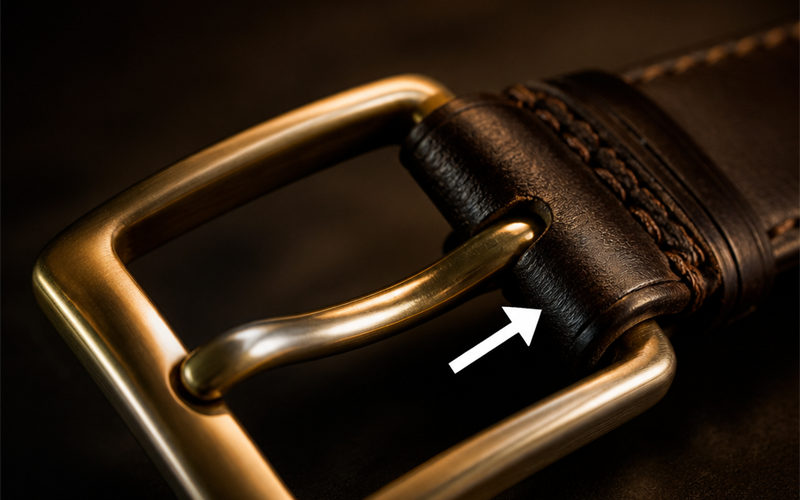
Three common squeak locations: 1) the buckle-leather interface (most common — the strap rubs against the metal buckle bar), 2) inside the buckle slot (where the prong moves), and 3) layer-on-layer rubbing on belts built from two laminated layers stitched together. All three respond to the same fix.
How do you fix a squeaking leather belt?
The 60-second fix: 1) Pick up a beeswax-based leather conditioner (Bickmore Bick 4, Saphir Renovateur, Smith's Leather Balm — all work). 2) Apply a coin-sized amount to a soft cotton cloth. 3) Rub gently into both sides of the strap in small circles, focusing on the area near the buckle and any squeak-prone sections. 4) Apply a tiny dab inside the buckle slot where the prong sits. 5) Buff lightly and wait 30 minutes for absorption. The squeak typically disappears within an hour and stays gone for 3-6 months.
For stubborn squeak at the buckle bar specifically, lift the strap and apply conditioner directly to the leather edge that contacts the metal. This contact zone is where most squeaks originate, and it gets missed in normal conditioning passes.
Why do beeswax conditioners work better than oils for squeak?
Beeswax-based conditioners work better for squeak because they deposit a thin, durable film between leather and metal — actively reducing the friction that creates the noise. Pure oils (mink oil, neatsfoot oil) penetrate the leather but don't leave a friction-reducing surface film, so squeak often returns within weeks. Beeswax fills the microscopic gaps in the leather surface and stays put.

The chemistry difference matters: oils condition; beeswax conditions and coats. For squeak prevention specifically, beeswax wins consistently in our customer service data. For deep dryness on neglected leather, oil-based conditioners can be applied first, followed by beeswax — but pure oil alone usually doesn't silence a squeak permanently.
Key stat: Beeswax-conditioned leather belts go an average of 5-7 months between squeak-prevention treatments. Oil-only conditioning typically requires monthly reapplication to keep belts silent in dry climates.
Squeak source diagnosis and fix matrix
| Squeak Location | Cause | Specific Fix |
|---|---|---|
| Near the buckle when walking | Buckle bar rubs dry leather | Condition buckle-contact strip + tiny dab on bar |
| In the buckle slot during cinching | Prong moves against dry slot | Conditioner inside slot with cotton swab |
| Mid-strap during seated motion | Layer-on-layer friction | Condition both sides; flex while drying |
| Squeak only in cold/dry weather | Climate-driven dryness | Increase conditioning frequency to quarterly |
| Squeak immediately on a brand-new belt | Manufacturer didn't condition strap | Condition fully once; should not return |
| Squeak persists after conditioning | Bonded leather or backing failure | Replace belt — squeak indicates broader failure |
Does squeak indicate a belt is failing?
Sometimes. Mild, occasional squeak on a quality leather belt is just dryness and responds to conditioning. Persistent squeak that returns weeks after conditioning can indicate: 1) the leather is bonded and the polyurethane backing is dry-cracking against the top layer, 2) two-layer construction is delaminating internally, or 3) the buckle bar is rough or corroded and creating friction even on conditioned leather. Quality full-grain belts with solid metal buckles almost never have persistent squeak problems.

For full-grain belts that develop persistent squeak, check the buckle bar for surface roughness — sometimes a brushed-finish bar develops a micro-burr that catches the leather. A jeweler can smooth the bar in a few minutes if needed.
What's the best conditioner for a squeaky belt?
For most belts: a beeswax-based leather conditioner (Bickmore Bick 4 is widely recommended, around $10-$15 for a bottle that lasts years; Saphir Renovateur is the premium option at $25-$35). For darker belts that risk dye-color transfer: avoid pure mink oil and pure neatsfoot oil — they're effective but can over-condition dark-dyed leather and worsen color bleeding. For natural-finish or vegetable-tanned belts: any beeswax balm works perfectly.

Our deeper conditioner comparison in beeswax, mink oil, neatsfoot: which conditioner for which leather walks through the chemistry choices. For squeak specifically, beeswax is the strongest recommendation.
How often should you condition a belt to prevent squeak?
Every 3-6 months under normal conditions; every 1-2 months in very dry climates (desert, mountain, heated indoor winter). Most squeak appears in winter (dry indoor heating) and resolves through routine quarterly conditioning. Belts worn occasionally need less; belts worn daily need slightly more frequent attention.
Setting a calendar reminder for the first of each season (March, June, September, December) is the simplest schedule. See our 90-day belt maintenance ritual for a complete quarterly care routine.
Can a brand-new belt squeak?
Yes — new belts sometimes squeak straight out of the box if the tannery shipped the belt without final conditioning, or if it sat in dry warehouse storage for an extended period. One light conditioning treatment usually silences it permanently. Persistent squeak on a new belt within the first month of wear is a quality concern; contact the seller for a return or replacement under warranty.

Our men's belt collection and women's belt collection ship with final-stage conditioning included — new BELTLEY belts almost never squeak.
Related BELTLEY guides
- The 90-Day Belt Maintenance Ritual That Doubles Lifespan — full care routine
- Beeswax, Mink Oil, Neatsfoot: Which Conditioner for Which Leather? — conditioner choice
- The Worst Care Mistakes That Quietly Kill Leather Belts — preventable damage
- Why Does the Tip of My Belt Curl Up? — related dryness symptom
- Pre-Conditioning a New Leather Belt Before First Wear — preventive setup
The Bottom Line
A squeaking leather belt is one of the most satisfying wardrobe problems to solve — 60 seconds of beeswax conditioner usually silences it for months. The real win is the routine: condition every 3-6 months and most belts never squeak in the first place. At BELTLEY, every belt ships pre-conditioned and the men's belt collection is built in full-grain leather that responds reliably to standard conditioning. Browse the collection for belts that stay silent where they belong.
Frequently Asked Questions
Q: Why does my belt only squeak when I sit down?
Sitting compresses the strap and shifts the leather-metal contact pressure at the buckle bar. If the leather is dry at that contact point, sitting amplifies the friction noise. Condition the buckle-contact area directly.
Q: Can I use Vaseline or coconut oil to stop a squeaking belt?
Don't. Petroleum jelly attracts dirt and never absorbs properly; coconut oil goes rancid and can stain. Stick to leather-specific conditioners — they're formulated for the leather's chemistry.
Q: Will conditioning a belt make it lose its color?
Not if done correctly. Apply conditioner in thin coats and buff away excess. Over-conditioning can darken light leather temporarily but doesn't permanently change color. Avoid heavy oils on dyed dark leather where color transfer is already a risk.
Q: Why does my new belt squeak right out of the box?
The belt may have been in storage long enough for surface oils to evaporate, or the tannery skipped final conditioning. One light treatment usually fixes it. If squeak returns within weeks, the leather quality may be poor — request a return.
Q: How do I know if my belt needs conditioning?
Three signs: the surface feels slightly rough or dry to the touch, it squeaks during normal wear, or the leather has lost its slight sheen. Quality leather should feel smooth and slightly waxy; if it doesn't, condition it.


