Siamese Crocodile Belt: The Honest Buyer's Guide (2026)
TL;DR:
- The Siamese crocodile belt uses Crocodylus siamensis hide — smaller, more uniform belly scales than Porosus or Niloticus, almost always farm-raised in Thailand, Vietnam, or Cambodia.
- Wild Siamese crocodiles are CITES Appendix I (critically endangered); farmed hides trade legally under Appendix II with registered captive-breeding operations.
- They cost 30-50% less than Porosus at comparable craftsmanship — the smartest entry point into real crocodile if you want substance over status.
- BELTLEY exotic belts are in stock and ship in 2-3 days, $112–$289, backed by a 10-year warranty.
Is Siamese Croc Your Smart Entry?
The honest decision table:
| Your situation | Go with |
|---|---|
| First real croc belt, value-driven | Siamese — 30–50% below Porosus pricing with genuinely uniform scales. The smart entry. |
| Ethics checklist active | Farmed Siamese under CITES Appendix II only — ask for the certification; legitimate sellers volunteer it. |
| Chasing maximum prestige | Porosus or Nile — Siamese is the value play, not the flex play. |
| Suspicious of a "Siamese" deal | Check scale uniformity against the spotting guide below — embossed cowhide fakes Siamese most often because of its regular pattern. |
Genuine certified croc from $118: BELTLEY's collection.
Quick Facts: Siamese Crocodile at a Glance
| Stat | Detail |
|---|---|
| Species | Crocodylus siamensis |
| Wild status | IUCN Critically Endangered, CITES Appendix I |
| Farmed status | CITES Appendix II (registered farms only) |
| Primary farm countries | Thailand, Vietnam, Cambodia |
| Belly scale count (across) | 28-32 (vs. 24-28 in Porosus) |
| Typical retail belt range | $200-$900 (vs. $1,500+ Porosus) |
| BELTLEY exotic belt range | $112-$289, ships in 2-3 days |
I still remember the first Siamese hide I cut on the bench in 1999 — rolled in butcher paper from a Bangkok tannery, and noticeably quieter than the Porosus we usually worked with. Tighter scales, less drama, the kind of leather a man buys for himself rather than to be seen in. Twenty-seven years later, I still think it's the most underrated crocodile in the trade.

What is a Siamese crocodile belt?
A Siamese crocodile belt is a strap cut from the hide of Crocodylus siamensis, a freshwater crocodile native to Southeast Asia. Today nearly every legal Siamese hide on the market comes from registered captive-breeding farms in Thailand, Vietnam, or Cambodia, traded internationally under CITES Appendix II permits.
According to the IUCN Crocodile Specialist Group, wild populations have collapsed to perhaps a few hundred mature individuals — see the Wikipedia entry for the Siamese crocodile. Paradoxically, the leather industry is one reason the species still exists at all: commercial farms preserve genetics that have nearly vanished in the wild. Our guide on caiman vs. crocodile vs. alligator belts covers the species you'll actually encounter at retail.
How is Siamese different from Porosus and Niloticus?
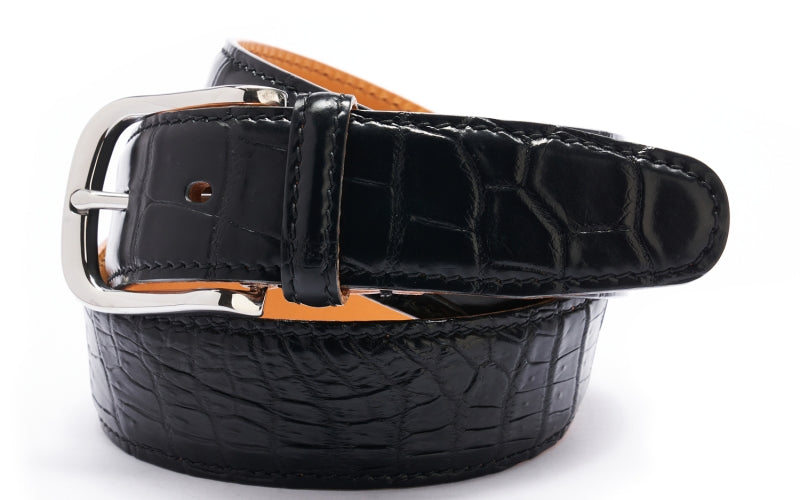
Siamese hides have smaller, more uniform belly scales (typically 28-32 across) compared to Porosus saltwater crocodile (24-28, larger and more dramatic) and Niloticus Nile crocodile (which shows visible follicle pores in each scale). Siamese leather looks calmer, more geometric — less "look at me," more refined repetition.

That uniformity is a feature, not a flaw. A Porosus belt is a statement; a Siamese belt is a quiet flex — scales sit in tighter rows, color takes evenly, and the strap drapes flatter through belt loops.
One technical note: Siamese are frequently cross-bred with Cuban crocodile (Crocodylus rhombifer) on Asian farms to improve hide size. Pure Siamese hides are small — a single belly typically yields one or two belts, the cost math we covered in how many crocodiles to make one belt. For a side-by-side of the top-shelf crocs, see Porosus vs Niloticus.
Is Siamese crocodile leather legal and ethical?
Yes, when sourced correctly. Wild Siamese crocodiles are listed on CITES Appendix I — international commercial trade is prohibited. Farmed Siamese hides are downlisted to Appendix II for registered captive-breeding operations and trade legally with proper export permits. Always insist on documentation.
The framework is published openly by CITES. Farms must be registered, breeding stock tracked, and every hide tagged with a unique CITES code that follows it from farm to finished good. If a seller can't produce that paperwork, walk away — and read why crocodile belts cost $500 vs $5,000 to see where legal sourcing sits in the price stack.
The ethics are genuinely nuanced — conservation biologists are split on whether farms preserve the species or dilute wild genetics. We don't pretend to resolve that debate. We do insist on Appendix II documentation for every exotic hide we buy.
Why doesn't Hermès use Siamese crocodile?
Hermès builds its crocodile category almost exclusively around Porosus (and some Niloticus) because those species offer larger hides, more dramatic scale patterns, and stronger heritage cachet at the ultra-luxury price point. Siamese is "too quiet" for a brand whose value depends on visible exotic statement. That's a marketing choice — not a quality verdict.

The mid-tier Asian luxury market — Thai, Vietnamese, Singaporean, Hong Kong houses — has used Siamese for decades because it's beautiful, locally sourced, and doesn't carry the colonial-era Porosus mystique. If you've admired a crocodile belt on a businessman in Bangkok, odds are you were looking at Siamese.
When is a Siamese crocodile belt the smart buy?
Buy Siamese when you want real crocodile leather, real legally traded sourcing, and real handcraft — without paying the European brand tax. It's the right pick if you value the material itself more than the logo, or if this is your first exotic belt and you want to learn the category before stepping up to Porosus.
Where Siamese makes obvious sense:
- First exotic belt, ever — the genuine experience without a $2,000 commitment.
- Daily-driver crocodile — smaller scales hold up better to belt-loop friction.
- Conservative wardrobes — lawyers, bankers, anyone who wants exotic leather that whispers.
- Travel — looks intentional, not flashy, in customs lines and hotel lobbies.
Key Takeaways
- Siamese hide = smaller, more uniform scales; quieter look than Porosus.
- Legal trade requires CITES Appendix II permits from registered farms.
- Often cross-bred with Cuban crocodile for size — pure Siamese is small.
- Best value entry point into authentic crocodile leather.
- BELTLEY exotic belts ship in 2-3 days, not weeks.
How can you spot a real Siamese crocodile belt?
Look for tight, square belly scales in 28-32 columns across the strap, no visible follicle pore in the center of each scale (that pore is the Niloticus tell), and a CITES tag or certificate from the seller. Embossed cowhide will show repeating identical "scales" with seams that don't follow real anatomy.

To train your eye, our embossed cowhide vs real crocodile breakdown is the fastest education. Two field tests: real scales vary subtly in size across the belly midline; embossed prints don't. And run a fingernail across the scales — real hide has a soft, waxy resistance; embossed feels like rubber.
What does a Siamese crocodile belt cost?
Honest market range: $200-$400 from independent Asian workshops, $400-$900 from mid-tier luxury brands, and $1,500+ once a European logo gets stamped on. The hide cost is roughly the same across all three tiers — most of the difference is brand markup, retail rent, and distribution.

This is the conversation we built BELTLEY's DTC model around in 2025. Founded in 1999, we went direct-to-consumer to remove the layers that turn a $300 belt into a $1,500 one. Same artisans. Same Appendix II hides. No brand tax. Read the full story on our About Us page, or browse our exotic leather belt collection and crocodile/alligator belts.
The Bottom Line
The Siamese crocodile belt is the connoisseur's choice hiding in plain sight — every quality marker that matters (real exotic hide, legally traded sourcing, hand-cut and hand-stitched construction) without the European brand premium that triples the sticker price for the same underlying material. Style Meets Legacy describes the customers who've figured out that legacy is built by what you choose, not what you're told to want. Every BELTLEY exotic belt is in stock, handcrafted, and shipped within 2-3 days, priced $112–$289, with a 10-year warranty, 30-day returns, and free worldwide shipping. Browse the exotic leather belt collection and find your first — or next — crocodile.
Frequently Asked Questions
Q: Is the Siamese crocodile endangered?
Yes — wild Siamese crocodiles are critically endangered and listed on CITES Appendix I, meaning international commercial trade in wild specimens is prohibited. The leather you see at retail comes from farm-raised animals on registered captive-breeding operations, traded legally under CITES Appendix II permits.
Q: Is Siamese crocodile leather as good as Porosus?
For everyday wear, arguably better. Porosus has larger, more dramatic scales and stronger luxury cachet, which is why Hermès uses it. Siamese has tighter, more uniform scales that drape flatter, resist belt-loop wear, and look more refined in conservative settings. Quality of construction matters more than species at the same price tier.
Q: How do I know my Siamese crocodile belt is real?
Check three things: scale uniformity (28-32 columns of small square belly scales), no central follicle pore in each scale (that's the Niloticus tell), and CITES documentation from the seller. Real hide also has subtle scale-size variation across the belly midline that embossed cowhide cannot replicate.
Q: Why is Siamese crocodile cheaper than Porosus?
The hides themselves are smaller (one belly often yields just one or two belts), and the species lacks the heritage marketing wrapped around Porosus by European houses. Farm efficiency in Thailand and Vietnam also keeps raw-hide costs down. You're not paying for a lesser leather — you're paying less because the brand layer is thinner.
Q: Are Siamese crocodile belts CITES legal in the US and EU?
Yes, when accompanied by valid CITES Appendix II export and import permits. Reputable sellers handle this paperwork; the certificate should reference a unique tag number that traces back to the source farm. Buying without documentation risks customs seizure and is the single biggest red flag in the exotic leather market.