Best Belt for Pilots and Flight Crew: A Complete Guide
TL;DR:
- Commercial airline pilots wear a black leather belt matching black trousers and shoes — most airlines specify this in their uniform manual with no deviation permitted during probationary periods
- Flight crew using the Known Crewmember (KCM) program bypass standard TSA security screening, so belt buckle metal content is not a practical concern for commuting or deadhead travel
- For cockpit comfort on long-haul flights, a ratchet (automatic) buckle belt allows precise waist adjustment that a prong-hole belt cannot match over a 12-hour sector
A pilot's belt sits at the intersection of strict uniform compliance, physical comfort across 8–14 hour flights, and the professional presence that passengers associate with the flight deck. Get it wrong and it's a uniform infraction; get it right and it's one less thing to think about before a 5 a.m. report time. This guide covers every crew context — commercial airline, general aviation, cabin crew, and off-duty deadhead travel — with specific recommendations for each.

What Belt Should a Pilot Wear in Uniform?
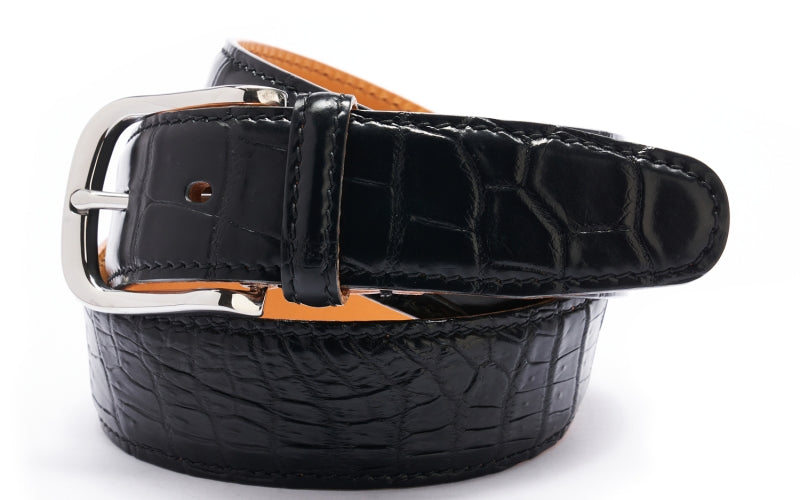
A commercial airline pilot in uniform should wear a smooth black leather belt, 32–38mm wide, with a simple rectangular metal buckle. Black is standard across virtually every airline uniform program worldwide — it matches black uniform trousers, black shoes, and the overall conservative color scheme of commercial aviation dress codes. No brown, no novelty buckles, no visible branding.
ATP Flight School's published uniform policy specifies that pilot trainees must wear a black leather belt at all times when in uniform — a standard that reflects the industry-wide expectation. According to Simple Flying's analysis of airline pilot uniform programs, individual airlines establish their own dress code specifics, but the black belt-black shoes-black trousers combination is the baseline across major carriers from United and Delta to Emirates and Lufthansa. Explore BELTLEY's black leather belt collection for options that meet this standard.

Belt Specifications by Airline Role
Airline uniforms are not uniform — they vary by carrier, rank, and crew role. The belt expectations follow accordingly:
| Role | Belt Standard | Color | Width | Buckle |
|---|---|---|---|---|
| Captain (4 stripes) | Smooth leather, formal | Black | 32–35mm | Slim rectangular, silver or black |
| First Officer (3 stripes) | Smooth leather, formal | Black | 32–35mm | Slim rectangular, silver or black |
| Second Officer / Flight Engineer | Smooth leather | Black | 32–35mm | Slim rectangular |
| Flight Attendant | Airline-specified uniform belt | Black or airline color | Per airline spec | Per airline spec |
| General Aviation / Private Pilot | Smart-casual to professional | Black or brown | 35–38mm | Simple rectangular |
| Charter / Corporate Pilot | Professional, conservative | Black | 32–35mm | Slim rectangular |
Flight attendant belt specifications are often contractually defined. The American Airlines flight attendant uniform standards published by APFA state that only the current uniform belt is to be worn and it will always be worn with skirt and pants — leaving no discretion for substitution during working flights. Cabin crew should verify their specific airline's uniform manual before purchasing any replacement belt.

Does a Metal Belt Buckle Cause Problems at Airport Security for Crew?
No — not for credentialed airline crew. Commercial pilots and flight attendants at participating airlines use the Known Crewmember (KCM) program, which allows them to bypass standard passenger security screening entirely at most major US airports. KCM crew do not remove belts, shoes, or laptops at security checkpoints.
The TSA's Known Crewmember program enables eligible flight crew to access sterile areas through dedicated crew lanes with expedited screening. This means the metal buckle concern that affects passengers at checkpoint — standard metal detectors flag steel and brass buckles reliably — is simply not a practical issue for crew commuting or deadheading in uniform or with their crew ID.
For general aviation pilots, student pilots, and crew members at non-KCM airports or traveling as regular passengers, a stainless steel buckle at the right size passes through most advanced imaging technology without triggering alarms. BELTLEY's stainless steel buckles are medical-grade alloy — the same grade used in implants and marine hardware — and are less reactive to detection equipment than lower-grade zinc alloy or brass buckles.

Cockpit Comfort: Does Belt Style Matter on Long-Haul Flights?
Yes — significantly. Pilots seated in cockpit seats for 8–14 hours experience waist compression that desk workers never encounter. Standard prong-hole belts lock into one of five fixed positions spaced an inch apart. If your waist sits between two holes after a meal or during extended seated time, you spend the sector either too tight or too loose.
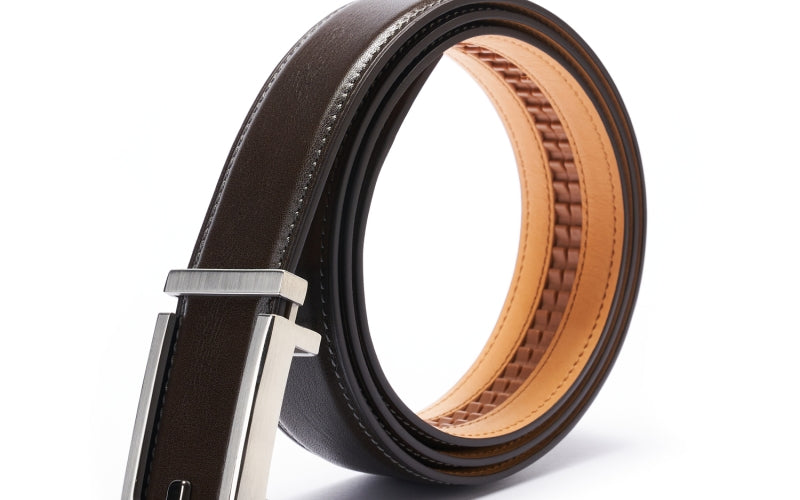
A ratchet (automatic) buckle belt solves this precisely. Ratchet mechanisms adjust in 6mm (¼-inch) increments across the full belt length, allowing exact fit calibration at push-down and after any meal. The buckle releases with a single motion and re-engages instantly — relevant when moving between cockpit and cabin during turnback. Visually, a slim ratchet buckle is nearly indistinguishable from a standard plaque buckle at a glance, so it meets airline uniform appearance standards while adding functional precision.
Research on seated posture and waist compression during extended periods confirms that tight waist constriction during prolonged sitting increases discomfort and reduces concentration over time — a relevant concern in a cockpit environment. BELTLEY's ratchet buckle belts combine full-grain leather with stainless steel ratchet mechanisms for the fit precision long-haul flying demands.

What Belt for General Aviation and Private Pilots?
General aviation and private pilots have significantly more flexibility than airline crew. Without a carrier uniform policy to enforce, the standard becomes professional rather than prescribed — smart enough for an FBO lobby or charter client meeting, practical enough for hours in a small-plane cockpit.
For private pilots and flight instructors, full-grain leather at 35–38mm in black or dark brown covers every context: pre-flight briefings, ATC radio interactions, flight school instruction, and post-flight client debriefs. The color call follows the standard professional rule — match the belt to shoes. According to the Pilot Uniform Guide published by BomCrew Mall, even non-commercial aviators benefit from dressing to the professional standard the flight deck represents, as it builds client confidence and reflects the discipline of the profession.
Full-grain leather dress belts at 35mm hit the right balance for general aviation: formal enough for any aviation context, not so stiff as to be uncomfortable in a confined cockpit seat for a 3-hour cross-country leg.
What Belt for Flight Crew Off-Duty and Deadhead Travel?
Deadheading — traveling as a passenger on another flight to reach a trip start city — puts pilots in a specific wardrobe situation: they're crew, not passengers, but they're not working. Most airlines specify civilian business casual attire for deadhead travel, which shifts the belt requirement from strict uniform black to the standard business casual rule: full-grain leather, matched to shoes, in black or dark brown.
The KCM advantage still applies on most deadhead trips if the pilot carries crew credentials — so the TSA belt removal concern remains irrelevant. The more practical consideration is comfort: a deadhead flight in a middle seat economy class cabin, followed immediately by a 10-hour long-haul sector, makes waist comfort over a full travel day a real priority. The ratchet belt's adjustability advantage applies here just as much as it does in the cockpit.
For off-duty and leisure travel, professional aviation culture tends toward understated quality over fashion statements — which aligns exactly with BELTLEY's approach. A full-grain leather belt that reads as clean and intentional travels as well as it works. See how to match a belt with your work outfit for the civilian context coordination guide.
What Belt for Female Pilots and Cabin Crew?
Female pilots in airline uniform face the same black-belt-matches-trousers standard as male colleagues — the color and finish rules are uniform-wide, not gender-specific. The width distinction applies: women's dress trouser loops typically accommodate 25–32mm (1"–1.25") belts, narrower than the standard men's dress trouser specification.
Flight attendants in most major carriers wear a uniform-specified belt as part of their complete uniform kit — the airline supplies or designates the exact item, and personal substitutions are generally not permitted during flights. Off-duty and deadhead context follows the same logic as female professionals in other fields: a slim leather belt matched to shoes, 25–30mm, in the standard professional color palette.
According to airline uniform program guides compiled by UniformMarket, airlines invest significantly in uniform cohesion because passenger perception of crew professionalism directly correlates with perceived brand quality. The belt is part of that cohesion. Browse women's belts by width for options calibrated to aviation professional contexts.
The Bottom Line
The best belt for pilots and flight crew answers three questions at once: does it meet the airline's uniform specification, does it stay comfortable through a 12-hour duty day, and does it hold up through years of daily professional use? For commercial airline crew, the answer is a smooth black full-grain leather belt, 32–35mm, slim rectangular buckle — the standard that almost every major carrier's uniform manual converges on. For long-haul sectors and deadhead comfort, a ratchet mechanism adds practical precision that a prong-hole belt can't match.
At BELTLEY, we build every belt with stainless steel buckles and full-grain leather chosen for exactly this kind of sustained daily performance — handcrafted, backed by a 10-year warranty, and shipped free worldwide. It's the kind of purchase a pilot makes once. Browse the complete dress belt collection to find the right specification for your role and carrier.
Frequently Asked Questions
Q: What color belt do airline pilots wear?
Virtually all commercial airline pilots wear a black leather belt as part of their uniform. Black matches the standard black trousers, black shoes, and conservative color palette of airline uniforms worldwide. Individual carriers specify belt color in their uniform manual — but black is the near-universal standard across major airlines including United, Delta, American, Emirates, and Lufthansa.
Q: Do pilots have to remove their belt at airport security?
No — not for credentialed airline crew using the Known Crewmember (KCM) program. KCM allows eligible commercial pilots and flight attendants to bypass standard passenger security screening at participating US airports. Passengers and general aviation pilots without KCM credentials follow standard TSA screening rules, which require removing metal-buckle belts at checkpoint.
Q: What belt width is correct for a pilot's uniform?
32–35mm (1.25"–1.38") is the standard belt width for commercial airline pilot uniforms. This fits dress trouser belt loops cleanly and maintains a slim, formal profile consistent with the conservative airline uniform standard. Wider casual belts (38mm+) are not appropriate for uniform wear.
Q: Is a ratchet belt appropriate for a pilot uniform?
Yes, provided the buckle profile matches the slim rectangular standard of the airline's uniform specification. A ratchet buckle is visually nearly identical to a standard plaque buckle. The functional advantage — precise fit adjustment in small increments across a 12-hour flight — makes it a practical upgrade for long-haul pilots without compromising uniform compliance.
Q: What belt should a private pilot or flight instructor wear?
Private pilots and flight instructors are not bound by airline uniform specifications. A full-grain leather belt, 35–38mm, in black or dark brown matched to shoes, is the professional standard for general aviation contexts — FBO meetings, flight school instruction, and charter client interactions. The same quality rules apply: full-grain leather over genuine leather for durability and appearance over years of regular use.