How to Match a Belt with Your Work Outfit in 2026
TL;DR: Quick Answer and main takeaways
The office is one of the few places where people actually notice your belt. Not because anyone's examining it — but because a wrong belt in a professional context reads as a detail you didn't think through. And in a meeting, on a first day, in an interview, those details add up.
The good news is the rules for matching a belt to a work outfit are simpler than they seem. Three dress codes, a handful of specific guidelines for each, and two or three practical belt choices that cover almost everything. That's it.
This guide covers business formal, business casual, and smart casual — for both men and women — so you have a clear answer for every situation your wardrobe runs into. If you want the broader guide beyond the office, our full belt matching guide for guys covers every outfit context.

What Should You Wear Tomorrow Morning?
Match your dress code before the deep dive:
| Your situation | Go with |
|---|---|
| Suit-and-tie formal | 1.25"–1.38" polished calfskin or full-grain, matched to your shoes, small buckle. |
| Business casual (chinos, blazer) | Medium-brown full-grain, 1.38" — the most versatile work belt that exists. From $58. |
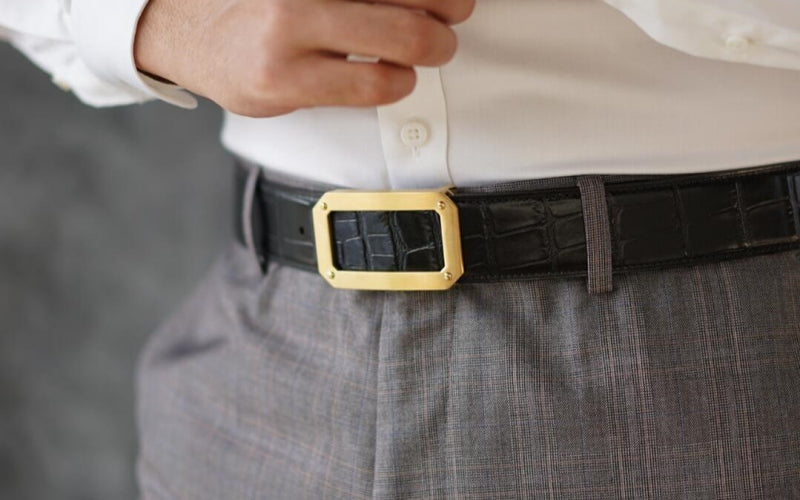
| Smart casual / creative office | Texture welcome: croc, braided, or a distinctive buckle that starts conversations. |
| Big interview this week | Black full-grain, silver buckle, zero personality on purpose. Save the flair for week two. |
One belt from each row builds a complete work rotation: BELTLEY men's belts.
The One Rule That Applies to Every Dress Code
Before the dress-code-specific guidance: your belt color should match your shoes. This rule doesn't change between casual Friday and a board presentation. Black shoes call for a black belt. Brown shoes call for a brown belt. The pants are a background element — they don't drive the belt decision, the shoes do.
Indeed's guide to business attire and virtually every professional dress code resource reach the same conclusion on this point. The belt-shoe relationship is the visual anchor of a work outfit. When it's right, everything else reads as intentional. When it's off, the outfit feels unfinished in a way that's hard to name but easy to perceive.
Get the shoe-belt match right first. Then apply the dress-code-specific details below.

Business Formal: When the Belt Is Part of the Uniform
Business formal — suits, dress shirts, tailored trousers — has the strictest belt rules of any work dress code. Which also makes it the easiest, because there's very little left to interpretation.
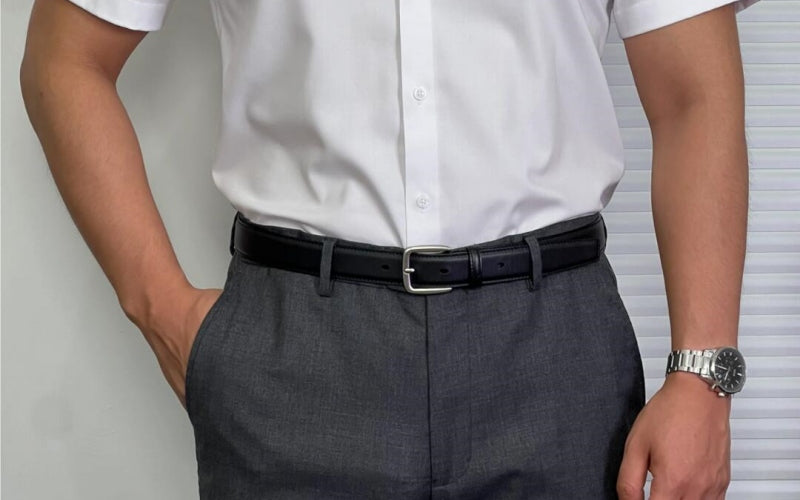
Color: Black or dark brown, matched exactly to the shoes. In formal settings, the belt and shoes should share the same leather tone and the same finish level. Polished Oxford with polished belt. There's no room for casual contrast in this register.
Width: 1"–1.25" (25–32mm). Nothing wider. A suit trouser's belt loops are sized for a slim belt, and a casual 1.5" belt forces its way through those loops looking like it escaped from a pair of jeans. The disruption to the suit's silhouette is visible from across a room.
Buckle: Small, simple, flat — a frame buckle or bar buckle in silver or gold depending on your watch and cufflinks. The buckle should be invisible in the context of the outfit. If someone notices your buckle, it's probably too large or too decorative for the setting.
Leather finish: Smooth and semi-polished. No embossing, no heavy grain texture, no distressed leather. The formality of the suit requires a belt that mirrors that register.
Buckle My Belt's leather belt etiquette guide describes the formal belt well: it should be a quiet, cohesive part of the outfit, not a feature. Its job is to complete the look, not contribute to it. BELTLEY's dress belt collection is built around exactly this brief — slim widths, full-grain leather, simple hardware that holds its finish without tarnishing.

Business Casual: More Flexibility, Still Some Rules
Business casual is where most professionals spend most of their wardrobe decisions in 2026, and it's also where the most belt mistakes happen — because the flexibility of the dress code doesn't mean anything-goes.
The operating principle: you have room to express yourself, but the belt still needs to coordinate with the shoes and match the outfit's overall formality level. A belt that would look perfect on a Saturday doesn't automatically work in a business casual office environment.
For Men in Business Casual
The typical business casual outfit — chinos or dress trousers, a blazer or button-down, leather shoes or clean leather boots — fits a 1.25"–1.38" belt comfortably. This width is slightly more relaxed than a formal belt but doesn't read as casual the way a full 1.5" jeans belt does.
Color stays tied to shoes: brown belt with brown or cognac shoes, black belt with black or dark shoes. The tone can be richer than in formal settings — a cognac or medium brown belt with tan leather loafers and grey chinos is a strong business casual combination that has more personality than the standard black-on-black formal uniform.
Leather texture has slightly more latitude. A light pebble grain or subtle emboss is acceptable in business casual where it would look wrong on a suit. Full-grain leather in any surface quality works well here. The Modest Man's business casual style guide notes that business casual is precisely the register where the quality of individual items becomes most visible — you're not hidden behind the formality of a suit, so materials and construction read more directly.
This is the BELTLEY context. No middlemen, no Brand Tax — just quality leather at a price that reflects actual material and craft, not a logo premium. A full-grain men's leather belt at this quality level holds up differently than what you'd find from a department store: the leather develops character over time rather than just wearing down.
For Women in Business Casual
The belt question in women's professional dressing is often "whether to wear one" as much as "which one." Corporette's practical take on belts with work pants reflects a real tension that women navigate: a belt can sharpen an outfit or clutter it depending on the silhouette and garment.
The practical guidance: a belt adds value to a women's work outfit when it creates waist definition in a looser silhouette (an oversized blazer, a flowy shirt, wide-leg trousers) or when the outfit needs a visual anchor. It doesn't add value when the outfit is already well-fitted and structured — in those cases, a belt is one accessory too many.
When worn:
- Width: 1" or under for most office contexts. A slim leather or suede belt sits cleanly over tailored trousers or a tucked blouse without adding bulk.
- Color: Match to the shoes or to a dominant neutral in the outfit. Black, tan, cognac, and dark brown all work in professional women's styling.
- Buckle: Minimal. A thin frame, bar, or simple gold buckle. Office settings aren't the place for statement hardware unless the rest of the outfit is very paired down.
Who What Wear's 2026 belt styling guide notes that in 2026, the belt-as-finishing-touch approach has become a defining move in elevated workwear — thin leather, refined hardware, nothing logoed. It signals that an outfit was considered, which lands differently in professional environments than showing up in the same tailored basics without any personal touch.
BELTLEY's women's belt collection covers the slim, refined end of that spectrum — full-grain leather, clean hardware, widths that work with professional silhouettes without competing with them.

Smart Casual in the Office: Where Self-Expression Actually Fits
Smart casual — the Friday standard in most offices, the daily register in creative industries and startups — gives the belt the most room of any work dress code. You can use color, you can use texture, you can use a slightly more interesting buckle.
The constraint is that "smart" is still in the name. A well-worn casual belt that belongs with jeans on the weekend doesn't necessarily belong in an office environment even on a casual Friday. The difference is quality and condition: a beat-up canvas belt is casual, a full-grain leather belt in a warm cognac or tan is smart casual.
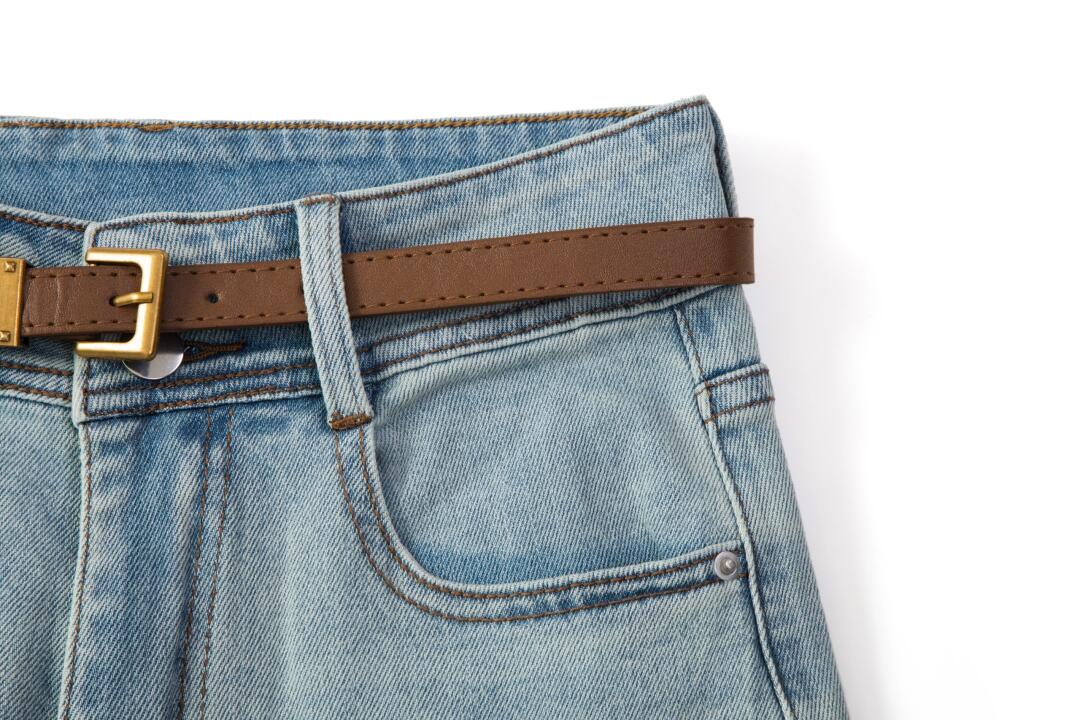
For men, a 1.5" brown leather belt in a rich cognac or dark tan paired with dark chinos and clean leather sneakers or loafers is a textbook smart casual combination. Effortless Gent's belt matching framework describes smart casual as the register where the belt can do color work rather than just coordinate — a statement in a way that formal and business casual can't accommodate.
For women, smart casual opens the door to a slightly wider belt (1"–1.25") used as a deliberate waist accent over a relaxed blazer or longline top. An interesting buckle — a small gold bar, a minimal geometric frame — reads as intentional personality rather than distraction in this context.

What the Buckle Signals at Work
Buckle choice communicates something specific in a work environment, even if no one articulates it.
A simple, small buckle in silver or gold says: I dressed thoughtfully, the details are right, the belt is doing its job without calling attention to itself. This works at every formality level from business formal to smart casual.
A large, decorative, or logo-heavy buckle says: I have a strong personal aesthetic. That's fine in creative or casual environments. It's a liability in conservative industries — finance, law, corporate consulting — where professional convention favors restraint.
Metal coordination: buckle metal should match your watch and visible jewelry. Silver watch, silver buckle. Gold jewelry, gold buckle. This applies to both men and women and it applies in every work context. Mismatched metals don't ruin an outfit, but matching them is one of those details that makes an outfit look finished rather than assembled.
The Art of Manliness complete belt guide is direct on this: in formal and professional settings, the buckle should be as inconspicuous as possible. The smaller and simpler the buckle, the more formal the belt. Save the personality for the leather color and quality, not the hardware size.
At BELTLEY, we use marine-grade stainless steel on our buckles for a specific reason: it doesn't tarnish or develop a greenish patina the way standard zinc alloy hardware does. When you're matching your buckle to your watch over years of wear, the buckle staying consistent matters. A buckle that's changed color is harder to coordinate than one that holds its finish.

The Belts Worth Owning for a Work Wardrobe
Most work wardrobes need exactly two belts. This isn't minimalism for its own sake — it's that two well-chosen belts genuinely cover every office context without overlap.
Belt 1 — Black dress belt, 1"–1.25" wide. Smooth full-grain leather, simple frame buckle in silver. Covers business formal, smart-casual with black shoes, and any outfit where the belt should disappear into the look. This belt should last a decade with basic conditioning. Browse the black leather belt collection for options built to that standard.
Belt 2 — Brown or cognac belt, 1.25"–1.38" wide. Full-grain leather in medium brown, cognac, or dark tan — flexible enough for business casual chinos through to smart casual jeans on Fridays. Brown covers more ground in everyday professional wear than black because it works with the broader range of earth tones that show up in casual and smart-casual wardrobes. Our brown leather belt collection covers this range in full-grain leather across several widths.
Both should be correctly sized — the buckle pin going through the middle hole, the tail passing through the first keeper loop and stopping. If you're unsure of sizing, the BELTLEY size guide walks through the measurement. A belt that's too long or too short undermines the whole outfit regardless of how well the color and width are matched.

Common Work Belt Mistakes
These come up repeatedly, and each is a simple fix once you know to look for it.
Wearing a casual jeans belt with dress trousers. The belt's width, texture, or buckle size is wrong for the trouser. Fix: keep separate belts for formal/business casual and casual contexts.
Mismatching the leather finish. Correct color, wrong finish. A matte rough-out belt with polished leather Oxfords. Fix: mirror the shoe's surface quality in the belt.
Belt tail too long. The end flops past the second keeper loop. Fix: order the correct size — belt size should be 1–2 inches more than your trouser waist — or have it trimmed by a cobbler.
Buckle too large or decorative for the dress code. Fine on a casual Saturday, reads as misplaced in a formal meeting. Fix: reserve statement buckles for smart casual and casual contexts only.
Ignoring metal coordination. A gold buckle with a silver watch. Fix: decide on one metal tone for all accessories before you dress and stick to it. See the full decision in our brown belt vs. black belt guide.

The Bottom Line
Matching a belt to a work outfit comes down to three variables adjusted for your dress code: color matched to shoes, width matched to trouser and formality level, and buckle scaled to the register of the occasion. Business formal demands precision. Business casual allows personality within a framework. Smart casual gives you genuine flexibility — use it deliberately.
Two quality belts cover every work scenario: one slim black dress belt, one medium-width brown or cognac casual belt. Both in full-grain leather, both correctly sized, both with simple hardware that coordinates with your other metals. That's the whole system. Start with the men's belt collection or the women's belt collection depending on which gap you're filling — every belt comes with a 30-day return policy if the size or color isn't right.
Frequently Asked Questions
Q: Should a belt always match your shoes at work?
Yes — the belt and shoes should be in the same leather color family in any professional context. Black shoes with a black belt, brown shoes with a brown belt. In formal settings, the finish level should match too (polished with polished). This is the single most important belt rule for work outfits and it applies across all dress codes.
Q: What belt width is correct for business formal?
For business formal — suits and tailored dress trousers — a 1" to 1.25" (25–32mm) belt is the correct width. A wider belt disrupts the suit's silhouette and reads as casual regardless of its leather quality. Keep the buckle small and simple, and match it to your watch and cufflinks.
Q: What belt should women wear to the office?
A slim leather belt — 1" or under — in black, tan, or cognac is the strongest work option for women. It should coordinate with the shoes and sit cleanly over the waistband without adding bulk. The buckle should be minimal. A belt adds the most value in women's office dressing when it creates waist definition in a looser or more relaxed silhouette.
Q: Can you wear a brown belt to a formal business meeting?
Yes — if you're wearing brown shoes, a dark brown or cognac belt that matches is correct and appropriate. Brown is fully acceptable in business formal when it coordinates with the footwear. The mistake to avoid is wearing a light tan or casual-finish brown belt with formal trousers — the shade and finish need to match the formality of the shoes and outfit.
Q: How do you know if a belt is too casual for the office?
A belt is too casual for the office if: it's wider than 1.5" and going on dress trousers; it has a large decorative or logo-heavy buckle; the leather is heavily distressed or textured in a way that reads as rugged rather than refined; or it's clearly a jeans belt being worn with tailored clothing. The fix is keeping purpose-built belts for formal and business casual contexts rather than using one belt across the entire wardrobe.