How to Remove Water Stains, Salt Rings, and Sweat Marks on Leather
Quick answer: Water stains, salt rings, and sweat marks each need slightly different treatment. Water stains: lightly dampen the entire affected area to even out moisture, pat dry, then condition once dry. Salt rings: make a diluted vinegar solution (1:1 water and white vinegar), wipe gently with a damp cloth, then water-rinse and condition. Sweat marks: clean with damp cloth and mild pH-neutral soap, then condition lightly. Some marks become permanent over time — accept them as part of the belt's history rather than damaging the leather further trying to remove them.
Last updated: May 2026 • By BELTLEY Editorial
TL;DR:
- Water stains: even out the moisture rather than try to "remove" the stain — works because the mark is uneven absorption.
- Salt rings: diluted vinegar (1:1 with water) dissolves salt residue, then rinse and condition.
- Sweat marks: gentle soap cleaning + light conditioning.
- Avoid: aggressive scrubbing, undiluted vinegar, alcohol, heat — all cause additional damage.
- Some old marks are permanent — restoration sometimes means accepting character, not erasing it.
A full-grain leather belt worn daily eventually picks up marks — water spots from rain, salt rings from winter slush, sweat darkening at the buckle area, condensation marks from humid summers. Most of these are removable if you treat them correctly within the first few days; older marks are sometimes permanent. Below is the honest stain-by-stain guide. For broader cleaning, see how to clean a full-grain leather belt without killing the patina.
Why do water stains appear on leather in the first place?
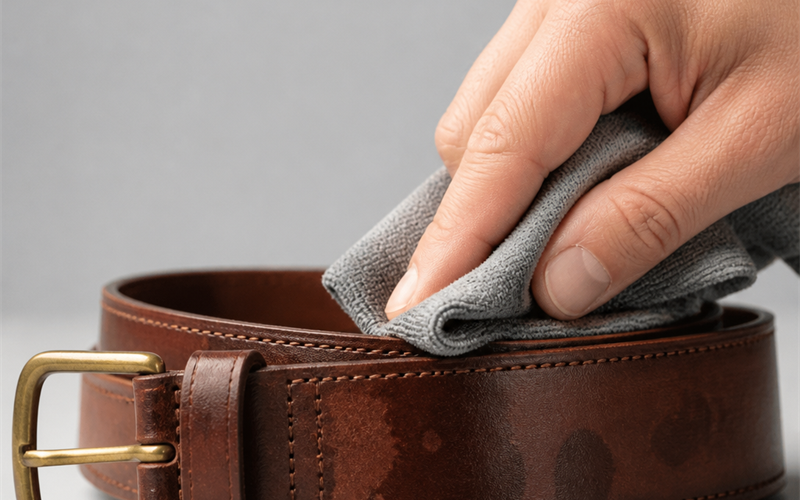
Uneven absorption. A water stain isn't dirt — it's a visible boundary where the leather absorbed water unevenly. When water hits leather and dries unevenly, the wet zone absorbs more thoroughly than the dry zone, leaving a visible color difference at the boundary. The mark isn't a stain in the traditional sense; it's a moisture history line.

This insight is what makes water-stain removal work. You don't need to lift a substance off the leather; you need to make the moisture distribution even across the area. Once the entire region has been uniformly moistened and dried, the visible boundary disappears. See is full-grain leather waterproof for the broader water-leather interaction.
How do you remove a water stain from leather?
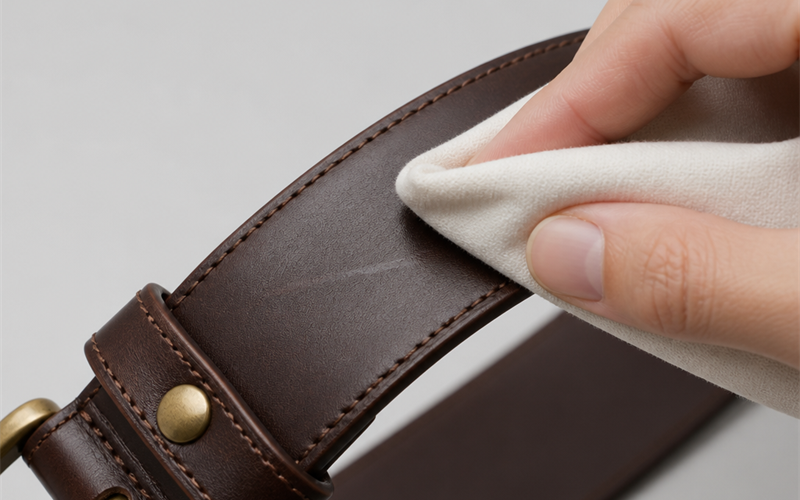
Even out the moisture across the affected area. (1) Lightly dampen a clean cloth with plain water. (2) Wipe the entire affected zone — including the visibly stained area AND a few inches around it — so the whole region is uniformly damp. (3) Pat dry with a separate clean cloth. (4) Air-dry at room temperature for 30-60 minutes. (5) Once fully dry, apply a thin coat of leather conditioner to even out the surface tone.
The technique works because you're erasing the boundary, not the stain. Within 24-48 hours, the area should look uniformly colored again. Older water stains (weeks or months old) may not fully come out — the moisture difference has had time to "set" into the leather's color memory. Newer stains usually disappear completely with this method.
Key stat: Water stains addressed within 24-48 hours typically remove completely with the even-out-the-moisture technique. Water stains older than 4-6 weeks often only partially remove — the moisture differential has had time to set into the leather's color memory and may be permanent.
How do you remove salt rings from leather?
Diluted vinegar dissolves the salt residue. Salt rings appear on leather belts during winter when road salt or slush dries on the surface — the visible ring is salt crystals deposited where the water evaporated. To remove: (1) mix 1:1 white vinegar and water. (2) Lightly dampen a clean cloth with the solution. (3) Wipe gently over the salt ring along the grain. (4) Rinse by wiping with a second clean cloth dampened with plain water. (5) Pat dry and air-dry for 60+ minutes. (6) Apply leather conditioner once fully dry.

The vinegar's mild acidity dissolves the salt crystals; the water rinse removes the vinegar residue; the conditioner restores the natural oils that the cleaning process may have slightly stripped. Avoid using undiluted vinegar — too acidic, will damage the leather finish.
Stain removal techniques
| Stain type | Cause | Removal method | Success rate |
|---|---|---|---|
| Water stain (new) | Uneven moisture absorption | Even out moisture, then condition | 90%+ |
| Water stain (old) | Set color memory | Same method | 30-60% |
| Salt ring | Road salt residue | 1:1 vinegar-water solution | 80%+ |
| Sweat marks | Skin oils and salt deposits | Mild soap + condition | 70%+ |
| Condensation marks | Humidity cycles | Even out moisture, condition | 70-80% |
| Old set-in marks | Long-term oxidation | Often permanent | <30% |
How do you remove sweat marks from leather?
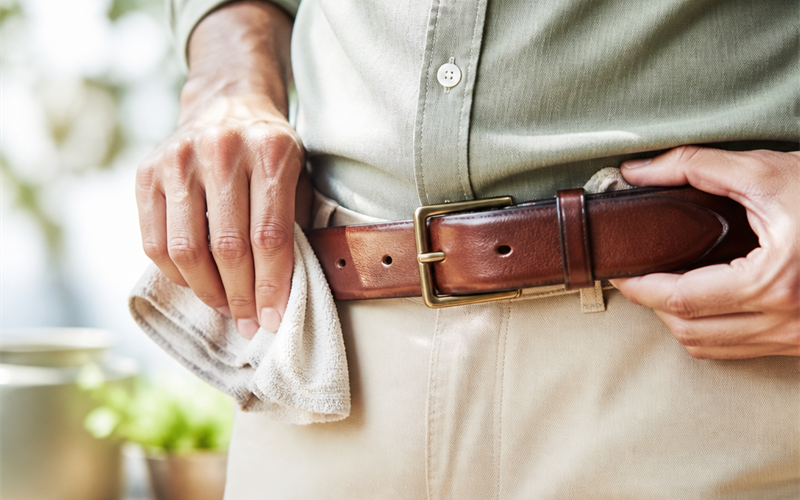
Mild soap cleaning followed by conditioning. Sweat contains salt, skin oils, and minerals that gradually darken and discolor leather, especially at the buckle area (where sweat collects against the back of the buckle). To remove: (1) wipe the area with a clean damp cloth to remove surface oils. (2) Apply one drop of pH-neutral mild soap (saddle soap or castile soap) on a damp cloth. (3) Wipe gently along the grain. (4) Wipe clean with a second damp cloth to remove soap residue. (5) Pat dry, air-dry 60+ minutes. (6) Apply light conditioner to restore the oils stripped by cleaning.

Heavy sweat marks may not fully come out — the salt and oils have had time to penetrate. Often, the best result is partial improvement rather than full removal; accept the slight darkening as part of the belt's life history. See neatsfoot oil vs mink oil vs beeswax for the conditioner choice.
What should you avoid when treating leather stains?
Five common but destructive approaches. (1) Scrubbing aggressively — damages the surface finish more than it removes the stain. (2) Undiluted vinegar — too acidic, can damage finishes and dry the leather. (3) Alcohol or hand sanitizer — strips oils, dries leather, often deepens the stain. (4) Heat-drying — never use a hair dryer or heat source on a wet leather belt; causes cracking. (5) Multiple aggressive products in sequence — vinegar + soap + alcohol + conditioner all in one session over-strips the leather.
The general principle: leather stain removal is gentle and patient. Aggressive cleaning trades the stain for new damage. If the gentle approach doesn't fully remove a stain, accept the partial result rather than escalating to harsher methods.
When should you accept a stain rather than try to remove it?
When the leather is old enough that the stain is "set" and removal risks more damage than the stain causes. Several scenarios. (1) Old water marks (3+ months) — the color differential has set; aggressive treatment often spreads the mark rather than fixing it. (2) Long-term sweat darkening at the buckle — common, partly cosmetic, often impossible to fully remove without bleaching the surrounding leather. (3) Vintage marks on inherited belts — often part of the belt's character and history.

A belt with a few set-in marks isn't ruined — it's lived-in. Real full-grain belts develop a complex surface history that includes minor stains, patina shifts, and small character marks. The honest framing: cleaning preserves belts; over-cleaning destroys them. See how to clean a full-grain leather belt without killing the patina for the broader philosophy.
What about specific products marketed for leather stain removal?
Most commercial "leather stain removers" are too aggressive for full-grain. Many leather stain removal products (especially those marketed as "spot cleaners" or "magic erasers") contain solvents, surfactants, or abrasives designed for synthetic leather or heavily-finished commercial leather. On real full-grain leather, they often strip finish, change color, or damage patina along with the stain.

Two safer commercial options. (1) Saddle soap — traditional product designed for leather; gentler than household cleaners; safe for occasional use. (2) Bickmore Bick 1 (leather cleaner) — specifically formulated for full-grain leather; pH-balanced. For most stains, however, the gentle home methods above work as well as commercial products and won't risk additional damage.
The Bottom Line
Water stains, salt rings, and sweat marks each respond to slightly different treatment: even out moisture for water stains, diluted vinegar for salt rings, mild soap for sweat marks. All three approaches are gentle, patient, and conservative — aggressive cleaning trades the stain for new damage. Fresh stains (within 24-48 hours) usually remove completely; older marks may only partially come out, and some become permanent character. The principle: clean gently, condition afterward, and accept that some marks become part of the belt's history. BELTLEY's full-grain leather belts are built to develop honest character over years of wear — backed by a 10-year warranty. Ready for a belt that lives well? Start there.
Frequently Asked Questions
Q: Will water permanently stain a leather belt?
Fresh water stains (less than 48 hours old) usually remove completely with the even-out-the-moisture technique. Older water stains (weeks or months) often partially remove but may leave faint permanent traces. The key is treating water stains quickly — the longer they sit, the more the moisture differential sets into the leather's color memory.
Q: How do you get salt off a leather belt?
Diluted white vinegar (1:1 with water) dissolves salt residue safely. Lightly dampen a cloth with the solution, wipe gently along the grain, rinse with plain damp cloth, pat dry, and condition once fully dry. Avoid undiluted vinegar — too acidic for leather.
Q: Can sweat ruin a leather belt?
Long-term, yes — sweat contains salt, oils, and minerals that gradually darken and weaken leather, particularly at the buckle area. Wipe sweat off after wear when possible; clean the area with mild soap occasionally; condition regularly to maintain the leather's structural oils. Heavy sweat-induced darkening at the buckle is sometimes permanent but rarely structurally damaging.
Q: What's the best way to remove old leather stains?
Older stains (months to years old) often only partially come out; the discoloration has set into the leather. The gentle techniques above can help fade them, but aggressive removal attempts usually cause more damage than the stains themselves. For valuable belts with significant staining, professional restoration may be worth the cost.
Q: Can I use vinegar on leather?
Yes — but only diluted (1:1 with water for salt rings, sometimes more dilute for other uses) and only briefly. Undiluted vinegar is too acidic and damages leather finishes. Vinegar's mild acidity is useful for dissolving salt and some mineral deposits; for most stains, plain water or mild soap is enough.