How to Cut Down a Belt That's Too Long (Without Ruining It)
Quick answer: To safely cut down a belt that's too long, trim from the buckle end (not the tip), preserve the original holes, mark the new length precisely, cut straight across with a sharp utility knife on a hard surface, then re-shape and reattach the buckle hardware. The tip end stays untouched, so your belt keeps its factory finish. Plan on 15 minutes and one steady hand.
Last updated: May 2026 • By BELTLEY Editorial
TL;DR:
- Always cut from the buckle end, never the holed tip.
- Wear the belt, mark where it should attach, add ~1–2 inches for the fold-back.
- Cut straight with a sharp utility knife on a hard, flat surface.
- Reattach the buckle (Chicago screws, prong, or stitch — depending on the style).
A belt that's two notches too long isn't broken — it's just a fitting away from perfect. The mistake most people make is trimming the wrong end and destroying the factory tip in the process. Cut from the buckle side instead, and you keep the original finished tip (with all its punched holes) right where it belongs. Below is the safe method and the trap to avoid. If you're not sure your belt is worth the surgery in the first place, see how to tell if a belt can be restored or tossed.
Which end of the belt should you cut?
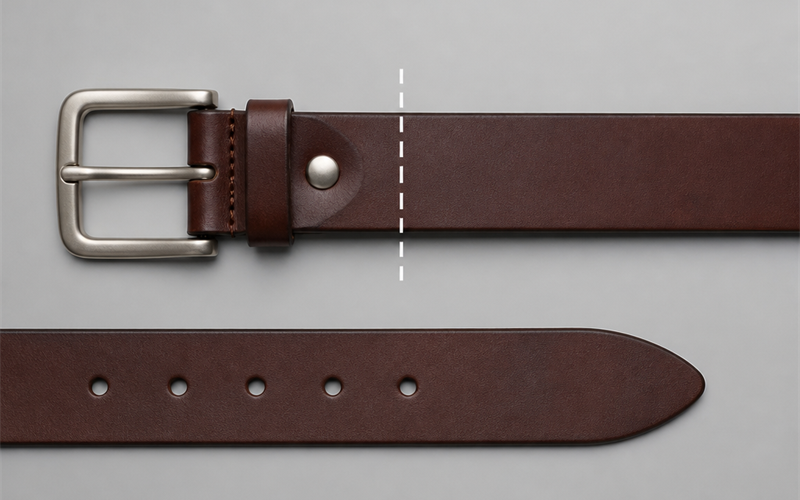
The buckle end — never the tip. The tip end of a leather belt has the punched holes, the shaped point, and the original factory edge finish — that's the visible part of the belt and the part you want to keep. The buckle end is hidden inside a fold or screw assembly and is the only side designed to be cut.

The construction tells you. On most quality belts, the buckle is attached by Chicago screws, a snap, or sometimes a stitched fold — all of which are reversible. The tip end is glued, burnished, and finished in ways that aren't. Our men's belts and dress belts use the same construction, and they all open from the buckle side. Cutting from the tip is the #1 way to ruin an otherwise good belt.
How do you find the right cut length?
Wear it, mark it, then add for the fold. Put the belt on with the prong in the middle hole (its correct fit position). Mark the leather where it currently attaches to the buckle assembly — that's your reference point. Then add 1–2 inches of length back toward the buckle to account for the fold-back or screw hole that re-attaches the hardware. Cut at that mark.

The math is short, but missing it costs you the belt. The middle-hole rule comes from the same principle we cover in how do I know what size men's belt to buy and our size guide. The extra 1–2 inches gives the leather room to fold around the buckle bar (or hold a Chicago screw) without leaving the assembly hanging on by a half-inch tab.
How do you make a clean straight cut?
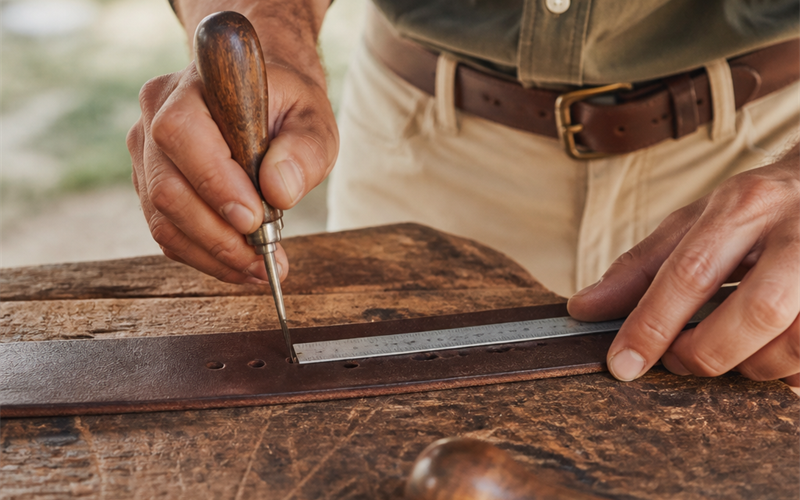
Use a sharp utility knife and a hard, flat surface. Place the belt on a cutting mat or thick wood block, line up a metal ruler across your mark perfectly perpendicular to the strap, and draw the blade through with steady downward pressure — usually two or three passes is enough. Scissors will crush full-grain leather; a sharp blade slices it cleanly.
Sharp is non-negotiable. A utility or craft knife with a fresh blade gives the cleanest result; a dull blade compresses the fibers and leaves a ragged edge. The belt's grain (the smooth side) should face up, with the ruler holding it flat. Aim for a single confident pull rather than a sawing motion. If the leather is double-layered — like our double layer belts — you may need three or four passes.
Key stat: A fresh utility knife blade cuts through a single layer of full-grain leather in 2–3 passes with light pressure; a dull blade or scissors typically requires 8+ passes and leaves a crushed, uneven edge.
How do you reattach the buckle?
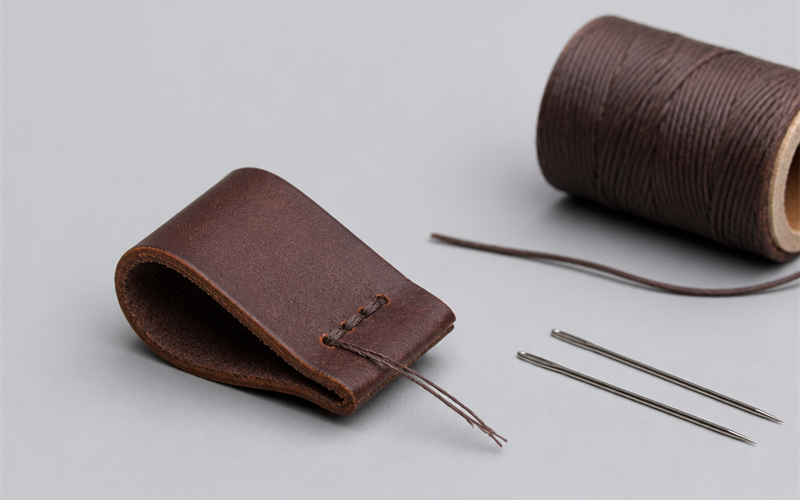
It depends on the buckle style. (1) Chicago screw buckle: unscrew, slide off the cut portion, punch a new screw hole on the buckle end (4–5mm), reassemble. (2) Snap buckle: open the snap, remove the cut tail, punch a new snap hole, snap closed. (3) Stitched buckle: harder — you'll need to cut and re-stitch by hand or take it to a cobbler. (4) Box & prong dress buckle: usually pulls out of a slot that you can re-glue.

Most quality belts use removable hardware. The Chicago screw is the standard on full-grain casual belts because it lets the customer (and the maker) swap or repair without a sewing machine. Our classic casual belt with solid brass uses exactly that design. If you're unsure which style you have, look at the underside of the buckle attachment for visible screw heads or snaps before you cut.
Belt-shortening cheat sheet
| Step | Action | Tool |
|---|---|---|
| 1. Identify | Find the buckle end (cut here) and the holed tip (keep) | — |
| 2. Mark | Wear belt, mark current attach point, add 1–2" toward buckle | Pencil + ruler |
| 3. Detach | Remove buckle (Chicago screws, snap, or seam) | Screwdriver / nothing |
| 4. Cut | Straight perpendicular cut with sharp blade | Utility knife + metal ruler |
| 5. New hole | Punch hole for screw/snap on the new buckle end | Awl or punch |
| 6. Reattach | Fold back, screw or snap buckle in place | Same tool |
| 7. Finish | Condition the cut edge | Leather conditioner |
How do you finish the new cut edge?
Smooth, round, and condition it. The fresh-cut edge of leather is square and raw — it needs a quick refinishing to match the rest of the belt. Lightly sand the cut surface with fine sandpaper to round the corners, then rub a small amount of leather conditioner along the edge with your finger. For a more polished result, use a beeswax-based edge slicker to burnish it.

Refinishing closes the fibers. A bare cut edge will absorb moisture and fray over time — which is why every professional belt has burnished or painted edges, the third leg of our 3-Material Rule. Since the cut edge sits hidden under the buckle on most setups, perfect cosmetics aren't critical — but a 30-second seal still adds years to that joint. Our leather care page covers conditioner basics if you don't already keep one on hand.
When should you not DIY this?
When the belt is stitched, exotic, or sentimental. Heavily stitched belts, fully stitched dress belts, and exotic-leather belts (crocodile, alligator, python) deserve a cobbler's hands — not a utility knife at the kitchen counter. The same goes for inherited or vintage pieces where mistakes can't be undone. If your belt is a crocodile or exotic leather piece, take it to a professional.

The DIY zone is full-grain cowhide with screw-attached buckles. Outside that zone, a leather goods repair shop charges $15–$30 to shorten a belt cleanly and refinish the edge — cheap insurance for a $200+ piece. We dig into the assessment side in our companion post on how to tell if a belt can be restored.
The Bottom Line
Cutting down a too-long belt is a 15-minute job if you do two things right: cut from the buckle end (keep that beautiful factory tip intact), and re-fit the hardware cleanly with a Chicago screw, snap, or careful re-stitch. Skip the tip-side trim — that's how good belts get ruined. At BELTLEY, every belt is built with this kind of repairability in mind: full-grain leather, removable solid-metal hardware, hand-finished edges, and a 10-year warranty that covers materials and construction. Ready for a belt that fits perfectly out of the box? Browse our full-grain leather belts and size guide.
Frequently Asked Questions
Q: Should I cut a belt from the buckle end or the tip end?
Always the buckle end. The tip has the factory shaping, finished edges, and the holes — that's the part you want to keep. The buckle end is hidden inside the assembly and designed to be cut and reattached.
Q: What's the best tool to cut a leather belt?
A fresh-bladed utility or craft knife on a hard cutting surface, used with a metal ruler as a guide. Scissors crush full-grain leather; a sharp blade slices it cleanly in two or three passes.
Q: How much length should I trim off?
Wear the belt with the prong in the middle hole and mark where it currently attaches. Add 1–2 inches back toward the buckle (for the fold or screw hole) and cut there. That keeps the prong centered after reattachment.
Q: Should I take an expensive belt to a cobbler instead?
Yes, especially for stitched, exotic-leather, or sentimental belts. A pro shortens a belt cleanly for $15–$30 and refinishes the edge to match the original — cheap insurance for a $200+ piece you don't want to risk.
,%20preserve%20the%20original%20holes,%20mark%20the%20new%20length%20precisely,%20cut%20straight%20across%20with%20a%20sharp%20utilit...)