How to Choose a Good Belt for Guys: The No-Fluff Buying Guide
TL;DR: Quick Answer and main takeaways
- Start with full-grain leather — it's the only grade that lasts 10+ years, develops a patina, and holds its edge under daily use
- Width is set by occasion: 1.25"–1.38" for dress and suits; 1.5" for jeans and casual; never swap them
- Size by waist measurement, not pants label — measure over your pants and add 2 inches
- Match belt color to your shoes in formal contexts; in casual, tone-match is fine
Most guys don't think much about their belt until it starts peeling, the buckle goes dull, or someone notices it doesn't match. At that point, they buy another cheap replacement and repeat the cycle. A better approach: buy once with a clear set of criteria, and the belt outlasts most of what's hanging in your closet.
This guide covers how to choose a good belt for guys — five decisions that determine quality and fit, with none of the padding.

The Right Belt for Your Week
What your typical week looks like decides what to buy first:
| Your situation | Buy this |
|---|---|
| First serious belt | Full-grain dress belt, 1.25"–1.38", black — interviews, office, weddings, done |
| Jeans most days | 1.5" casual in dark brown — the daily workhorse |
| Suits regularly | Match belt to shoe color exactly — it's the rule people notice when broken |
| Both belts already owned | You're ready for the exotic upgrade — crocodile from $118 at DTC pricing |
All four answers live in the men's collection. What separates good from junk:
What Makes a Men's Belt Actually Good Quality?
A good men's belt has three measurable markers: full-grain leather (not bonded, split, or "genuine"), solid metal hardware that won't tarnish, and clean edge finishing on all four sides. These aren't aesthetic preferences — they directly determine whether the belt survives three years of daily use or starts cracking at the fold point after six months.
Leather grade is the single most important factor. Full-grain leather uses the outermost, densest layer of the hide with the natural fiber structure intact. It resists cracking, develops a rich patina with age, and can last 10–20 years with basic care. According to leather industry grading standards, full-grain is the only grade where the surface hasn't been sanded, corrected, or coated — what you see is the actual hide. "Top-grain" has been buffed smooth and given a finish coat; it's cleaner looking but thinner and less durable, typically lasting 3–10 years. "Genuine leather" is the lowest recoverable grade — a legally permissible term for compressed scrap layers that peel and crack within 1–3 years of regular wear.
For a side-by-side comparison of how these grades hold up over time, the full-grain vs. genuine leather belt guide breaks it down without the marketing language.

Physical quality checklist before buying:
- Edges are beveled and burnished, not raw or painted over fraying
- Leather feels dense and supple, with visible natural grain variation — not uniform or plasticky
- Buckle feels solid and heavy; hollow die-cast buckles flex when pressed
- Stitching (if present) is tight, even, and close to the edge — not loose or decorative
- Consistent thickness throughout; uneven thickness indicates inconsistent hide quality
What's the Difference Between a Dress Belt and a Casual Belt?
A dress belt is narrow (1.25"–1.38"), made from smooth or fine-grained leather, and carries a small, low-profile buckle. It threads standard dress trouser loops and suits formal and business settings. A casual belt is wider (1.5"+), typically made from heavier or textured leather, and can carry a larger buckle. The two are not interchangeable — a casual belt on dress trousers looks sloppy; a dress belt on jeans looks precious.
This distinction is the most commonly ignored rule in men's belt buying. The width difference isn't arbitrary — dress trousers have narrower belt loops, and a 1.5" casual belt physically won't thread through them without forcing. Jeans have wider loops specifically to accommodate thicker, wider belts. Getting the width wrong for the context is the most visible belt mistake a man can make, and no amount of leather quality compensates for it.

The dress belt vs. casual belt breakdown covers the full distinction — material, finish, buckle hardware, and occasion — if you're choosing between two different wardrobes.
| Setting | Width | Leather Finish | Buckle Size |
|---|---|---|---|
| Black-tie / formal | 1"–1.25" | Smooth, polished | Small, flat |
| Business / office | 1.25"–1.38" | Smooth or fine grain | Medium, slim |
| Business casual | 1.38"–1.5" | Smooth or light texture | Medium |
| Jeans / weekend | 1.5"–1.75" | Full-grain, textured | Medium–large |
| Rugged casual | 1.5"–2" | Heavy grain, harness | Large, statement |

What Belt Width Should Men Choose?
For most men, 1.5" (38mm) is the most practical belt to own first — it works with jeans, chinos, and most casual trousers without looking out of place. For dress occasions, 1.25"–1.38" (32–35mm) is the standard. Anything wider than 1.5" belongs in casual and rugged contexts only.
Width also has a proportional relationship to body size. Taller men with broader frames can wear wider belts without the belt consuming a disproportionate share of their waistline. Shorter or slimmer men are better served by mid-range widths that don't overwhelm. Research on men's clothing proportion consistently positions 1.5" as the versatile daily standard for most builds.
BELTLEY's 1.5" belt collection covers both casual and semi-dress options at the most useful single width. For a dedicated dress option, the 1.25" (32mm) collection is the right move alongside a suit wardrobe.

How to Size a Men's Belt Correctly
Belt sizing is where most men go wrong, and the mistake is always the same: buying a belt based on their pants size. Men's pants are sold with vanity sizing — a pair labeled 34" typically measures 36"–37" at the actual waist. A belt bought to match the pants label ends up too small.
The correct method:
- Measure your bare waist at navel height (where the belt will sit)
- Add 2 inches to that number — this is your belt size
- When the belt arrives, it should fasten on the middle hole while standing relaxed
- You should have 2 holes available above and below the middle hole for adjustment
Men's belt sizing reference:
| Bare waist measurement | Belt size to order |
|---|---|
| 30–32" | 34" |
| 32–34" | 36" |
| 34–36" | 38" |
| 36–38" | 40" |
| 38–40" | 42" |
| 40–42" | 44" |
The belt tip — the end that passes through the buckle — should extend 2–3 inches past the first belt loop after fastening. Longer than that looks sloppy; shorter looks like you grabbed the wrong size. See the BELTLEY size guide for a step-by-step visual walkthrough.

Which Buckle Type Is Right for Your Style?
Prong buckles (traditional single-pin) are the standard for formal and everyday wear — they work with any belt and any occasion, and they're the easiest to replace if hardware needs changing. Ratchet buckles use a continuous track with no holes, allowing micro-adjustment and a consistently clean look without the worn-hole problem. Frame buckles (no moving parts, belt threads through a rectangle or D-ring) are the most minimal and work best in casual contexts.
Buckle size signals formality in the same direction as belt width: smaller buckles are more formal, larger buckles are more casual. A thumb-sized frame buckle in polished steel reads as business-ready. A wide, engraved or sculptural buckle belongs on a weekend outfit. Mixing a large statement buckle with a suit is the buckle equivalent of wearing sneakers to a wedding — technically possible, functionally wrong.
Hardware material matters for longevity. stainless steel is the benchmark — it's the same grade used in surgical instruments and marine hardware, and it won't tarnish, corrode, or discolor with daily contact. Standard zinc alloy plated buckles degrade within 1–3 years, especially under sweat and friction. BELTLEY uses stainless across all hardware — not as a marketing claim, but because replacing a good leather belt because the buckle went green is a waste of a good belt.

The Shoe-Matching Rule Every Man Should Know
One rule applies across virtually every formal and business context: match your belt leather color to your shoes. Black shoes — black belt. Brown shoes — brown belt. This rule exists because the belt and shoes are the two leather accessories in a man's outfit most visible against his clothing, and mismatching them creates visual dissonance the eye picks up immediately.
In casual contexts — jeans, chinos, weekend wear — the rule relaxes to tone-matching: a cognac belt with tan boots, or a dark brown belt with burgundy shoes, works without an exact match. The key is avoiding obvious contrast (black belt, white sneakers; brown belt, black dress shoes).
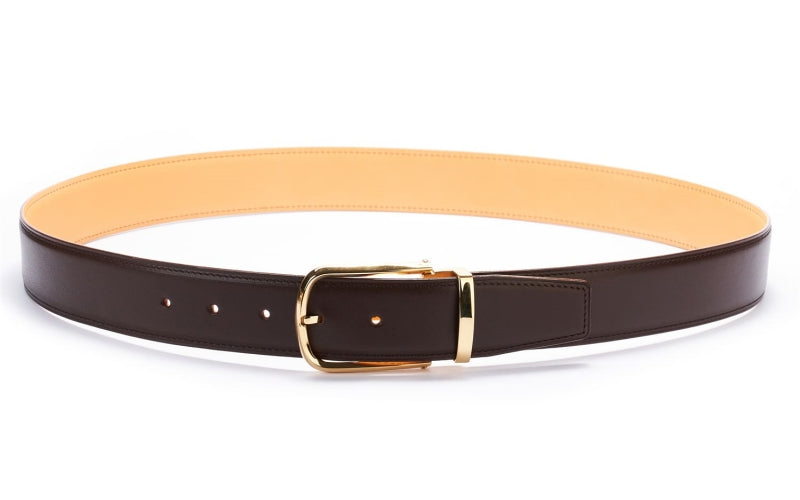
Metal tone follows the same logic as leather color: gold-toned buckle with gold watch and shoe hardware; silver-toned buckle with silver hardware. This isn't fussy — it just means one decision made once per outfit.
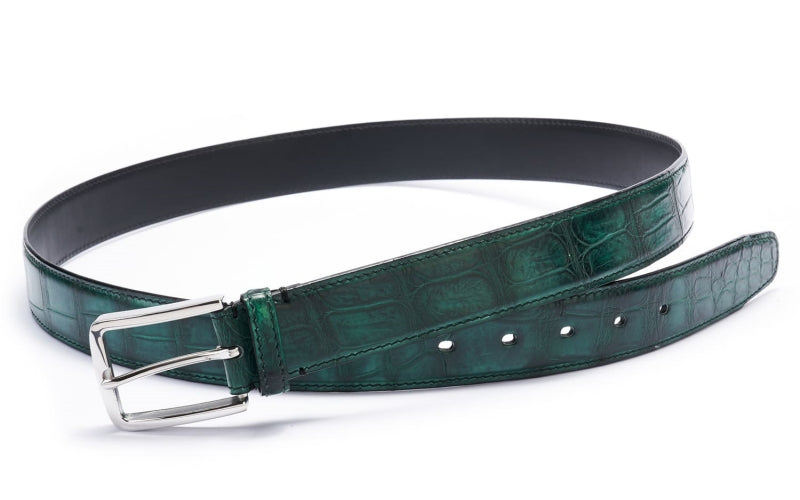
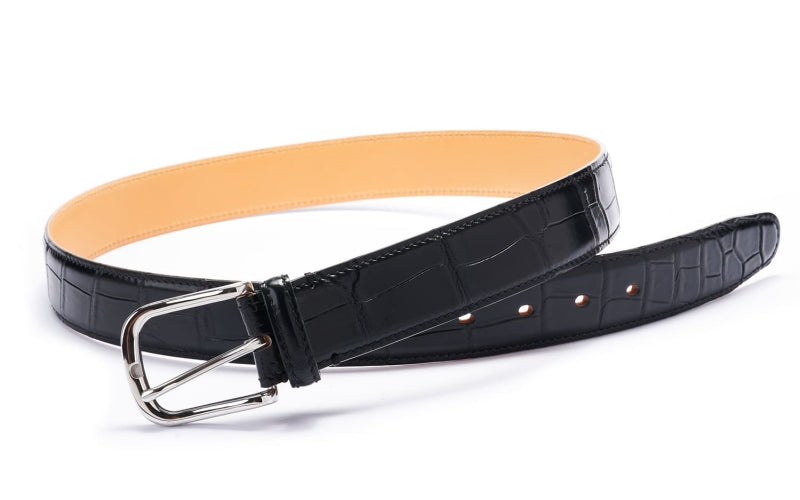
For men investing in an exotic leather belt, the matching logic becomes even more relevant. A crocodile belt in espresso pairs with brown and tan shoes for a refined everyday statement. A black alligator belt anchors a formal look the way a standard cowhide belt can't — the texture does work that smooth leather doesn't. Explore the crocodile and alligator belt collection to see the range of colorways available.

When to Step Up to Exotic Leather
Full-grain cowhide is the baseline for a good belt. Exotic leather is a different category — not just materially better, but visually and texturally distinct in a way that changes what the belt contributes to an outfit.
Crocodile and alligator leathers have a tiled scale structure that's immediately recognizable and increasingly rare as a genuine article in a market flooded with embossed imitations. The scales are structurally integrated into the leather, making these hides exceptionally durable — often outlasting standard cowhide belts under the same daily-use conditions. [Insert external link to: exotic leather durability comparison study or industry report]
Elephant leather is matte, heavily grained, and unlike any other surface. Python brings graphic scale patterning — a statement for a man who wants his accessories to do more than coordinate.
The case for exotic leather isn't complexity — it's longevity and distinctiveness. At BELTLEY, every exotic leather belt is handcrafted in small batches by artisans who specialize in these hides, with stainless steel hardware and a 10-year warranty on materials and construction. DTC pricing means no middleman markup — the cost reflects the craft, not a brand name. Browse the full men's belt collection across leather types, or go directly to the exotic leather collection if you're ready to invest in something that won't need replacing.
The Bottom Line
Choosing a good belt for guys comes down to five decisions: leather grade (full-grain only), occasion type (dress or casual — pick the right width for each), correct sizing (waist measurement plus two inches, never the pants label), buckle type that matches the setting, and color matched to shoes. Make those five decisions right and a belt becomes one of the few things in your wardrobe that actively improves over time.
The 15 types of leather belts for men guide covers every style, material, and construction in detail if you want to go deeper before buying.
Frequently Asked Questions
Q: What is the best leather for a men's belt?
Full-grain leather is the best grade for a men's belt. It uses the outermost, densest layer of the hide, resists cracking, and develops a patina over time. Exotic full-grain leathers — crocodile, alligator, elephant — are the premium tier above standard cowhide for men who want a belt that doubles as a statement piece.
Q: What width belt should a man wear?
1.5" (38mm) for jeans and casual wear; 1.25"–1.38" (32–35mm) for dress trousers and suits. Never wear a casual-width belt with dress trousers — the belt loops on dress pants are narrower and won't accommodate the extra width cleanly.
Q: How do I find my belt size as a man?
Measure your bare waist at navel height and add 2 inches. Do not use your pants size — vanity sizing means pants are typically labeled 1–3 inches smaller than the actual waist measurement. The belt should fasten on the middle hole, with the tip extending 2–3 inches past the first belt loop.
Q: Should a man's belt always match his shoes?
In formal and business settings, yes — match belt color to shoe color, and match metal buckle tone to shoe hardware. In casual contexts, the rule relaxes to tone-matching rather than exact matching. The strictness of the rule scales with the formality of the occasion.
Q: Is a ratchet belt better than a regular belt for men?
A ratchet belt offers a cleaner look and more precise fit than a traditional prong belt, because it adjusts in small increments along a continuous track rather than jumping between pre-drilled holes. It's particularly useful if your weight fluctuates, or if you're between standard hole positions on a traditional belt. The trade-off is that ratchet belts are typically less formal-looking than a slim prong belt for suit wear.