How to Choose a Good Belt for a Woman: The Complete Guide
TL;DR: Quick Answer and main takeaways
- A good belt for a woman starts with full-grain leather — it's the only grade that develops a patina, holds its edge under daily use, and lasts 10+ years
- Width should match your torso length and the occasion: 1"–1.25" for formal and petite frames; 1.5"+ for casual and taller builds
- Size up: measure your waist where the belt will sit and add 2 inches — belt and pants sizing are not the same
- Buckle style sets the tone — slim plaque for professional, statement hardware for casual, rhinestone or engraved for fashion
Most women buy a belt based on how it looks on a hanger. That's the wrong starting point. The belt that looks good in-store but cracks after one season, or fits fine standing but digs in after an hour of sitting, is not a good belt — it's an expensive mistake. This guide covers exactly how to choose a good belt for a woman: the four decisions that determine whether a belt lasts a decade or ends up in a drawer.

Your Shortcut by Situation
The full guide is below — here's the fast path for where you're starting:
| Your situation | Do this |
|---|---|
| One quality belt, no fuss | Full-grain leather, 1.25", black or dark brown — covers a decade of outfits |
| Office and professional wear | 1"–1.25" with a slim plaque buckle — refined, never loud |
| Casual and weekend | 1.5"+ with statement hardware — this is where personality belongs |
| Petite frame | Stay narrow (1"–1.25") regardless of occasion — proportion first |
| Sizing it | Measure where the belt will sit and add 2 inches — pants size is not belt size |
Start in the women's collection. What "good quality" technically means:
What Makes a Belt "Good Quality" for a Woman?
A good-quality women's belt has three non-negotiable characteristics: full-grain leather (not bonded or split leather), clean-finished edges with no fraying, and a buckle made from solid metal — not hollow die-cast. These three markers separate a belt that ages well from one that peels, cracks, or tarnishes within a year.
Leather grade is the most important factor. Full-grain leather is the outermost layer of the hide, with the natural fiber structure intact. It develops a patina over time, gaining character rather than losing it. According to research on leather grading standards, full-grain hides are the densest and most abrasion-resistant grade — the only grade that genuinely improves with age. Top-grain leather has the surface sanded away and a finish coat applied; it looks uniform but has a shorter lifespan of 3–10 years. "Genuine leather" is an industry-legal term for the lowest recoverable grade — a compacted composite that typically cracks within 1–3 years of regular use.
For a detailed breakdown of what separates these grades, the full-grain vs. top-grain leather guide covers everything with side-by-side comparisons.

What Belt Width Should a Woman Choose?
Width is determined by two factors: body proportion and occasion. For formal and business settings, 1"–1.25" (25–32mm) is the standard — narrow enough to thread standard belt loops and polished enough to complement tailored clothing. For casual styling, 1.5"–2" creates visual impact and works as a statement accessory. Petite and short-waisted women generally wear narrower belts; taller and longer-torso women can carry wider widths without proportion issues.
The relationship between torso length and belt width matters more than most guides acknowledge. A wide belt on a short torso consumes a disproportionate share of the visible midsection and can shorten the overall silhouette. A skinny belt on a tall frame disappears visually and loses its defining effect. The general principle: belt width should cover no more than one-third of your visible waist area.
Quick reference by occasion:
| Setting | Width | Why |
|---|---|---|
| Formal / business | 1"–1.25" (25–32mm) | Fits standard belt loops; understated |
| Smart casual | 1.25"–1.5" (32–38mm) | Versatile; works with jeans and skirts |
| Casual / fashion | 1.5"–2"+ (38–50mm) | Statement impact; cinching effect |
| Dresses / waist cinching | 1.5"–3" | Defined silhouette; corset-style look |
Browse by width at the women's belt collection, or go directly to 1.25" (32mm) belts for the most versatile everyday width.
How Should a Women's Belt Be Sized?
Measure your waist at the position where you plan to wear the belt — over your clothing, not your bare skin — then add 2 inches. The belt should fasten on the middle hole when you're standing relaxed. This gives two holes of adjustment in each direction, which accommodates clothing thickness, daily fluctuation, and the natural stretch of new leather over time.
The common mistake is ordering based on pants or dress size. Women's clothing sizing is inconsistent across brands and has no fixed relationship to actual waist circumference. A dress marked size 8 and a different dress also marked size 8 can vary by 2–4 inches in the waist — and neither tells you your belt size.
Sizing chart:
| Waist measurement (over clothes) | Belt size to order |
|---|---|
| 26–28" | 30" |
| 28–30" | 32" |
| 30–32" | 34" |
| 32–34" | 36" |
| 34–36" | 38" |
| 36–38" | 40" |
The BELTLEY size guide includes a full measuring walkthrough with visual instructions.

How to Choose Belt Leather: Full-Grain, Exotic, and Everything Between
Once you've established that the belt is full-grain, the next question is which hide. This is where the range expands significantly — and where BELTLEY's catalog starts to look different from a standard leather goods store.
Full-grain cowhide is the baseline for a quality belt. It's dense, consistent, and widely available. A well-made full-grain cowhide belt from a skilled craftsman will outlast a dozen mass-market alternatives. At BELTLEY, the full-grain leather belt collection is produced in small batches — each belt hand-finished, not machine-stamped.
Exotic leathers occupy a different tier entirely. The exotic leather belt collection includes crocodile, alligator, elephant, and python — each with distinct visual and tactile properties:
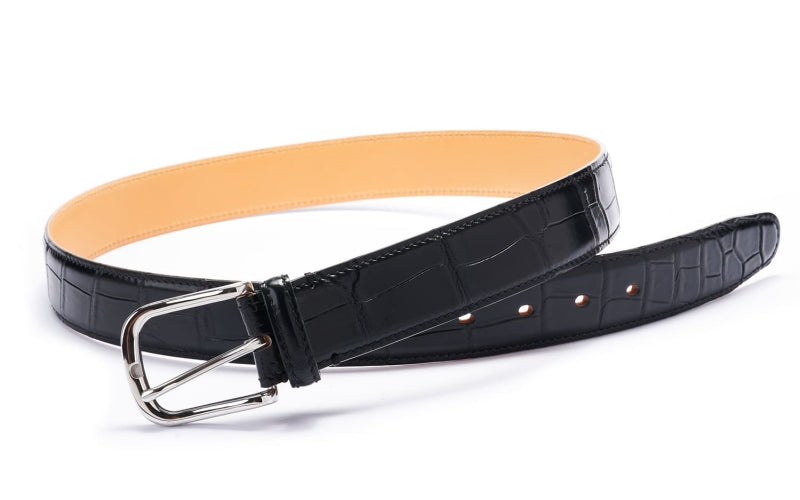
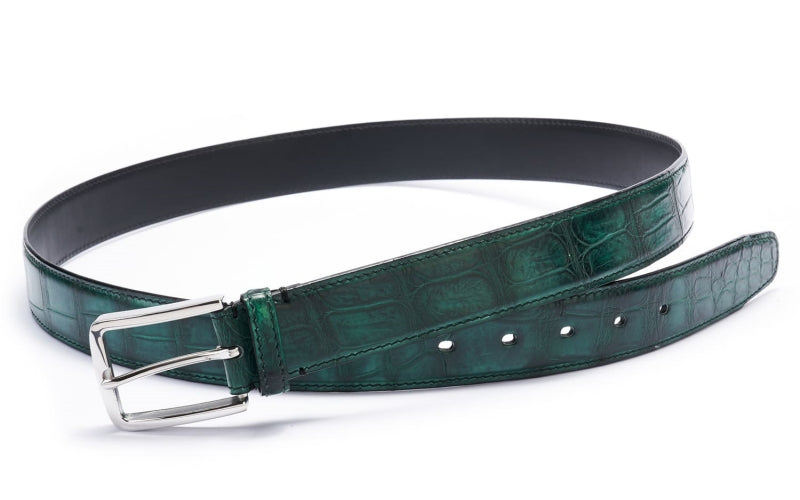
- Crocodile and alligator have a distinctive tile-like scale pattern that is immediately recognizable. The scales are tightly integrated into the leather, making them remarkably durable. Crocodile has a more uniform scale pattern; alligator has slightly larger, more varied scales with natural variation between panels. Both develop a deep luster over time that no synthetic or painted surface can replicate.
- Elephant leather has a matte, deeply grained surface with a rugged texture unlike any other hide. It's exceptionally dense and resistant to wear.
- Python is a lighter, more graphic option — the scale overlay creates a visual texture that reads as bold or subtle depending on colorway.
According to Grand View Research, the women's leather accessories segment is growing at 7.4% annually — with exotic leather driving the premium end of that growth. If you're investing in one statement belt, the crocodile and alligator belt collection holds its value in a way that a standard cowhide belt — however good — does not.

Which Buckle Style Works for Which Occasion?
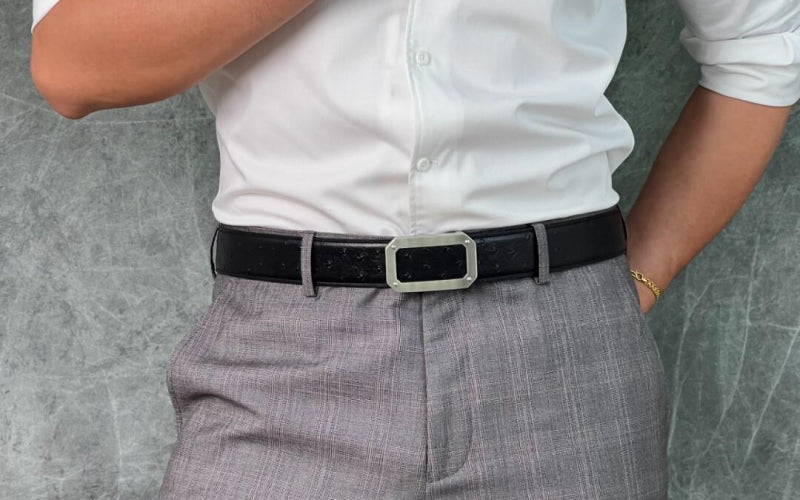
Match buckle hardware to the formality of the setting. A slim, flat plaque buckle in polished steel or brass works across business, smart casual, and formal wear. A box-and-prong buckle with visible hardware suits everyday and casual use. Statement buckles — engraved, rhinestone, or sculptural — belong in casual and fashion contexts, not professional ones.
The scale of the buckle relative to the belt width also matters. A large buckle on a narrow belt creates visual tension; a small buckle on a wide belt looks lost. As a proportion rule, the buckle face should roughly match the belt width — a 1.25" belt pairs best with a buckle that's 1.25"–1.5" wide. Anything significantly oversized dominates the look rather than complementing it.
For women choosing a belt as a long-term investment, stainless steel hardware is worth specifying. It resists corrosion, tarnish, and scratching far better than standard zinc alloy or chrome-plated hardware. BELTLEY uses stainless across the range — the same grade used in surgical instruments and marine hardware, chosen specifically for longevity. The complete belt buckle guide covers every mechanism and finish in detail.

How to Match Belt Color to Your Outfit
Color is the most flexible of the four decisions — but there are two principles that work consistently:
Match or tone-match. A belt in the same color family as your trousers, skirt, or dress creates a unified vertical line that reads as taller and more polished. Black belt with black jeans is the simplest version; cognac belt with camel trousers is the more nuanced one. Both work because the belt doesn't interrupt the outfit's line.
Lead with neutrals, accent with color. Black, brown, cognac, and espresso are wardrobe workhorses — they coordinate with nearly everything and look sharp across every formality level. Fashion colors (red, cobalt, forest green, cognac orange) work best as deliberate accent pieces against neutral outfits, not as afterthoughts. A red belt over a neutral outfit draws the eye to the waist intentionally; a red belt over a multicolor outfit just adds noise.
The Belt Color 101: A Woman's Guide covers every outfit scenario — jeans, dresses, suits, and patterns — with specific color-pairing recommendations.

The Bottom Line
Choosing a good belt for a woman comes down to four decisions made in order: leather grade first (full-grain only), then width for your body type and occasion, then size to your actual waist measurement, then buckle style to match the setting. Color is the finishing decision, not the first.
The women's belt market has no shortage of options that look fine at first glance. The difference shows at year three — whether the edges have frayed, the surface has cracked, or the buckle has gone dull. At BELTLEY, every belt is handcrafted in small batches using full-grain and exotic hides, finished by artisans who've worked with leather for decades, and backed by a 10-year warranty on materials and construction. No Brand Tax — just the belt, priced for what it costs to make it well.
Shop the women's belt collection — free worldwide shipping, 30-day returns, 100% satisfaction guarantee.

Frequently Asked Questions
Q: What is the best leather type for a women's belt?
Full-grain leather is the highest quality grade and the best choice for a women's belt that will last. It retains the natural outer layer of the hide, develops a patina over time, and resists cracking. Exotic full-grain leathers — crocodile, alligator, python — are the premium tier above standard cowhide.
Q: What belt width is most versatile for women?
A 1.25" (32mm) belt is the most versatile width for women. It fits standard belt loops in both casual and tailored clothing, works across formal and everyday contexts, and suits most body proportions without overwhelming shorter torsos or disappearing on taller frames.
Q: How do I know my belt size as a woman?
Measure your waist over your clothing at the position where the belt will sit, then add 2 inches to that number. Do not use your dress or pants size — clothing sizes are inconsistent and don't correspond to a fixed waist measurement. The belt should fasten on the middle hole when you're standing relaxed.
Q: How can I tell if a belt is good quality before buying?
Examine the edges first — quality leather belts have smooth, painted or burnished edges, not raw or frayed ones. The surface should show natural grain variation, not a perfectly uniform printed pattern. The buckle should feel solid and heavy, not hollow. The leather should feel supple and consistent in thickness throughout. If it smells strongly of chemicals, it's likely treated split leather or bonded leather.
Q: Should a woman's belt match her shoes?
Matching belt to shoes is a traditional rule that still holds in formal and business settings — it creates a coordinated, intentional look. In casual and fashion contexts, the rule is optional. Tone-matching (similar color family, not identical) is the modern version — it looks pulled-together without being rigid.