How to Wear a Belt with a Big Stomach for Men
TL;DR: Quick Answer and main takeaways
- Wear the belt above the stomach at the natural waist — 1–2 inches above your belly button — never across it or at the hips
- A 1.5" (38mm) full-grain leather belt spreads pressure evenly and holds its shape without rolling or digging in
- Ignore your pants label size: measure your actual waist over your pants and add 2 inches for the correct belt length
- Low-profile plaque or ratchet buckles lie flat and prevent the pressure points that chunky hardware creates all day
Most men with a big stomach wear their belt wrong — not because of the stomach, but because of where the belt lands. A belt sitting across the widest part of the gut pushes the stomach out and forward. Move it two inches higher and you get a waistline instead of a billboard. That single adjustment changes more than any belt style or buckle swap.
This guide covers exactly how to wear a belt with a big stomach: where it should sit, what width to choose, how leather quality affects comfort, how to size it right, and the outfit moves that make a belt look like it belongs there.

Which Setup Will Feel Best on You?
Comfort first — match your main complaint to the fix:
| Your situation | Go with |
|---|---|
| Belt digs in when you sit | Move it to the natural waist (above the belly button) and choose a 1.5" width to spread pressure. |
| Buckle presses into your stomach | Low-profile plaque or ratchet buckle — flat hardware, no prong bulge. |
| Belts never seem to be your size | Measure your actual waist over pants and add 2" — never order by pants label. |
| Cheap belts roll and curl | Full-grain leather holds flat for years; that's the structural difference, not a luxury detail. From $58. |
Sizes run generous and honest at BELTLEY's men's collection — see the size guide before ordering.
Does a Belt Make a Big Stomach Look Worse?
No — a correctly positioned belt does not make a big stomach look worse. The opposite is true. A belt placed at the natural waist creates a defined mid-section anchor that improves your silhouette. The problem is a belt placed at the wrong height: across the widest point of the stomach or at the hips, which frames and amplifies the belly rather than rising above it.
According to the CDC's body measurement data, the average adult American man has a waist circumference of 40.6 inches — and that number has grown steadily over two decades. The clothing and belt industry has been slow to adapt. Most standard belts still top out at 44–46 inches, and most styling advice assumes a 34-inch waist. This guide doesn't. Explore the men's belt collection for styles and sizes that work at real-world proportions.

Where Should the Belt Sit on a Big Stomach?
Position the belt at your natural waist — the narrowest point of your torso, typically 1–2 inches above the belly button. This is where your torso bends naturally when you lean sideways. At this position, the belt sits above the stomach, not across it. Wearing the belt below this point — at the belly button or lower — pushes the stomach forward and downward, making it appear larger.
The challenge: most jeans and casual trousers have a rise of 8–10 inches and naturally pull the waistband down toward the hips. That drags your belt with it. The fix is switching to higher-rise trousers (10–12 inch rise) for jeans, or proper suit trousers for dress occasions, which sit closer to the natural waist by design. Pleated trousers are worth considering specifically — the front folds accommodate the stomach without stretching flat across it, allowing the belt to sit higher with less tension.
What Belt Width Works Best for a Big Stomach?
A 1.5" (38mm) belt is the best width for men with a big stomach. This width distributes pressure across the waistband without concentrating it on a single edge — which matters when you're wearing a belt against a larger midsection all day. Narrower belts under 1.25" create uncomfortable pressure lines. Wider belts over 1.75" can feel rigid and restrict movement in the seated position.
Width also has a visual effect. A 1.5" belt at the natural waist creates a clean horizontal definition line above the stomach. It reads as intentional and structured. A very skinny belt draws attention by contrast against a wider midsection — the narrow strip makes the area around it appear larger by comparison.
The standard belt width guide covers how width maps to build, occasion, and trouser type if you want to get precise about it. For a starting point, the 1.5" leather belt collection covers both dress and casual in that optimal range.

Why Full-Grain Leather Outperforms Stretch Belts for Larger Men
Stretch and elastic belts are heavily marketed to bigger guys on the premise of comfort. That marketing misses something important: the problem isn't usually the material — it's the wrong placement and wrong size. A correctly fitted full-grain leather belt at the right waist position is more comfortable than an elastic belt worn too low or too tight.
Full-grain leather has specific advantages for men who wear a belt all day:
- It molds to your body over time. Full-grain hides are the outermost layer of the hide, with the tightest fiber structure. After a few weeks of wear, the leather conforms to the slight curve of your waist and lies flat rather than stiffening against it.
- It doesn't roll or fold under pressure. Cheaper split-grain or bonded leather belts buckle under lateral stress — exactly the kind a larger midsection creates. Full-grain holds its edge.
- It breathes. This matters for prolonged wear. Full-grain leather is naturally porous. Synthetic and stretch materials trap heat and moisture against the body.
At BELTLEY, every belt uses full-grain hides selected for density and flexibility — both matter when a belt is worn for 10+ hours. Backed by a 10-year warranty on materials and construction, because a belt that costs more and lasts a decade is better math than replacing budget belts every year. Browse the full-grain leather belt collection for the full range.

Which Buckle Type Is Most Comfortable for a Big Stomach?
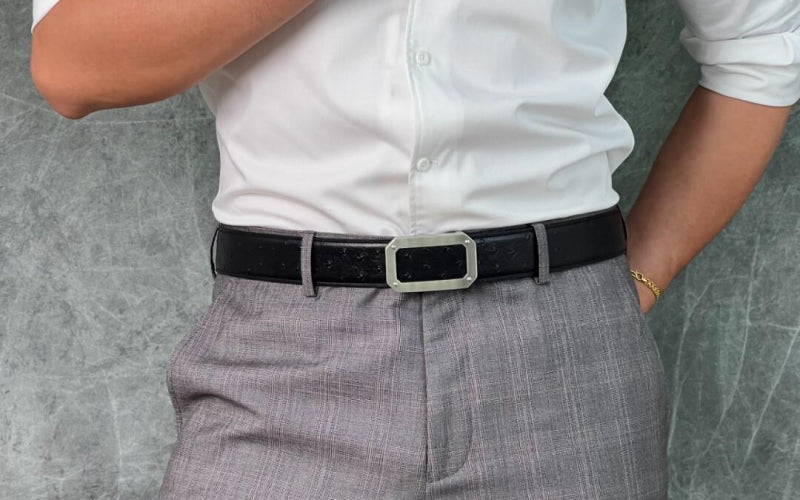
A ratchet buckle or slim plaque buckle is the most comfortable choice for men with a big stomach. Ratchet buckles adjust along a continuous track with no pre-drilled holes, so you get a precise fit that doesn't create a pressure ridge. Slim plaque buckles lie flat against the body and don't project forward into the stomach when sitting or driving.
The worst choice for a bigger stomach: large, raised, or three-dimensional buckles. They sit away from the belt surface and press directly into the lower abdomen the moment you sit down. After an hour at a desk or in a car, that becomes genuinely uncomfortable. Beyond discomfort, a big ornate buckle centered on the stomach draws the eye exactly where you don't want it.
BELTLEY's ratchet buckle belts solve the between-holes problem that catches most larger men — you're not stuck between a too-tight and too-loose hole all day. All buckles are stainless steel: polished, durable, and low-profile without being anonymous. The full types of belt buckles breakdown shows every mechanism side by side if you want to compare options.

How to Size a Belt Correctly for a Big Stomach
This is where most men go wrong. The standard advice — "buy a belt two inches larger than your pants size" — doesn't work reliably for men with larger waists because of a well-documented problem: vanity sizing. Men's pants are systematically labeled smaller than their actual measurements.
Research from Styleforum and confirmed by multiple fit studies shows that a man wearing size 38 jeans often has an actual waist measurement of 40–42 inches. A belt bought to match the pants label will be too short.
The correct method:
- Put on the trousers you plan to wear the belt with
- Measure your waist over the waistband, at the position where the belt will sit
- Add 2 inches to that number — this becomes your belt size
- The belt should fasten on the middle hole when standing relaxed
Sizing reference:
| Measured waist (over pants) | Correct belt size |
|---|---|
| 34–36" | 38" |
| 38–40" | 42" |
| 42–44" | 46" |
| 46–48" | 50" |
| 50–52" | 54" |
The BELTLEY size guide includes a step-by-step measuring walkthrough and extended sizing notes.

The Outfit Formula That Works Every Time
Belt placement and sizing handle the structural problem. These outfit choices handle the visual one:
Wear darker colors on top. A dark shirt or jacket over lighter trousers draws the eye upward toward the shoulders and chest — away from the midsection. This is the single most effective visual proportion trick for men with a bigger stomach.
Use an open blazer or sport coat. An unbuttoned blazer creates a natural V-shape from shoulders down, making the upper body appear broader and the waist appear narrower by comparison. The belt remains visible at the front while the jacket covers the side profile. It works for dress occasions and casual jeans alike.
Leave the shirt untucked — the right way. A tucked shirt on a big stomach can look strained. An untucked shirt is fine, but the hem should fall no more than 2–3 inches below the waistband. Longer hems look unintentional. Curved-hem shirts designed to be worn untucked are especially good here.
Match belt color to trousers. A black belt with black trousers, or brown with tan — the unbroken vertical line from waist to floor reads as taller and leaner than a contrasting belt that cuts the silhouette in half. [Insert external link to: men's color coordination principles in professional dress]
For a detailed breakdown of how different belt constructions work across casual, business, and formal settings, the 15 types of leather belts for men guide covers every occasion.

The Bottom Line
Wearing a belt with a big stomach is about three things done right: position it above the stomach at your natural waist, choose a 1.5" full-grain leather belt that distributes pressure without rolling, and size it to your actual measured waist — not the vanity number on your pants label. Add a ratchet or slim plaque buckle and the comfort problem goes away. Add a dark blazer and matching belt color and the visual problem goes away with it.
The belt itself matters more than most men give it credit for. A cheap belt fails under the lateral stress of a larger waist — it rolls, the edges lift, and the buckle sits crooked all day. Full-grain leather holds its edge and breaks in to the shape of your body over time. BELTLEY builds every belt in small batches with full-grain hides and stainless steel hardware, backed by a 10-year warranty and DTC pricing that cuts out the brand markup.
Shop the men's belt collection — free worldwide shipping, 30-day hassle-free returns.
Frequently Asked Questions
Q: Where should a belt sit on a man with a big stomach?
At the natural waist — 1–2 inches above the belly button. This is the narrowest point on most men's torsos. Placing the belt here creates definition above the stomach rather than framing the widest part of it. High-rise trousers (10–12" rise) help anchor the belt closer to the natural waist automatically.
Q: What belt width is best for men with a big stomach?
1.5 inches (38mm) is the optimal width. It distributes pressure evenly across the waistband without digging in, and creates enough visual definition to look intentional. Narrower belts concentrate pressure on a thin edge; wider belts can feel rigid and restrict seated movement.
Q: Should I get a bigger belt size if I have a large stomach?
Yes — and ignore your pants label. Measure your actual waist over your pants at the position the belt will sit, then add 2 inches. Men's pants are routinely labeled 2–3 inches smaller than their actual waist measurement, so buying a belt based on pants size usually results in a belt that's too short.
Q: Is a ratchet belt better for men with a big stomach?
For most men with a larger midsection, yes. A ratchet belt adjusts along a continuous track rather than fixed holes, which means you can fine-tune the fit as your waist fluctuates during the day. This eliminates the common situation of being stuck between a hole that's too tight and one that's too loose.
Q: Should a man with a big stomach tuck in his shirt with a belt?
Optional, but generally better untucked with a belt. If you tuck, the shirt needs to be well-fitted at the shoulders and slightly relaxed across the stomach — not straining. Untucked works well if the hem falls 2–3 inches below the waistband. Longer than that looks unintentional rather than casual.
%20full-grain%20leather%20b...)