Does Full-Grain Leather Smell Different from Corrected-Grain?
Quick answer: Yes — markedly. Full-grain leather has a warm, complex, organic smell that combines the natural hide, the vegetable or chrome tannage, and the conditioning oils. Corrected-grain leather usually smells fainter and is often layered with chemical, plastic, or adhesive notes from the coating and stamping process. The difference is one of the fastest tests you can run to tell real high-grade leather from corrected-grain or coated alternatives — and it works in under five seconds without any tools.
Last updated: May 2026 • By BELTLEY Editorial
TL;DR:
- Full-grain = warm, complex, organic smell with notes of hide, tannin, and oils.
- Corrected-grain = fainter, often with chemical, plastic, or adhesive undertones.
- The smell test is the fastest single-sense leather identification check.
- Combined with the bend test and cut-edge test, it's nearly impossible to misidentify good leather.
The smell test is the most underrated leather identification technique in menswear. People focus on visual checks (surface, color, edge) and tactile checks (bend, hand feel) but forget that the human nose is exceptionally good at distinguishing organic tanning from synthetic coating. Full-grain leather and corrected-grain (or bonded, or PU) leather smell genuinely different — and once you've smelled both side by side, you can identify either one in seconds for the rest of your life. Below is what each one actually smells like and how to use the test. For the broader physical-verification toolkit, see what does "100% full-grain leather" actually mean.
What does full-grain leather smell like?
Warm, complex, and organic. A new full-grain leather belt smells of hide, tannin (oak or chestnut for vegetable-tanned; faintly metallic for chrome-tanned), conditioning oils, and sometimes faint smoke or beeswax notes from finishing. The smell is layered — you can detect multiple components if you concentrate — and it sits in the same family as old leather-bound books, saddle shops, and quality leather boots.

The smell isn't strong or unpleasant. Quality full-grain leather has a moderate, warm, faintly sweet smell that fills a small space (a leather goods shop) without being overwhelming. It deepens slightly with age — a 10-year-old full-grain belt smells richer than a new one, and a vintage saddle shop has the most concentrated version of the scent. The smell comes from the natural collagen, tanning agents, and oils — none of which a synthetic coating can replicate.
What does corrected-grain leather smell like?
Fainter, with chemical undertones. Corrected-grain leather has been buffed (sanding away the natural grain surface) and then sprayed or stamped with a synthetic coating that mimics grain texture. The coating layer reduces the natural leather scent significantly, and adds its own chemical notes — plastic, lacquer, glue, or polymer. The result is leather that smells weak, slightly artificial, or simply "off" compared to true full-grain.
Lower-grade products go further down the scale. Bonded leather smells strongly of adhesive (sometimes alarmingly so when new). PU and vegan leather smells of plastic — a mild but distinctly synthetic note. The further the product moves from "intact hide" toward "coated composite," the more the smell shifts from organic to chemical. Even a beginner can usually detect bonded leather by smell within seconds of opening the packaging.
Key stat: The human nose can detect leather-related compounds at concentrations as low as parts per billion — meaning even a slight chemical undertone from coating or adhesive registers consciously, even when you can't articulate what's "off."
Why do they smell different?
Different materials and different processes. Full-grain leather retains the natural compounds of the hide (collagen, lipids, tanning agents from oak bark, chestnut, or chromium salts) and the oils added during finishing — all of which produce real, complex aromatic compounds. Corrected-grain leather has had the natural surface sanded off and replaced with a synthetic polymer coating; the natural scent is muted and the coating contributes its own.

Lower grades double down on synthetics. Bonded leather is held together with polyurethane or latex adhesives — both contribute strong chemical smells, especially when new. PU/vegan leather is essentially plastic on fabric — the smell is the smell of plastic. The further from "real hide" you go, the stronger the synthetic odor signature.
How do you actually do the smell test?
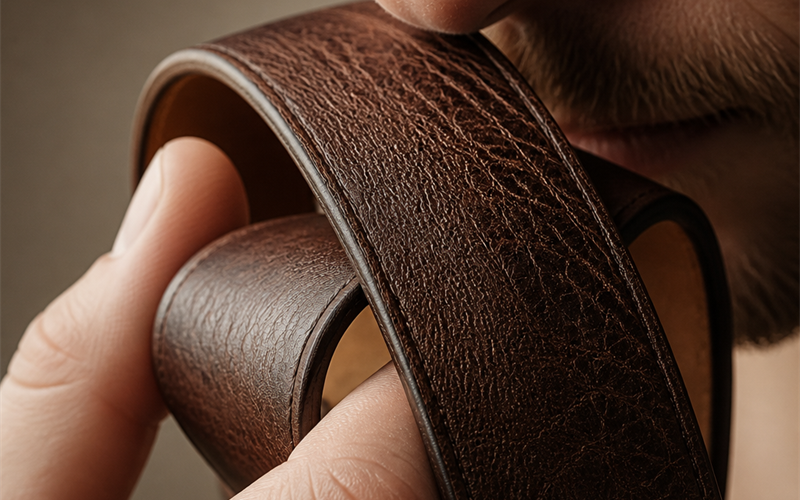
It's simple. Hold the belt close to your nose (about 2–5 cm away), inhale gently and deliberately, and pay attention. Repeat on a different section of the belt to confirm. If you have two belts to compare, alternate between them — the contrast becomes obvious within seconds. Avoid heavily perfumed environments (department stores, candle shops, areas with strong cleaning products), which mask the leather scent.

The smell test takes seconds. Combined with the bend test (full-grain creases and smooths back; corrected/bonded cracks at the bend) and the cut-edge test (full-grain shows one dense fiber layer; bonded shows layered composite), it's nearly impossible to misidentify good leather. Three senses, three confirmations, three seconds each.
Full-grain vs corrected-grain by smell
| Aspect | Full-grain | Corrected-grain | Bonded leather | PU / vegan |
|---|---|---|---|---|
| Primary scent | Warm, complex, organic | Faint, slightly artificial | Adhesive, chemical | Plastic |
| Detectable from | Inches away | Up close | Up close to inches | Inches away |
| Intensity | Moderate, deepens with age | Weak | Strong (new), fades | Moderate, stable |
| Complexity | Multi-layered (hide + tannin + oil) | Single-note coating | Single-note adhesive | Single-note plastic |
| Pleasantness | Pleasant, "leather shop" | Neutral to slightly off | Off-putting (new) | Neutral to chemical |
| Ages well? | Yes — deepens | No change | No change | No change |
What other tests pair with the smell test?
Three additional checks make a complete verification. (1) Bend test — sharply bend the leather; full-grain creases and smooths back; corrected/bonded leather cracks or shows the underlying coating. (2) Cut edge — examine the cross-section at the end of the belt; full-grain shows a dense single fiber layer; corrected-grain may show a thin coating over a fibrous base; bonded shows layered strata with fabric visible. (3) Surface variation — full-grain shows natural pores and subtle variation; corrected-grain shows a perfectly uniform stamped pattern.
Smell + bend + cut edge is the three-test toolkit. Any belt failing all three is definitely not full-grain. Any belt passing all three is almost certainly real full-grain. Single tests can occasionally mislead (good corrected-grain can be subtle, a poorly conditioned full-grain can smell weak), but three tests together are essentially foolproof. We unpack the broader verification approach in what does 100% full-grain leather actually mean.
What about older or used leather?
The smell test still works, with a caveat. Used or vintage full-grain leather develops a deeper, more complex scent — sometimes called "old leather" — as oils oxidize and the hide ages. Used corrected-grain leather often loses what little scent it had, smelling mostly neutral or faintly dusty. Used PU/bonded leather often develops new unpleasant scents as adhesives degrade.

For vintage and inherited belts, the smell test can actually reveal the original leather quality. A 30-year-old belt that still smells warmly of leather was full-grain to start with. A 10-year-old belt that smells faintly chemical was corrected-grain or worse. We dig into the broader assessment in how to restore an inherited belt.
Can high-quality corrected-grain mimic the full-grain smell?
Rarely, and never perfectly. Some premium corrected-grain finishes try to mimic the smell by adding leather scents to the coating — and it sometimes works initially, but the synthetic note is detectable on careful inspection. More important, the smell-spoofing fades faster than real leather scent, so even an initially convincing corrected-grain belt smells weaker within months.

The reliable signal is the depth and complexity. Real full-grain leather smells like many things at once (hide, tannin, oil, sometimes smoke or wax). Corrected-grain with leather-scent additives smells like one thing (a simplified "leather" smell). The nose detects the difference even when the conscious mind struggles to articulate it.
The Bottom Line
The smell test is the fastest and most accessible leather identification technique — and it works reliably across the entire leather grade hierarchy. Full-grain leather smells warm, complex, and organic. Corrected-grain smells fainter and often has chemical undertones. Bonded leather smells of adhesive. PU/vegan leather smells of plastic. Combined with the bend test and cut-edge test, the smell test makes misidentification almost impossible. Use it before you buy — and never trust a "leather" product that smells wrong. At BELTLEY, every belt in our full-grain leather belts collection passes all three tests because the leather is real full-grain from named tanneries, finished honestly. Paired with solid hardware, hand-finished edges, and a 10-year warranty. Ready for a belt that smells like the real thing? Browse our men's collection.
Frequently Asked Questions
Q: Does full-grain leather really smell different from other leather?
Yes — markedly. Full-grain leather has a warm, complex, organic smell with notes of hide, tannage, and oils. Corrected-grain smells fainter and often has chemical undertones; bonded and PU leather smell distinctly synthetic. The differences are obvious once you've compared them.
Q: What does fake leather smell like?
Plastic, adhesive, or chemical. Bonded leather often smells strongly of glue (especially when new). PU and vegan leather smells of plastic, sometimes faintly, sometimes strongly. The synthetic note is the giveaway — real leather doesn't smell that way.
Q: Can I trust the smell test alone?
It's reliable, but pairing it with the bend test and cut-edge test makes verification nearly foolproof. Three senses, three checks, three seconds each. Any belt failing all three isn't full-grain; any belt passing all three almost certainly is.
Q: Why does corrected-grain leather smell weaker?
Because the natural grain surface has been sanded off and replaced with a synthetic coating. The natural leather scent comes from the intact hide; corrected-grain has lost most of it and gained a thin chemical note from the coating layer.
Q: Does the smell of leather fade over time?
Full-grain leather scent deepens slightly with age — a 10-year-old belt smells richer, not weaker. Corrected-grain and PU leather scents fade or change unpleasantly over time as coatings and adhesives degrade. The scent profile over time is itself a clue to leather quality.