Why Luxury Fashion Houses Rarely Use Full-Grain Leather (Counter-Intuitive POV)
Quick answer: Many luxury fashion houses don't actually use full-grain leather in their flagship products — and it's not because they can't afford it. The reasons are counter-intuitive: full-grain leather's natural variation (scars, color shifts, real texture) breaks the uniformity that luxury merchandising depends on. Coated and corrected-grain leathers photograph more consistently across thousands of identical units, take logo embossing and monogram patterns cleanly, and produce the visual uniformity that defines a recognizable luxury silhouette. The trade-off: a designer leather belt may be technically lower-grade than a $100 DTC full-grain belt.
Last updated: May 2026 • By BELTLEY Editorial
TL;DR:
- Luxury houses prioritize visual uniformity over natural leather character.
- Many designer belts use corrected-grain or coated leather, not full-grain.
- Coated/monogrammed materials photograph identically across thousands of identical units.
- A $400 designer belt may be technically lower-grade leather than a $120 DTC full-grain belt.
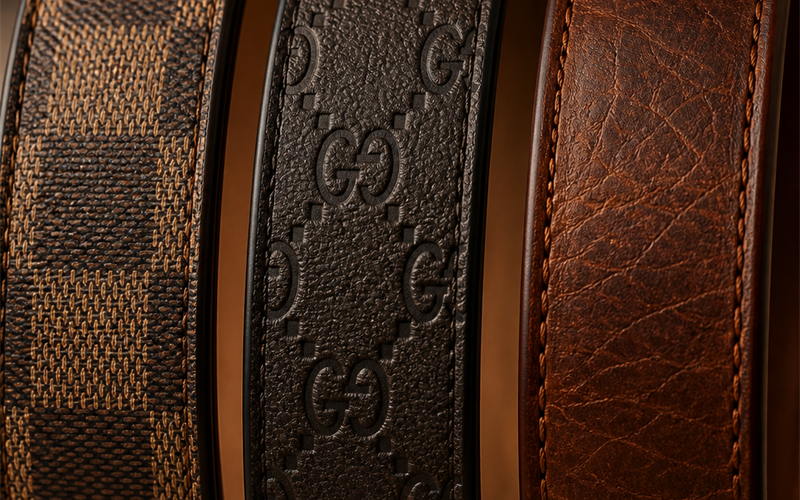
This is the menswear conversation that brand-loyal shoppers least want to have: the leather inside many luxury fashion belts and bags is often not full-grain. The Louis Vuitton monogram canvas is a coated material with a thin leather binding; the Gucci GG canvas similarly; many Hermès products use full-grain, but several lines use corrected-grain or coated leathers for design consistency. The reasons aren't about cost — luxury houses can afford the best of anything. The reasons are about consistency, branding, and the logic of selling thousands of identical units at premium prices. Below is the honest explanation and what it means for buyers. For the broader designer-pricing case, see why are designer belts so expensive.
Wait — luxury houses don't all use full-grain leather?
Many don't, depending on the line. The flagship "iconic" products at major luxury houses are often built around coated canvas (LV monogram, Gucci GG, Coach signature) or corrected-grain leather where uniform color and stamped logo legibility matter more than natural leather character. Some high-end leather lines (Hermès Togo, certain LV Epi, some Gucci dress collections) use full-grain or top-grain leather — but it's not the default across every product.

The product mix tells the story. Look at any luxury house's bestsellers and you'll find:
- Coated canvas signatures — printed monogram material with leather trim
- Embossed/coated leather signatures — logo plaques or all-over monograms on coated leather
- Smooth dyed leather — usually corrected-grain or chrome-tanned for color uniformity
- Full-grain leather lines — present, but usually a smaller percentage of the range
We touch on the LV-specific question in what are Louis Vuitton belts made of.
Why don't they use full-grain leather as the default?
Four reasons, none about cost. (1) Visual uniformity at scale. A flagship luxury bag may be produced in tens of thousands of identical units; full-grain leather's natural variation (scars, color shifts, real grain texture) makes those units look subtly different from each other, which conflicts with the brand's identity of "perfect identical luxury object." (2) Logo and pattern fidelity. Stamping a sharp monogram or logo onto natural full-grain leather is harder than onto a coated surface — the irregular grain affects ink uptake and stamp depth. Coated and corrected-grain leather receives logos cleanly. (3) Photography consistency. A coated leather product photographs identically every time, which matters when the brand publishes thousands of marketing images. Full-grain photographs as the unique object it is. (4) Predictable aging. Full-grain develops patina; coated leather doesn't. For luxury houses selling lifetime-of-the-purchase aesthetics, a belt that changes over years is a feature problem, not a feature.
The economic logic flows from the model. Luxury houses sell uniform aspirational objects at scale, and full-grain leather's character undermines uniformity. Heritage tanneries (Wickett & Craig, Hermann Oak, Italian Tuscan) and DTC brands sell individualized character objects at honest pricing, and full-grain is the perfect material for that. Different business models lead to different material choices.
Key stat: A flagship luxury bag silhouette is often produced in tens of thousands of identical units per year. Maintaining visual uniformity across that volume is materially impossible with high-grade full-grain leather — which is the structural reason coated and corrected-grain materials dominate luxury flagships.
What about Hermès and the "exotic leather" lines?
Hermès is the partial exception, and even there it's nuanced. Hermès uses high-grade leather across many of its iconic bags (Togo, Epsom, Clemence, Box) — these are top-grain or full-grain leathers from selected tanneries, finished to refined standards. The brand's reputation for craftsmanship is genuinely earned in these lines. However, even Hermès uses coated and corrected-grain materials in some lower-tier products, and its smaller goods (some belts, some wallets) sometimes use less-prized hide selections than its flagship bags.

The exotic-leather lines (crocodile, alligator, ostrich) are a separate category — these are inherently full-grain by nature, since exotic skins are used in their natural state. Hermès, LV, Gucci, and others all use real exotic leather in their highest-tier products, but at price points ($10,000+) far beyond the standard luxury range. We cover the exotic side in our exotic leather belts and alligator vs crocodile belts posts.
So is designer leather actually lower quality?
Sometimes — and that's the counter-intuitive part. A $400 luxury monogram-canvas belt is, in raw material terms, a coated woven product with leather trim. A $120 DTC full-grain leather belt is, in raw material terms, top-of-hide leather with solid hardware. The DTC belt has the better leather, even though the designer belt has the higher price tag.

This isn't a takedown of luxury. Luxury brands sell aesthetic identity, status association, and a specific aspirational experience — those are real things that real customers value. But the value isn't in the leather grade; it's in the brand. Buyers who assume "expensive = better materials" are often surprised when they learn what's actually inside their luxury purchases. We unpack the pricing logic in why are designer belts so expensive and is it worth buying an expensive belt.
Luxury flagship leather vs DTC full-grain leather
| Factor | Luxury fashion flagship | DTC full-grain belt |
|---|---|---|
| Primary material | Coated canvas / corrected-grain | Full-grain leather |
| Leather grade | Variable, often coated | Top of hide, unaltered |
| Visual uniformity | Highest priority | Lower priority (character allowed) |
| Logo / branding | Stamped or printed prominently | Usually understated |
| Photographs identically | Yes (key marketing asset) | Each piece is slightly unique |
| Patina | Minimal (coating prevents it) | Develops over years |
| Repairable | Limited (coating wears, can't restore) | Yes (full restoration possible) |
| Resale value pattern | Brand-driven, can hold value | Material-driven, depreciates as worn |
| Common price | $300–$600 | $80–$200 |
What about the "luxury craftsmanship" claim?
It's real for some products, marketing for others. Construction quality (stitching, edge finishing, hardware tolerance) at top-tier luxury houses can be genuinely excellent — Hermès leather goods are stitched by hand with saddle stitching to a high standard. But construction quality is not the same as leather grade; you can have great construction on corrected-grain leather, and many luxury products do. The claim "made in Italy" or "made in France" usually refers to assembly location, not necessarily to leather grade.
The honest signal is the material specification. Luxury houses that name their leather explicitly (Hermès Togo, LV Epi, Hermès Box) are giving you real information; houses that just say "premium leather" or "luxury leather" without specification are usually obscuring the actual grade. Most luxury monogram-canvas products say "coated canvas" somewhere in the fine print — it's accurate, just rarely highlighted.
Why do customers still pay luxury prices?
Three legitimate reasons. (1) Brand identity and status — owning a recognizable luxury object signals certain things in certain social and professional contexts, and that signaling has real economic value to some buyers. (2) Aesthetic preference — some people genuinely prefer the look of monogram canvas or coated luxury leather; that's a valid aesthetic, not a mistake. (3) Retail experience and service — luxury boutiques offer real concierge service, repair programs, and an experiential purchase that DTC can't fully replicate.

None of these reasons are about the leather. A luxury purchase is buying the brand, the design, and the experience — not the material itself. Understanding that lets buyers make conscious choices about what they're paying for, instead of assuming the high price reflects higher-grade materials.
What should you actually pay for if you care about leather?
If leather grade is the priority: skip the luxury houses and buy from heritage tanneries or DTC brands. A genuine full-grain leather belt from Hermann Oak, Wickett & Craig, Horween, or Italian Tuscan veg-tan — at fair DTC pricing — is a better leather purchase than most luxury flagship belts at 3x the price. The leather is the upgrade; the brand isn't.

If brand identity and aesthetics matter most: the luxury purchase makes sense, with the understanding that you're paying for what's on the outside (the brand and design) rather than what's on the inside (the leather grade). Our luxury belts worth it post unpacks the broader value math.
BELTLEY 3-Material Rule
The 3-Material Rule = full-grain leather + stainless or solid brass buckle + sealed (painted or burnished) edges. The rule is, in some ways, a counter to the luxury-flagship logic — it prioritizes the three observable material qualities that determine a belt's actual longevity and craft, independent of brand recognition. A luxury-branded belt that fails the rule has high brand value but limited material value. A DTC belt that clears the rule has high material value, often at much lower price. Both can be the right purchase for the right buyer; the rule helps you tell which one is which.
The Bottom Line
The counter-intuitive truth about luxury fashion is that the leather inside many flagship products isn't the highest available grade. Luxury houses prioritize visual uniformity, logo fidelity, and predictable aging — all of which favor coated canvas and corrected-grain leather over full-grain. That's not a scandal; it's a structural consequence of selling tens of thousands of identical units at premium prices. The buyer who pays luxury prices for the brand is making a conscious aesthetic and status purchase. The buyer who pays luxury prices assuming "better material" is often surprised by what's actually inside. If leather grade matters to you, DTC heritage brands and heritage tanneries deliver more material per dollar than luxury flagships. At BELTLEY, we build every belt with verifiable full-grain leather, solid hardware, and a 10-year warranty — the material story, told honestly. Ready to start with a belt where the leather inside matches the price outside? Browse our full-grain leather belts or men's collection.
Frequently Asked Questions
Q: Do luxury fashion houses use full-grain leather?
Sometimes, but not as the default. Many luxury flagships use coated canvas or corrected-grain leather for uniformity and logo fidelity. Houses like Hermès use high-grade leather across many products, but even they include coated and corrected materials in lower-tier lines.
Q: Why don't they use the best leather available?
Because uniformity matters more than material at scale. Selling tens of thousands of identical units requires visual consistency that full-grain leather (with its natural variation) can't deliver. Coated and corrected-grain materials photograph identically and stamp logos cleanly.
Q: Is a DTC full-grain belt really better than a designer belt?
For leather grade specifically, yes — often by a wide margin. A $120 DTC full-grain belt is genuinely higher-grade leather than a $400 designer monogram-canvas belt. For brand identity, status association, or specific aesthetics, the designer belt may still be the right purchase.
Q: What's Louis Vuitton's monogram canvas actually made of?
It's a coated woven fabric — a printed monogram pattern on a treated cotton-blend base — with leather trim and hardware. It's a high-quality coated canvas, but it's not "full-grain leather." We cover this specifically in our LV materials post.
Q: How can I tell what leather a designer product actually uses?
Look at the product description for specifically named leathers (Hermès Togo, LV Epi, Gucci Calfskin). If the description just says "premium leather" or "luxury leather" without specification, the leather grade is usually being obscured. Heritage tanneries and DTC brands are typically more transparent.