Crocodile Handbag Guide: How to Buy in 2026 (Without Overpaying)
TL;DR:
- A real crocodile handbag uses 3–5 crocodile hides — 4x the material of a belt — which sets a hard price floor of roughly $1,500.
- Optimal everyday size: 10–13 inches wide. Smaller reads as evening clutch; larger reads as travel tote.
- Color: matte black is the most versatile; Himalayan white and warm patina tones are the connoisseur statement choices.
- Structure: choose structured silhouettes (Kelly, satchel, top-handle) for crocodile — soft hobo styles work better in alligator.
- Price math: a real one-piece-paneled crocodile handbag from a DTC brand starts around $1,500–$2,500. Hermès Birkins in crocodile begin at $50,000+.
- Made-to-order: a custom-color or out-of-stock crocodile handbag takes roughly 3 weeks from hide selection to finished piece.

Quick Facts
- Hides per real handbag: 3–5
- Optimal everyday size: 10–13" wide × 8–10" tall × 4–6" deep
- Fair DTC price: $1,500–$2,500
- Hermès Birkin in crocodile: $50,000+
- Hermès Himalayan Birkin: $200,000+ (auction record $500,000+)
- Made-to-order timeline: 3 weeks
- Lifespan with proper care: 15–25 years
A crocodile handbag is the most photographed luxury accessory a woman can own — and the one that draws the most decisive judgment from people who know exotic leather. The right bag becomes a 20-year wardrobe anchor that signals taste without needing to shout. The wrong bag — wrong size, wrong color, wrong proportion — turns an investment-tier purchase into something you quietly retire after two seasons.
This guide covers what to actually look for in a crocodile handbag, how the hide-count math sets the price floor, and which silhouettes and finishes work for daily wear versus statement occasions. In our own workshop, we inspect 8–12 hides to find the 4 with matched scale size, color, and pattern density required for a coherent finished bag — the patient sourcing step that defines true luxury.

Which Croc Handbag Decision Is Yours?
Four buyer profiles, four answers:
| Your situation | Go with |
|---|---|
| First croc bag, daily use | Matte black, 10–13" structured top-handle — the most versatile combination possible. |
| Statement/collector purchase | Himalayan-tone or warm patina shades — the connoisseur colors that get noticed by the right people. |
| Seeing "$400 crocodile bags" online | Walk away — 3–5 hides per bag sets a real floor near $1,500; below it is embossed cowhide. |
| Ready to buy without fashion-house markup | DTC made-to-order: BELTLEY's croc handbags run $1,699–$2,899, built in ~3 weeks. |
The no-Brand-Tax route: BELTLEY's crocodile collection.
What Makes a Real Crocodile Handbag Different from a Cowhide Bag?
A real crocodile handbag uses leather from one of the Crocodylus species (Nile or saltwater) with visible single-pore scales, structured hand-feel, and CITES Appendix II documentation. Cowhide bags use bovine leather without the species-specific scale pattern, no documentation requirement, and significantly lower production cost.
The structural quality of crocodile leather supports bag silhouettes that cowhide cannot. The slightly firmer, more architectural hand of crocodile holds structured shapes — the satchel silhouette, the Kelly box, the top-handle frame — without internal stiffening or sagging over time. Cowhide bags require internal canvas or plastic structure to hold the same shapes; the structure eventually softens or collapses.
According to the IUCN Crocodile Specialist Group, the global luxury exotic leather market sources from a small number of regulated farms in Australia, Zimbabwe, Singapore, and the southern United States. Our alligator vs crocodile belts guide covers the species framework that applies equally to handbags.

How Many Crocodiles Does It Take to Make One Handbag?
A standard crocodile handbag (10–13 inches wide) requires 3–5 crocodile belly hides for the main panels, gussets, base, handle, and trim. Larger bags can require 5–7 hides. A Hermès Birkin in crocodile typically uses 3–4 matched hides; bags with maximum pattern symmetry can require selection from 6–8 hides.
The hide math: a 12-inch handbag has two main side panels, two end caps, a base, and at least one structural top section, plus handle and trim. Each panel needs an uninterrupted hide section sized to fit, which in practice means starting with hides of similar grade, color, and scale size. Our how many crocodiles to make one belt guide covers the underlying yield framework.
This is also why genuine crocodile handbags below $1,200–$1,500 are extremely rare. The raw hide cost alone ($240–$1,000) plus tanning, hardware, and skilled construction labor pushes the absolute production floor to roughly $1,500.

What Size Crocodile Handbag Is Best?
The optimal everyday size is 10–13 inches wide × 8–10 inches tall × 4–6 inches deep. This sizing fits a phone, wallet, sunglasses, lipstick, and a small notebook without overstuffing. Smaller bags (under 9 inches) read as evening clutches; larger (over 14 inches) read as travel totes.
| Use case | Recommended size | What fits |
|---|---|---|
| Daily handbag | 10-13" × 8-10" × 4-6" | Phone, wallet, essentials |
| Evening clutch | 7-9" × 4-6" × 1-3" | Phone, lipstick, cards |
| Work satchel | 13-15" × 10-12" × 5-7" | Tablet, files, daily essentials |
| Travel tote | 15-17" × 12-14" × 6-8" | Laptop, day-trip essentials |
The 11-12 inch range is where most luxury houses concentrate their best craftsmanship — it's the most versatile silhouette and the volume seller that justifies maximum design investment.
Key Takeaways
- 3–5 hides per handbag = 4x the material of a belt
- 10–13" wide = optimal daily size; smaller is clutch territory
- $1,500 minimum for real one-piece DTC construction
- Matte black + structured silhouette = strongest daily piece
- Himalayan white and warm patina = connoisseur statements

What Color Crocodile Handbag Should You Buy?
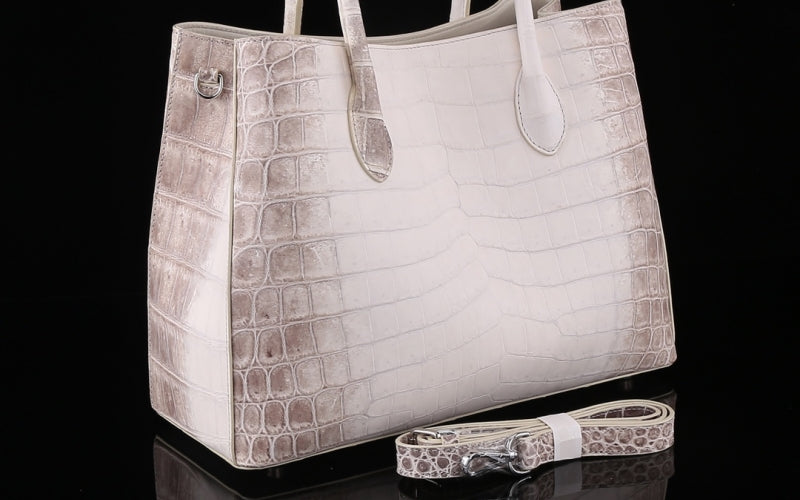
Matte black is the most versatile color and works across formal, business, and elevated casual wear. Espresso brown is the traditional warm-tone choice. Himalayan white is the connoisseur statement piece (the same finish that defines the Hermès Himalayan Birkin). Avoid trend colors for a single-bag investment.
| Color | Read | Best for |
|---|---|---|
| Matte black | Versatile, professional | Daily wear, business |
| Espresso brown | Traditional, warm | Brown-shoe wardrobes |
| Himalayan white | Connoisseur statement | Special occasions, photography |
| Burgundy / wine | Sophisticated, distinctive | Fall/winter wardrobe anchor |
| Navy blue | Modern professional | Versatile alternative to black |
| Cobalt / vivid blues | Statement piece | Limited-use, photography-friendly |
| Hermès orange | Signature reference color | Statement, collector-leaning |
Trend colors depreciate faster than neutral colors at resale — see our crocodile belt resale value analysis for the supporting market data.

What Handbag Style Works Best in Crocodile?
Structured silhouettes work best in crocodile leather: the satchel, top-handle, Kelly-box, and frame styles. Soft hobo and slouchy bucket styles work better in alligator (which is more pliable). The architectural quality of crocodile is the leather's defining strength.
Three style-and-leather pairings worth knowing:
- Structured satchel → crocodile is ideal — holds shape across decades of wear
- Top-handle frame bag → crocodile preferred — frame and panel coherence requires structured leather
- Kelly-box silhouette → crocodile or alligator — both work; crocodile reads more formal
- Soft hobo or bucket → alligator preferred — needs the softer hand-feel
- Crossbody / messenger → either species; see our crocodile crossbody guide for detail

How Much Should a Crocodile Handbag Cost?
A fair price for a real one-piece-paneled crocodile handbag from a DTC brand is $1,500–$2,500. Mid-luxury European brands run $4,000–$10,000. Designer houses charge $10,000–$30,000. Hermès Birkins and Kellys in crocodile begin at $50,000 and reach $500,000+ for Himalayan and rare colorways.
The price gap between $1,500 (DTC) and $30,000 (designer) is almost entirely retail markup, brand equity, and boutique overhead. Industry analysis from Bain & Company's annual luxury market study and Business of Fashion consistently identifies handbags as the single highest-margin category in luxury fashion. We covered the underlying cost-component math in our why some crocodile belts cost $500 and others $5,000 breakdown.

How Long Does It Take to Make a Custom Crocodile Handbag?
A custom-color or out-of-stock crocodile handbag takes roughly 3 weeks from order placement to finished piece. The timeline includes sourcing matched legally sourced Nile crocodile bellies, hand cutting each panel to maximize scale symmetry, panel assembly, hardware installation, and final hand-finishing.
The 3-week timeline is the genuine minimum for an artisan-built crocodile handbag. The most labor-intensive step is hide selection — a maker may inspect 8–12 hides to find the 3–5 with matched scale size, color saturation, and pattern density required for a coherent finished bag. Mass-production handbags skip this step by using pre-cut panels from larger hide batches, which is why they often show visible scale-size jumps between adjacent panels.
The Bottom Line
A crocodile handbag is the most visible luxury accessory in a woman's wardrobe — and the one most likely to deliver compounding visual returns over decades of use. The right size (10–13 inches), right color (matte black or warm neutral), right structure (satchel or top-handle), and right hardware (stainless or brass) deliver a 20-year wardrobe anchor that pays for itself in daily styling impact. The Brand Tax that pushes a structurally identical bag from $2,500 to $25,000 is overhead, not craft.
At BELTLEY, every crocodile handbag is hand-crafted from legally sourced Nile crocodile hides, with one-piece panel construction and stainless hardware. Made-to-order pieces ship in roughly 3 weeks. Three pieces worth knowing:
- Women's Black Matte Crocodile Business Satchel ($1,699) — the daily professional anchor
- BELTLEY Luxury Women's Black Matte Crocodile Bag ($1,699) — the versatile day-to-evening choice
- BELTLEY Himalayan White Crocodile Handbag ($2,899) — the statement / collector piece
Browse the BELTLEY Crocodile Handbag Collection →
Frequently Asked Questions
Q: Are crocodile handbags worth the investment in 2026?
For daily-use buyers who value the visual signal and structural durability, yes. A $1,500–$2,500 DTC crocodile handbag used regularly for 15+ years delivers strong cost-per-wear math. Investment-only buyers should focus exclusively on Hermès Birkin and Kelly pieces — see our are crocodile handbags worth anything analysis.
Q: How can I tell if a crocodile handbag is real?
Apply the seven authentication tests: visible pores in scales, scale uniformity, edge inspection, smell, flex behavior, CITES certificate, and price math. A real one-piece crocodile handbag below $1,200 is structurally implausible — see our embossed cowhide vs real crocodile guide for the full framework.
Q: Can a crocodile handbag be repaired?
Yes. Stitching, hardware replacement, lining repair, and edge re-painting can all be performed by a skilled exotic-leather repair specialist. Major scale damage is harder to repair invisibly.
Q: Does a crocodile handbag need a CITES certificate?
For domestic personal use, no inspection is required, but the CITES Appendix II certificate should be retained as proof of legal sourcing. For international travel with the bag as personal use, the certificate is not required at customs but is useful documentation. See CITES Appendix II information.
Q: How long does a crocodile handbag last?
15–25 years with proper care. Crocodile leather significantly outlasts cowhide in handbag construction because the structured leather resists the deformation that causes cowhide bags to sag and lose silhouette over time.
Q: Should the handbag hardware match my watch?
Yes, by metal family. Stainless watch = stainless or silver-tone hardware. Yellow gold watch = brass or yellow-gold hardware. The metal-coherence rule applies to handbags identically to belts and briefcases.
Q: Can I order a custom-color crocodile handbag?
Yes. Custom-color or made-to-order crocodile handbags ship in roughly 3 weeks, including hide sourcing, hand cutting, and panel assembly. The 3-week timeline reflects the patience required for genuine hand-crafted exotic leather work.
By the BELTLEY artisan team — handcrafting exotic leather goods since 1999. Last updated: May 10, 2026.